
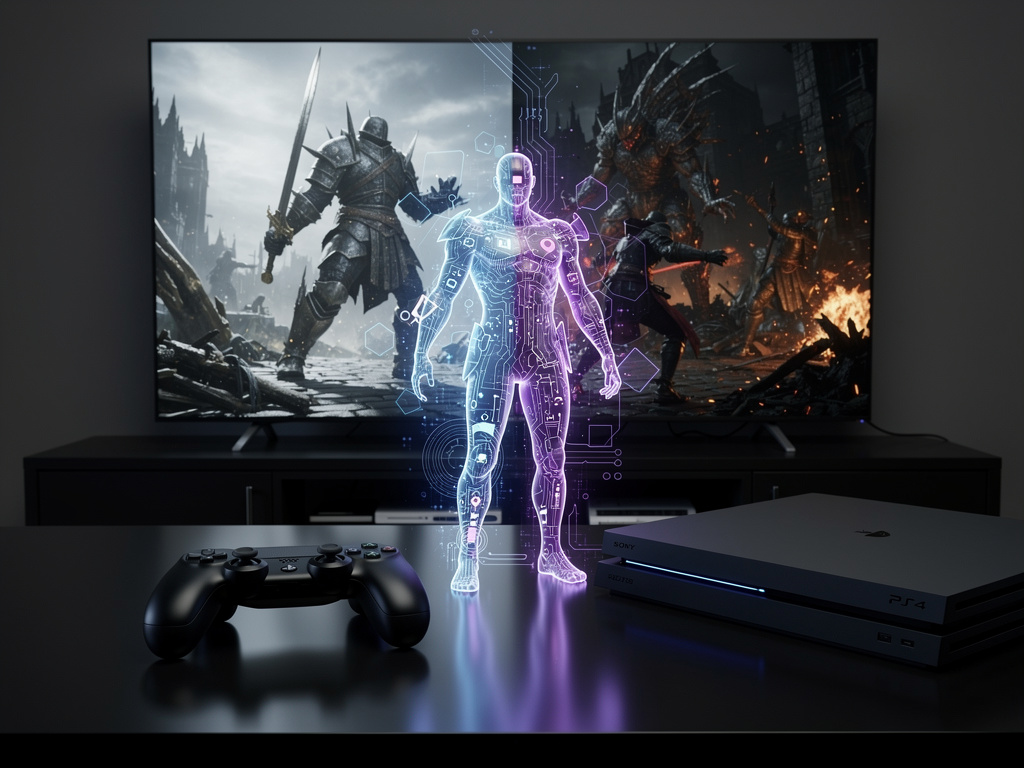
Sony’s Phantom Guides: How AI Could Reshape Player Assistance in Gaming
In the ever-evolving world of video games, where player engagement and accessibility are paramount, Sony Interactive Entertainment has quietly filed a patent that could transform how gamers navigate complex challenges. The technology, dubbed the “AI Ghost Player” system, promises to generate real-time tutorials tailored to individual players’ needs, potentially eliminating the frustration of getting stuck in difficult sections. This development comes at a time when artificial intelligence is increasingly integrated into entertainment, raising questions about its impact on gameplay authenticity and skill development.
The patent, detailed in recent filings, describes an AI that observes a player’s actions and intervenes with ghostly avatars or overlays that demonstrate optimal strategies. Unlike static tutorials or community-shared guides, this system would adapt dynamically, learning from the player’s style and providing context-sensitive help. Industry observers note that this could democratize gaming, making high-difficulty titles more approachable for casual players without diluting the core experience for veterans.
Sony’s move isn’t entirely new; patents for adaptive difficulty and AI assistance have surfaced before, but this iteration focuses on seamless integration. By leveraging machine learning algorithms, the AI could predict sticking points and offer proactive guidance, such as highlighting hidden paths or suggesting button combinations. This approach aligns with broader trends in tech, where personalization drives user retention, much like recommendation engines in streaming services.
Unpacking the Patent’s Mechanics
Delving deeper into the patent’s specifics, the system employs a combination of computer vision and behavioral analysis to monitor gameplay in real time. For instance, if a player repeatedly fails a boss fight, the AI could summon a spectral figure to perform the sequence correctly, allowing the user to mimic it. This isn’t just about hand-holding; it’s designed to foster learning, with the ghost fading as the player improves, encouraging independence.
Critics, however, worry about over-reliance on such tools. Gaming purists argue that struggle is integral to the experience, citing classics like Dark Souls where perseverance builds satisfaction. Sony’s patent acknowledges this by including options to toggle the feature, ensuring it remains optional. Yet, the potential for monetization looms, with whispers of microtransactions for premium AI assistance, echoing past controversies in the industry.
Sources from recent reports highlight the patent’s filing date and scope. According to a piece on Boing Boing, the system is pitched as a solution for those weary of traditional engagement, positioning it as a boon for accessibility. This echoes sentiments in gaming forums, where players express fatigue with repetitive failures.
Broader Implications for Game Design
The introduction of AI-generated tutorials could fundamentally alter game development priorities. Designers might craft more intricate worlds, knowing AI can bridge skill gaps, potentially leading to richer narratives and mechanics. This shift could benefit genres like role-playing games, where exploration often stumps newcomers, making titles like The Legend of Zelda series even more inclusive.
On the flip side, there’s concern that such technology might homogenize experiences, reducing the unique challenges that define a game’s identity. Industry insiders point to past experiments, such as adaptive difficulty in titles like Resident Evil 4, which adjusted enemy behavior based on performance. Sony’s patent takes this further by incorporating generative AI, capable of creating bespoke demonstrations on the fly.
Moreover, this innovation intersects with Sony’s other recent patents, including one for AI-driven content moderation. As reported by Interesting Engineering, that system aims to filter mature content for broader accessibility, suggesting a holistic approach to family-friendly gaming. Together, these patents indicate Sony’s strategy to leverage AI for both assistance and customization.
Voices from the Gaming Community
Reactions on social platforms like X (formerly Twitter) reveal a divided community. Some users hail the patent as a game-changer for accessibility, particularly for those with disabilities or limited time. Posts found on X describe it as a “lifesaver” for complex puzzles, drawing parallels to assist modes in modern games. Others decry it as “cheating,” fearing it undermines the merit of achievements.
Expert commentary adds nuance. Game developers interviewed in various outlets express optimism about reduced player drop-off rates. For example, a report from 80.lv discusses how similar AI tools could extend to content alteration, but in the context of tutorials, it emphasizes educational value. This perspective underscores the patent’s potential to evolve tutorials from static text to interactive mentors.
Comparisons to competitors are inevitable. Microsoft’s Xbox has explored AI in accessibility features, like narrative descriptions for visually impaired players. Sony’s ghost player could position PlayStation as a leader in intelligent assistance, potentially influencing cross-platform standards.
Technological Underpinnings and Challenges
At its core, the AI Ghost Player relies on advanced neural networks trained on vast datasets of gameplay footage. This allows it to generate realistic simulations, mimicking human-like decisions. Challenges include ensuring the AI doesn’t spoil plot elements or disrupt immersion, which the patent addresses through user-defined parameters.
Privacy concerns also arise, as the system would analyze personal playstyles. Sony has yet to comment on data handling, but precedents in cloud gaming suggest robust safeguards. Integration with hardware like the PlayStation 5’s SSD could enable near-instantaneous responses, minimizing latency issues that plague current AI implementations.
Further insights come from Vice, which explores Sony’s parallel censorship patent, noting overlaps in real-time processing. While the tutorials focus on aid, the tech stack could share foundations, hinting at a unified AI ecosystem for Sony’s consoles.
Strategic Positioning in the Market
Sony’s patent filing reflects a strategic pivot amid intensifying competition. With Nintendo’s emphasis on intuitive design and PC gaming’s modding community, PlayStation needs differentiators. This AI could enhance user loyalty, especially in live-service games where retention is key.
Economic factors play a role too. The gaming industry, valued at over $180 billion, sees AI as a cost-effective way to extend content lifespan. By automating tutorials, developers save on manual creation, reallocating resources to innovation.
Posts on X amplify market sentiment, with users speculating on implementations in upcoming titles like God of War sequels. One viral thread debates whether this signals the end of traditional walkthroughs, favoring AI’s adaptability.
Ethical Considerations and Future Horizons
Ethically, the patent raises questions about fairness in multiplayer scenarios. If AI assists single-player modes, could it extend to competitive play, creating imbalances? Sony’s documentation limits it to non-competitive contexts, but slippery slopes worry ethicists.
Looking ahead, this could pave the way for AI companions in virtual reality, where immersion demands sophisticated help. Integration with Sony’s VR headset might create holographic guides, blending digital and physical worlds.
A NotebookCheck.net article, available at NotebookCheck.net, warns of risks in related censorship tech, such as imposing biases. Applying this to tutorials, there’s potential for cultural insensitivity if AI misinterprets global playstyles.
Industry Ripple Effects
The ripple effects extend beyond Sony. Rivals might accelerate their AI initiatives, fostering a new era of smart gaming. Indie developers could license similar tech, leveling the playing field against big studios.
Consumer adoption will be telling. Surveys in gaming media suggest mixed reception, with younger players more open to AI aids. This generational divide could shape marketing strategies.
From a tbreak.com report at tbreak.com, which touches on real-time modifications, the tutorials patent complements by offering positive interventions, balancing control with empowerment.
Innovation’s Double-Edged Sword
Ultimately, Sony’s AI Ghost Player embodies innovation’s double-edged sword: empowering while potentially eroding challenge. As patents often precede products by years, its realization depends on technical feasibility and market demand.
Collaborations with AI firms like those behind ChatGPT could accelerate development, merging natural language processing with visual aids for verbal tutorials.
X posts reflect ongoing debates, with influencers predicting a paradigm shift in how we learn games, from rote memorization to adaptive coaching.
Pushing Boundaries in Player Experience
Pushing boundaries further, imagine AI that not only tutors but evolves game narratives based on player choices, creating personalized stories. While the patent stops short, it opens doors to such possibilities.
Regulatory scrutiny might follow, especially regarding AI’s role in education-like features. Governments eyeing tech ethics could influence deployment.
A YouTube short discussed in sources, though not directly linked here, exemplifies public intrigue, with creators dissecting the patent’s diagrams for hidden gems.
Envisioning the Next Generation
Envisioning next-generation consoles, this patent could define PlayStation’s identity as an inclusive platform. By addressing pain points, Sony aims to capture a wider audience, from novices to experts.
Challenges remain in perfecting the AI’s accuracy, avoiding frustrating misguidance. Beta testing in future updates will be crucial.
Drawing from WebProNews, which covers censorship aspects, the shared AI framework suggests modular tools that developers can mix and match.
The Road Ahead for AI in Gaming
The road ahead involves balancing assistance with authenticity. Sony’s patent, while innovative, must navigate community feedback to avoid backlash.
Partnerships with game studios could refine the system, ensuring it enhances rather than supplants human creativity.
Finally, as seen in Retro Handhelds, the tech’s accessibility angle resonates, potentially redefining age-appropriate gaming without rigid barriers. This holistic view positions Sony at the forefront of AI-driven evolution in entertainment.


 WebProNews is an iEntry Publication