
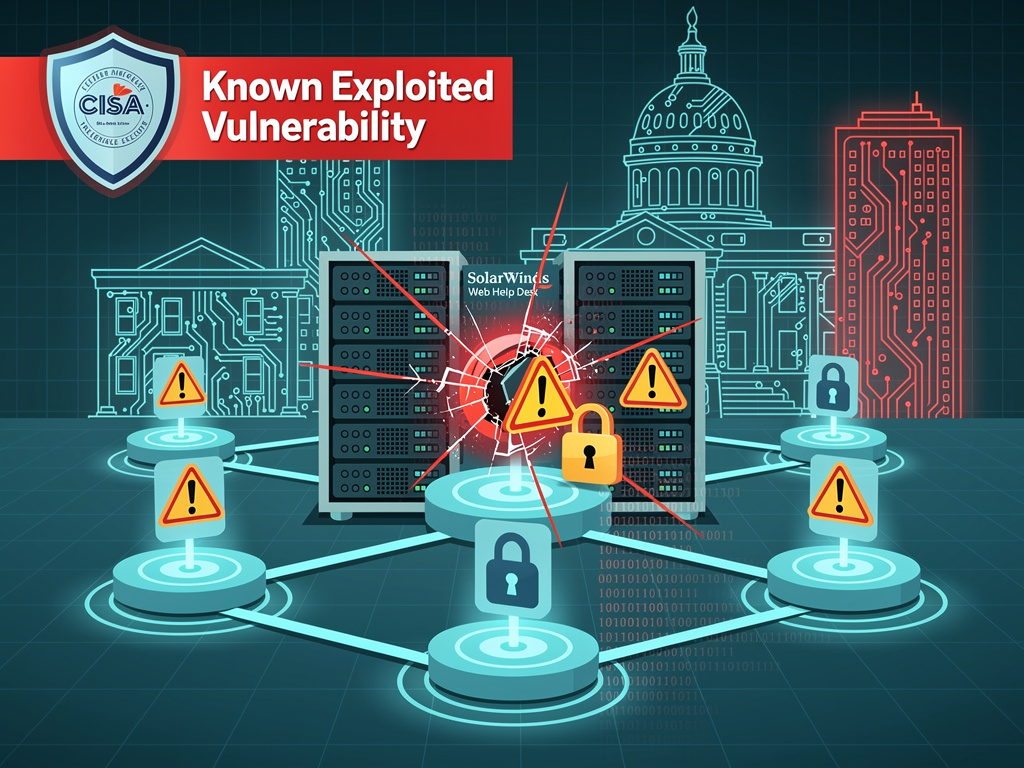
Federal cybersecurity authorities have escalated warnings about a critical security flaw in SolarWinds Web Help Desk software, adding the vulnerability to their catalog of actively exploited weaknesses as threat actors intensify attacks against enterprise IT management systems. The Cybersecurity and Infrastructure Security Agency’s decision to list CVE-2024-28987 signals a troubling expansion of attack surfaces targeting infrastructure that organizations rely upon for day-to-day operations.
According to The Hacker News, the vulnerability carries a CVSS score of 9.8 out of 10, placing it in the critical severity category. The flaw enables unauthenticated remote attackers to execute arbitrary code on affected systems, effectively granting complete control over compromised Web Help Desk installations. Security researchers have observed active exploitation attempts in the wild, prompting CISA’s addition of the vulnerability to its Known Exploited Vulnerabilities catalog—a designation reserved for security flaws with confirmed real-world attacks.
The timing of this vulnerability disclosure carries particular weight given SolarWinds’ history as a target of sophisticated nation-state actors. While this latest flaw differs from the supply chain compromise that dominated headlines in 2020, it underscores the persistent attention adversaries pay to widely-deployed IT management platforms. Organizations using SolarWinds Web Help Desk versions 12.8.3 and earlier face immediate risk, with federal agencies now under binding operational directive to patch affected systems within prescribed timelines.
The Technical Mechanics Behind Remote Code Execution
The vulnerability stems from inadequate input validation within the Web Help Desk application, allowing attackers to inject and execute malicious code without requiring authentication credentials. This class of security flaw represents one of the most severe categories in cybersecurity, as it eliminates the primary barrier—authentication—that typically protects enterprise systems from external threats. The remote code execution capability means adversaries can leverage this weakness from anywhere on the internet, dramatically expanding the potential attack surface.
Security experts note that help desk software presents an especially attractive target for threat actors due to its privileged position within IT environments. These platforms typically maintain elevated access permissions to facilitate troubleshooting and system administration tasks, making them valuable footholds for lateral movement across networks. Once compromised, a help desk system can provide attackers with credentials, system information, and access pathways to more sensitive infrastructure components.
Federal Response and Compliance Mandates
CISA’s inclusion of CVE-2024-28987 in the Known Exploited Vulnerabilities catalog triggers mandatory remediation requirements for federal civilian executive branch agencies under Binding Operational Directive 22-01. These agencies must implement vendor-provided patches or discontinue use of affected products within timeframes specified by the directive, typically ranging from two to six weeks depending on vulnerability severity and exploitation status.
While the binding directive applies specifically to federal agencies, CISA strongly recommends that private sector organizations treat the catalog as a prioritization framework for their own vulnerability management programs. The agency’s rationale centers on the observation that vulnerabilities under active exploitation pose demonstrably higher risk than theoretical weaknesses, regardless of CVSS scores or other technical metrics. Organizations across critical infrastructure sectors—including healthcare, finance, energy, and telecommunications—rely on SolarWinds products, amplifying the potential impact of widespread exploitation.
Vendor Response and Patch Availability
SolarWinds released security updates addressing CVE-2024-28987 in Web Help Desk version 12.8.3 HF1 and later releases. The company has published security advisories urging customers to upgrade immediately, while providing detailed mitigation guidance for organizations unable to implement patches within standard maintenance windows. The vendor’s response includes enhanced logging capabilities to help security teams identify potential exploitation attempts and assess whether compromise occurred prior to patching.
The patch deployment process for Web Help Desk requires careful planning, as the application often serves as a critical component of IT service delivery. Organizations must balance the urgency of addressing an actively exploited vulnerability against the operational impact of taking help desk systems offline for maintenance. Security teams recommend testing patches in non-production environments before deploying to production systems, while simultaneously implementing compensating controls such as network segmentation and enhanced monitoring to reduce risk during the patching window.
Broader Implications for IT Management Security
This incident highlights a troubling trend of adversaries targeting IT management and monitoring platforms as primary attack vectors. Beyond SolarWinds, security researchers have documented increased attention to similar products from vendors including ManageEngine, Ivanti, and ConnectWise. These platforms share common characteristics that make them attractive targets: widespread deployment across organizations of all sizes, deep integration with IT infrastructure, and privileged access to sensitive systems and data.
The concentration of risk within IT management platforms creates a force multiplier effect for successful attacks. A single compromised help desk system can provide adversaries with visibility into an organization’s entire IT environment, including asset inventories, configuration details, and user credentials. This intelligence gathering capability enables more sophisticated follow-on attacks, as threat actors leverage stolen information to identify high-value targets and craft convincing social engineering campaigns.
Detection and Incident Response Considerations
Security teams should prioritize forensic analysis of Web Help Desk systems to determine whether exploitation occurred prior to patching. Indicators of compromise include unexpected administrative account creation, unusual process execution patterns, and anomalous network connections from Web Help Desk servers. Organizations should review authentication logs for failed login attempts that might indicate scanning or exploitation activity, while examining file system modifications for web shells or other persistent access mechanisms.
Incident response procedures should assume that successful exploitation of this vulnerability could lead to broader network compromise. Security teams must expand their investigation scope beyond the initially compromised system to identify potential lateral movement, credential theft, and data exfiltration. This comprehensive approach requires coordination across security operations, IT infrastructure, and business units to assess impact and contain threats before they escalate into major breaches.
Long-Term Security Posture Improvements
Organizations should view this incident as an opportunity to reassess their approach to securing IT management platforms. Security architectures should incorporate defense-in-depth principles, including network segmentation that isolates management systems from general corporate networks and the internet. Multi-factor authentication, privileged access management, and just-in-time access controls can limit the damage from compromised credentials, even when vulnerabilities exist in underlying applications.
The persistent targeting of IT management platforms suggests that organizations need to elevate these systems to the same security tier as domain controllers and other critical infrastructure. This elevation should include enhanced monitoring, accelerated patching cycles, and regular security assessments to identify configuration weaknesses and potential attack paths. Threat modeling exercises that specifically examine IT management platforms can help security teams anticipate adversary tactics and implement appropriate countermeasures before exploitation occurs.
Industry-Wide Implications and Future Outlook
The SolarWinds Web Help Desk vulnerability represents another data point in the ongoing challenge of securing complex enterprise software ecosystems. As organizations continue consolidating IT operations around centralized management platforms, the attack surface associated with these systems will likely attract sustained adversary attention. Software vendors must prioritize security throughout the development lifecycle, implementing rigorous testing and code review processes to identify vulnerabilities before products reach customers.
For enterprise security leaders, this incident reinforces the critical importance of vulnerability management programs that can rapidly identify, prioritize, and remediate security flaws across diverse technology portfolios. Organizations that maintain comprehensive asset inventories, establish clear patching procedures, and conduct regular security assessments will be better positioned to respond to emerging threats. The cybersecurity community must continue sharing threat intelligence and best practices to collectively improve defenses against adversaries who persistently probe for weaknesses in widely-deployed enterprise software.
As federal agencies work to comply with CISA’s directive and private sector organizations assess their exposure, the broader lesson remains clear: IT management platforms require security investments commensurate with their privileged position within enterprise environments. Organizations that treat these systems as commodity infrastructure rather than critical assets do so at considerable risk, as adversaries have repeatedly demonstrated their willingness and ability to exploit such platforms for strategic advantage.


 WebProNews is an iEntry Publication