
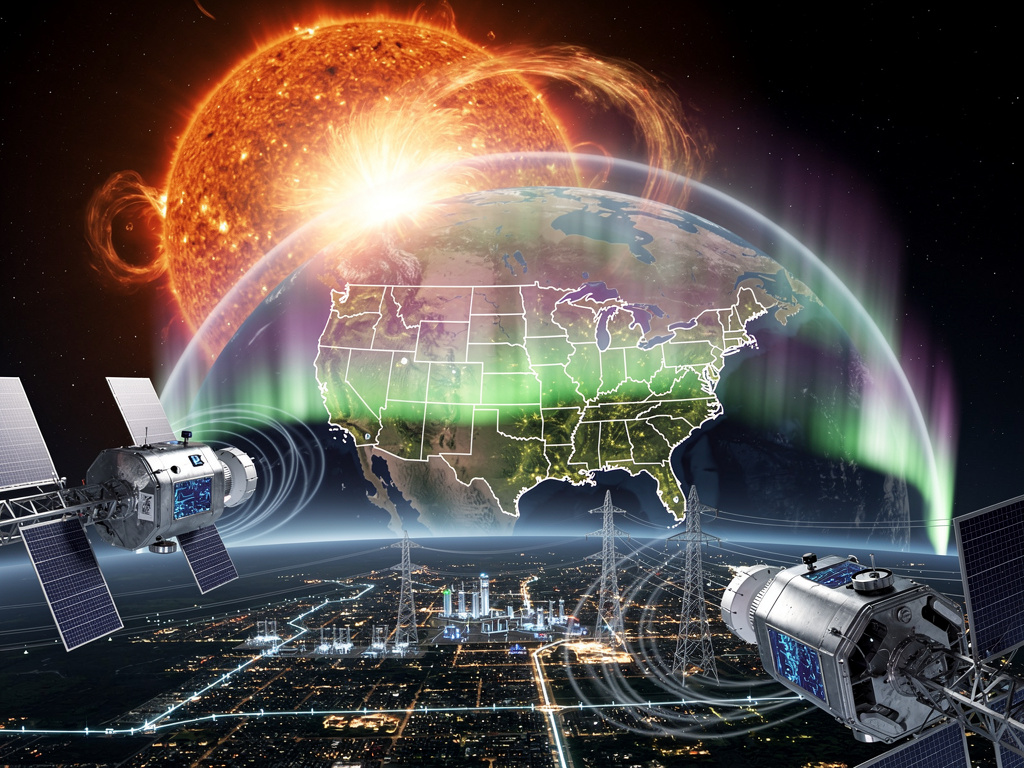
Earth’s magnetic defenses buckled under a ferocious coronal mass ejection late Monday, igniting a severe G4 geomagnetic storm hours ahead of projections and setting the stage for widespread auroral displays. The onslaught stemmed from an X1.9 solar flare erupted by sunspot region AR4341 on January 18, propelling a fast-moving plasma cloud directly toward our planet. NOAA’s Space Weather Prediction Center confirmed the CME shock arrival at 1938 UTC—2:38 p.m. EST—triggering storm levels that peaked swiftly and persisted into the evening.
This event marks one of the most intense space weather episodes of early 2026, with implications rippling through satellite networks, power grids, and high-frequency communications. Forecasters had issued a G4 watch for January 20 UTC day, but the premature impact underscores the challenges in predicting solar outbursts. As the CME passage continues, officials urge vigilance among operators of critical infrastructure.
Flare’s Ferocious Birth
The X1.9 flare peaked at 1809 UTC on January 18 from AR4341, unleashing radio blackouts rated R3-strong across the Americas, Europe, and Africa, per NOAA SWPC. X-class events, the most powerful on the solar scale, numbered after the ‘X’ denote peak flux in watts per square meter; this one’s 1.9 rating placed it among elite eruptions, capable of hurling billions of tons of magnetized plasma.
Such flares often accompany CMEs, billion-ton bubbles of solar wind that expand at millions of kilometers per hour. This one’s full-halo structure—encircling the solar disk—signaled Earth-directed fury, racing at speeds prompting the early strike. Space.com detailed how the flare’s energy release disrupted ionospheric layers, blacking out HF radio signals for over an hour in affected regions (Space.com).
Shock Arrival Accelerates Chaos
Upon impact, geomagnetic indices soared, with the Kp index hitting 8—G4 territory—by 1938 UTC, as reported by NOAA SWPC. The center noted S4 severe solar radiation storm conditions ongoing, posing risks to astronauts and high-altitude flights. Posts on X from NOAA’s NWSSWPC account confirmed: “G4 (Severe) storm conditions first reached at 1938 UTC (2:38pm EST) upon CME shock arrival.”
Real-time data from upstream sentinels DSCOVR and ACE revealed a southward Bz component in the interplanetary magnetic field, the key enabler for magnetospheric reconnection. This ‘open door’ effect funneled solar wind energy into Earth’s field, compressing the magnetopause and fueling substorms. ABC News highlighted potential northern lights visibility as far south as the southern U.S., with the storm’s early onset amplifying forecasts (ABC News).
Magnetic Orientation’s Pivotal Role
CME potency hinges on magnetic alignment: southward Bz links efficiently with Earth’s northward field, injecting plasma and sparking storms. Northward orientations shield us, but this event’s mix delivered fluctuating intensity. NOAA SWPC’s latest bulletins indicate ongoing G4 potential through January 20 UTC, with G1 minor storms possible January 21.
Forecasters at the U.K. Met Office echoed G3-to-G4 expectations, citing CME speed exceeding 1,500 km/s. Fox Weather reported aurora prospects across over 25 U.S. states, from Alaska to Alabama, urging skywatchers to prepare (Fox Weather). DTN Progressive Farmer noted minimal agricultural disruption in winter but flagged satellite navigation risks for precision farming.
Infrastructure Under Siege
Severe storms like this degrade GPS accuracy, induce geomagnetically induced currents in power lines, and elevate satellite drag, threatening low-Earth orbit assets. Starlink and other constellations face heightened collision risks, while transpolar flights reroute to dodge radiation. Forbes outlined a ‘severe’ alert for 24 states, tying it to the full-halo CME (Forbes).
Historical parallels abound: the 2003 Halloween storms caused blackouts in Sweden; today’s event, though potent, benefits from advanced monitoring. NOAA SWPC’s video updates, promised post-watch issuance, provide real-time guidance for operators.
Aurora’s Southern Surge
Charged particles slamming into oxygen and nitrogen atoms ignite vivid auroras, now spilling equatorward. EarthSky.org forecasted unsettled-to-active conditions from coronal holes, but the CME supercharged displays, with alerts for high-latitude chasers extending to mid-latitudes (EarthSky).
SpaceWeatherLive.com’s live plots show Kp indices validating G4, with 10.7 cm radio flux at 148 sfu signaling heightened solar activity. Met Office’s space weather forecasts predict prolonged effects.
Forecast Evolution and Vigilance
Initial watches from NOAA SWPC on X flagged G4 for January 20, upgraded as models refined arrival times. “A G4 (Severe) geomagnetic storm watch is in effect for the 20 January UTC-day due to Earth-arrival of a coronal mass ejection (CME),” read one post. Current 3-day outlooks from SpaceWeatherLive.com eye G1 lingering.
Region AR4341 remains potent, birthing the X1.9 alongside an S4 radiation storm. Operators monitor for subsequent CMEs, as solar maximum volatility persists into 2026.
Lessons from the Front Lines
Space weather firms like EverEdge Global and satellites operators drill for such events, with insurance markets pricing G5 risks. This storm tests resilience, from Wall Street’s trading systems to aviation’s polar routes. As NOAA SWPC urges: “Please continue to visit [site] for the latest information and updates.”
The episode reinforces solar cycle 25’s punch, with spotless days at zero in 2026 per SpaceWeather.com. Thermosphere Climate Index readings of 19.90×10^10 W signal a warming upper atmosphere, amplifying drag concerns.


 WebProNews is an iEntry Publication