
For years, Masayoshi Son’s SoftBank Group was synonymous with the boom-and-bust cycle of venture investing — a conglomerate that rode the highs of WeWork-era exuberance only to suffer billions in writedowns when the tide turned. Now, as artificial intelligence rewrites the rules of technology investing, Son’s early and aggressive bet on OpenAI is proving to be the fulcrum on which SoftBank’s fortunes are turning once again.
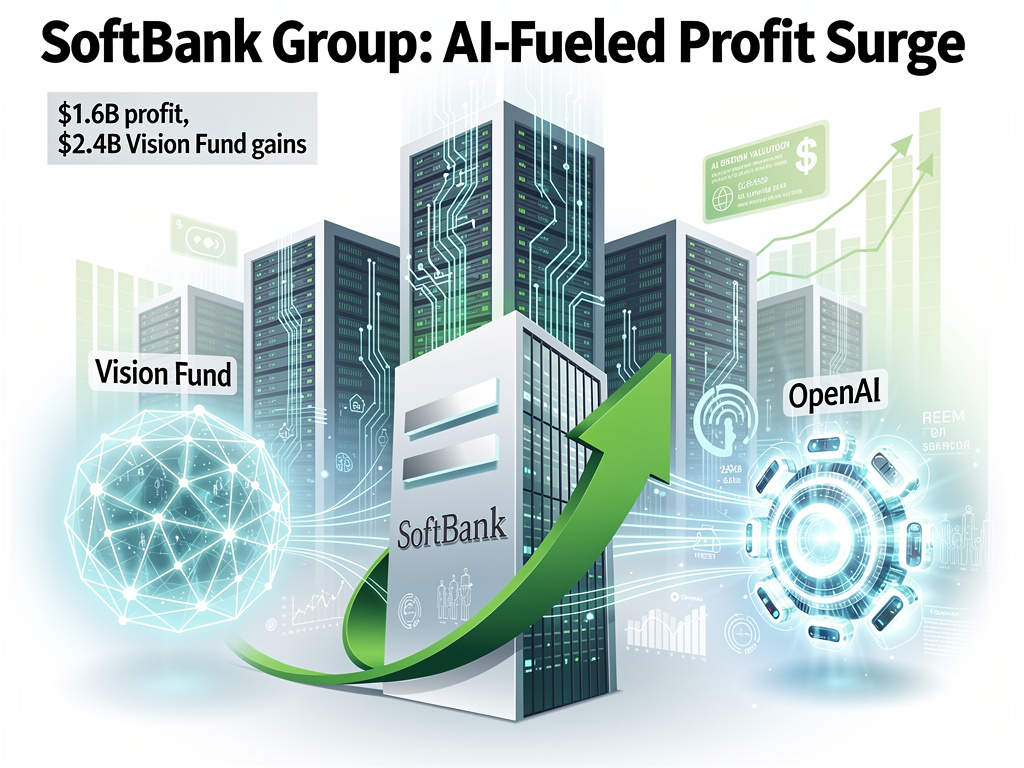
SoftBank Group Corp. reported a net profit of approximately ¥241.2 billion ($1.6 billion) for its fiscal third quarter ending December 2025, a dramatic swing from the losses that plagued the company in prior periods. The result was driven overwhelmingly by a $2.4 billion gain at its Vision Fund segment, where a surge in the carrying value of its OpenAI stake more than compensated for markdowns in other portfolio companies, according to CNBC. The quarterly profit represented a fivefold increase from the same period a year earlier, as reported by Nikkei Asia.
OpenAI: The Crown Jewel in Son’s AI Portfolio
The outsized contribution of OpenAI to SoftBank’s bottom line underscores just how concentrated the conglomerate’s fortunes have become in a single asset. SoftBank has steadily increased its exposure to OpenAI over the past two years, participating in multiple funding rounds that have valued the ChatGPT maker at levels that would have seemed fantastical even by Silicon Valley standards. The most recent valuation round pegged OpenAI at $300 billion, a figure that reflects both the explosive growth of generative AI and the intense investor appetite for exposure to frontier AI models.
According to Reuters, the Vision Fund’s investment gains were primarily attributable to unrealized valuation increases in OpenAI, which has seen its enterprise value climb as it transitions from a nonprofit research lab to a capped-profit entity with commercial ambitions spanning cloud computing, consumer products, and enterprise software. SoftBank’s cumulative investment in OpenAI is now believed to exceed $15 billion, making it one of the largest single bets in the history of venture capital. The Financial Times noted that the OpenAI position has become so significant that it now functions as a barometer for SoftBank’s overall financial health, a dynamic that carries both opportunity and risk, as reported by the Financial Times.
Vision Fund’s Mixed Bag: Winners and Losers
While OpenAI dominated the headlines, the broader Vision Fund portfolio told a more nuanced story. SoftBank’s Vision Fund segment — which encompasses Vision Fund 1, Vision Fund 2, and the newer Latin America Fund — posted aggregate investment gains of approximately $2.4 billion for the quarter. But beneath that headline number, several portfolio companies continued to weigh on performance. Losses in select holdings, including some late-stage startups that have struggled to achieve profitability or maintain growth trajectories in a higher-interest-rate environment, partially offset the OpenAI windfall.
SoftBank’s own financial disclosures, published in its quarterly earnings presentation, revealed that the Vision Fund segment recorded both realized and unrealized losses across a number of its roughly 475 portfolio companies. The dispersion of returns — a small number of massive winners alongside a long tail of underperformers — is a pattern that has characterized SoftBank’s investment approach since the inception of the first $100 billion Vision Fund in 2017. As Bloomberg reported, the quarterly results highlight the degree to which SoftBank’s investment thesis has shifted from a diversified portfolio strategy to one increasingly defined by a handful of AI-centric bets.
Masayoshi Son’s All-In AI Strategy
The results arrive at a pivotal moment for SoftBank and its founder. Masayoshi Son has spent the better part of three years repositioning the conglomerate as an AI-first investment vehicle, shedding legacy assets and doubling down on companies building or deploying artificial intelligence at scale. The strategy has included not only the OpenAI investment but also SoftBank’s participation in the Stargate joint venture — a massive AI infrastructure initiative announced in partnership with OpenAI, Oracle, and others, with ambitions to deploy up to $500 billion in AI data center capacity across the United States.
Son has described artificial intelligence as the defining technology of the next century, a conviction that has led him to make commitments that dwarf even the original Vision Fund in scale. At a January event alongside U.S. President Donald Trump, Son pledged $100 billion in U.S. investments focused on AI infrastructure, a figure that raised eyebrows among analysts who questioned whether SoftBank had the balance sheet to support such ambitions. The company’s earnings report offered partial reassurance: SoftBank’s loan-to-value ratio — a key measure of its financial leverage — remained within the company’s self-imposed ceiling, though it has crept higher as the conglomerate has taken on additional commitments, according to Nikkei Asia.
The Arm Holdings Factor
Beyond the Vision Fund, SoftBank’s majority stake in Arm Holdings continued to be a critical pillar of the group’s valuation. Arm, the British chip design firm that SoftBank took public in September 2023, has seen its market capitalization fluctuate significantly as investors debate the trajectory of AI-related semiconductor demand. As of the December quarter, Arm’s share price had appreciated meaningfully from its IPO level, providing SoftBank with a substantial unrealized gain on its retained stake.
However, Arm’s stock has also been subject to volatility driven by shifting expectations around AI chip spending cycles and competition from rivals such as RISC-V architecture proponents. SoftBank’s financial statements showed that the Arm stake, while not consolidated in the Vision Fund segment, contributed to the group’s overall net asset value and served as collateral for margin loans that fund other investments. The interplay between Arm’s valuation and SoftBank’s borrowing capacity is a dynamic that analysts at Morgan Stanley and Goldman Sachs have flagged as a key risk factor, particularly if semiconductor sentiment were to sour.
Debt, Leverage, and the Balancing Act
SoftBank’s aggressive investment posture has always been accompanied by significant leverage, and the current cycle is no exception. The company reported that its net debt stood at approximately ¥5.3 trillion as of December 2025, a figure that reflects both its investment commitments and the borrowing required to fund them. The loan-to-value ratio — calculated as net debt divided by the equity value of SoftBank’s holdings — was reported at roughly 16%, well below the company’s stated ceiling of 25% but above the levels that prevailed when SoftBank was in a more defensive posture during 2022 and 2023.
The balance sheet dynamics are particularly important given the scale of SoftBank’s forward commitments. The Stargate initiative alone could require tens of billions of dollars in capital deployment over the coming years, and SoftBank has signaled its intention to be a lead investor. Analysts at JPMorgan noted in a recent research note that SoftBank’s ability to fund these commitments without diluting shareholders or breaching its leverage targets will depend heavily on the continued appreciation of its OpenAI and Arm stakes — a circular dependency that introduces fragility into the financial model. As the Financial Times observed, the conglomerate’s financial architecture is essentially a leveraged bet on the AI supercycle continuing unabated.
OpenAI’s Evolving Corporate Structure and What It Means for SoftBank
One of the less discussed but critically important factors in SoftBank’s OpenAI investment is the ongoing evolution of OpenAI’s corporate governance and structure. OpenAI has been in the process of converting from its original capped-profit model — in which investor returns were limited to a multiple of their initial investment — to a more traditional for-profit corporation. This transition, if completed, would remove the return cap and potentially unlock significantly more upside for investors like SoftBank.
The restructuring has not been without controversy. OpenAI co-founder Elon Musk has mounted legal challenges to the conversion, and several state attorneys general have weighed in on the nonprofit governance implications. For SoftBank, the outcome of these proceedings is material: a successful conversion to a for-profit entity would likely trigger a further revaluation of its stake, while a legal setback could introduce uncertainty into the carrying value. Bloomberg reported that SoftBank’s management addressed the topic briefly during the earnings call, expressing confidence that the restructuring would proceed as planned but declining to comment on specific legal proceedings.
Market Reaction and the Road Ahead
Shares of SoftBank Group rose modestly in Tokyo trading following the earnings release, reflecting a market that had largely anticipated the positive contribution from OpenAI. The stock has been on a strong run over the past twelve months, more than doubling from its 2023 lows as investor sentiment toward AI has intensified. However, some analysts cautioned that the current valuation already prices in a significant amount of good news, and that any disappointment in the AI investment cycle — whether from OpenAI’s revenue growth, Arm’s chip design wins, or the pace of Stargate deployment — could trigger a reassessment.
For Masayoshi Son, the quarterly results represent vindication of a strategy that many had written off as reckless just two years ago. The Vision Fund, once derided as a cautionary tale of excess, is now generating the kind of returns that Son promised when he first conceived of the vehicle. Whether that performance is sustainable — or whether it represents another peak in SoftBank’s famously cyclical history — will depend on the trajectory of artificial intelligence itself. As Reuters noted, SoftBank’s story is now inseparable from the story of AI, for better or for worse.
The coming quarters will test that thesis in concrete terms. SoftBank is expected to participate in OpenAI’s next funding round, potentially at a valuation exceeding $350 billion. The Stargate project is entering its construction phase, with the first data centers expected to come online in Texas later this year. And Arm’s next earnings report will provide fresh data on the semiconductor cycle’s health. For industry watchers and investors alike, SoftBank remains the highest-stakes proxy for the AI revolution — a company whose quarterly earnings are, in effect, a report card on the most consequential technology bet of the decade.


 WebProNews is an iEntry Publication