
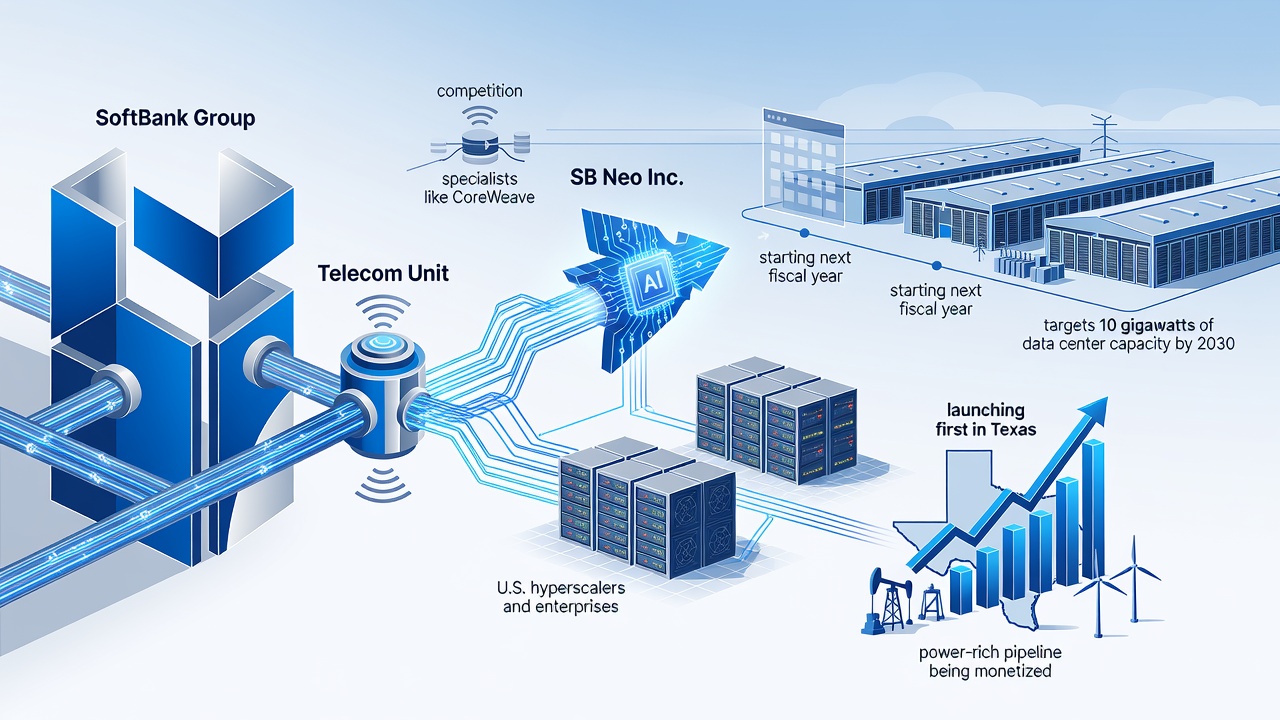
SoftBank Group Corp. is stepping directly into the frenzied market for artificial intelligence infrastructure. The Japanese conglomerate and its telecom arm announced this week they will rent out specialized computing capacity to U.S. companies. The move targets the exploding need for graphics processing units and related cloud services that power large AI models.
They plan to do it through a new venture called SB Neo Inc. Set to launch this month, the entity will offer AI chips and cloud services starting next fiscal year. Customers could include hyperscalers and other big enterprises hungry for more capacity than traditional providers can readily supply. Bloomberg reported.
Junichi Miyakawa, who heads SoftBank’s telecom unit, outlined ambitious targets. The neocloud operation aims to scale its data center resources to supply capacity at a level of 10 gigawatts by around 2030. That scale would support both training and inference for massive AI systems. Operations will begin in Texas. There, the company intends to construct a multiple-gigawatt data center.
But why now? Demand for AI compute has outstripped supply for years. Hyperscalers and AI startups alike scramble for GPUs from Nvidia and others. Pure-play specialists such as CoreWeave Inc. and Nebius Group NV have built businesses around renting that scarce resource. SoftBank sees an opening to compete using its growing pipeline of data center projects. The Information first flagged the rental plans.
Power, Not Just Chips, Becomes the Deciding Factor
Access to electricity stands out as the real constraint. Building data centers is one thing. Securing reliable, large-scale power is another. SoftBank’s strategy leans on sites with significant energy potential. Recent reports tie its U.S. ambitions to former nuclear-related facilities and other locations rich in power infrastructure. A 10-gigawatt target isn’t casual. It matches the voracious appetite of modern AI workloads.
SoftBank Corp., the listed telecom operator, could see its revenue transformed. Supplying the neocloud business in the U.S. might triple or quadruple its contributions, according to Miyakawa. That prospect excites investors who have watched the parent company’s big AI bets, including its stake in OpenAI. A recent $10 billion loan backed by that holding underscores the financial muscle behind these moves. The Register examined the rent-a-GPU race.
The new unit will draw on technology developed in Japan. SoftBank has beta-tested its Infrinia AI Cloud OS there since May. The software supports Kubernetes-as-a-Service in multi-tenant setups and inference-as-a-Service for large language models through APIs. Such tools could help differentiate SB Neo in a market that some consultants view as increasingly commoditized.
Masayoshi Son, SoftBank Group’s founder and chief executive, framed the effort in sweeping terms. “The SoftBank Group will work together to deploy world-class AI infrastructure and drive the AI revolution,” he said. The statement, while broad, signals commitment across the group’s many AI-related initiatives.
Yet challenges loom. McKinsey has warned that neocloud business models remain fragile. Commoditization of compute resources limits differentiation. Pricing pressure could intensify as more players, including big tech firms themselves, enter the fray. Just days ago Meta Platforms Inc. signaled plans to monetize its own excess AI capacity. That announcement sent ripples through specialist providers, with shares of CoreWeave and Nebius dropping sharply on competition fears.
SoftBank brings advantages. Its telecom backbone in Japan offers operational expertise. Long-term relationships with chip suppliers and a willingness to commit capital at scale matter too. The group has also joined the Stargate project, a massive U.S. AI infrastructure effort involving OpenAI, Oracle and others. Those ties could funnel demand toward SB Neo.
Analysts note the timing aligns with surging U.S. investment in AI. Companies can’t all build their own data centers fast enough. Renting capacity offers flexibility. For SoftBank, it turns potential stranded assets into revenue streams. The Texas launch site reflects a focus on states with favorable energy policies and land availability.
Still, execution risks abound. Hitting 10 gigawatts by 2030 demands flawless coordination on construction, power procurement and customer acquisition. Supply chain issues for advanced chips persist. Regulatory scrutiny over energy use and data center proliferation could slow progress. And the competitive field keeps expanding.
Investors reacted with interest but caution. SoftBank’s shares have ridden AI enthusiasm for months. This latest announcement adds concrete substance to the narrative. It shows the company moving beyond pure investment plays like its OpenAI position into direct operations. That shift could command higher multiples if successful.
Broader market context supports the bet. AI model sizes continue to grow. Training runs now consume power equivalent to small cities. Inference at scale for consumer applications multiplies that demand. Providers who secure both hardware and energy stand to capture significant value.
SoftBank’s Japanese neocloud service, built on similar technology, targets commercial launch in October. Success there could de-risk the U.S. expansion. Lessons from operating Infrinia domestically might accelerate American rollout.
The announcement arrives as Washington debates AI infrastructure policy. Bills aimed at speeding data center permitting and power plant construction circulate in Congress. Any tailwinds there would aid SoftBank and peers.
One thing seems clear. The era of easy access to AI compute is over. Companies with the foresight to amass capacity now, whether through ownership or rental agreements, gain strategic advantage. SoftBank wants to be the landlord in that marketplace. Its SB Neo venture represents a calculated gamble on that thesis.
How it plays out will depend on execution. But the signal is unmistakable. A major Asian technology investor is doubling down on American AI demand. And it’s doing so by offering the very resource in shortest supply: raw computing power at unprecedented scale.


 WebProNews is an iEntry Publication