
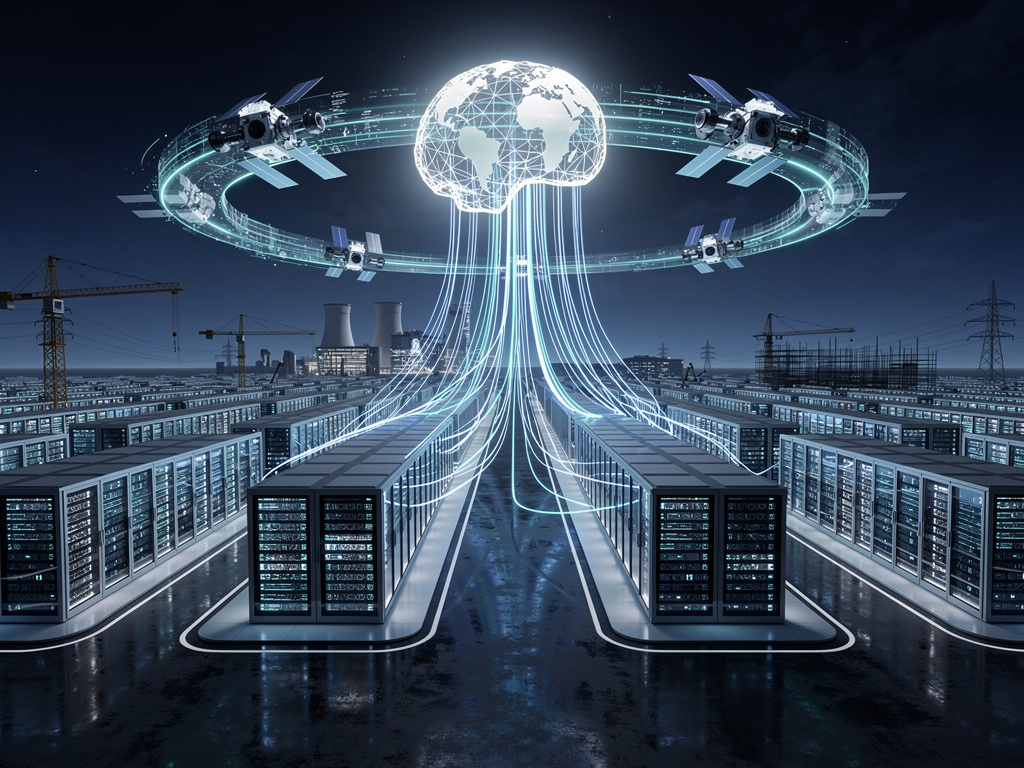
SoftBank CEO Masayoshi Son has outlined ambitious plans that place artificial intelligence at the center of a massive expansion in data center infrastructure and space-based technology, with projections pointing toward major developments by 2026. In a recent interview covered by Business Insider, Son described his vision for building enormous computing facilities to support advanced AI systems while drawing parallels to the work of Elon Musk and other innovators pushing boundaries in multiple sectors.
Son, whose SoftBank Group has long invested in technology companies including early stakes in Alibaba and more recent commitments to AI startups, sees data centers as the foundational element for the next wave of computational power. He anticipates that the demand for processing capacity will grow so rapidly that current facilities will prove insufficient within just a few years. According to the executive, SoftBank aims to construct data centers capable of handling the immense requirements of training and running large-scale AI models that could eventually surpass human intelligence in various domains.
The scale Son proposes involves investments that run into tens of billions of dollars. He has spoken about partnering with energy providers, chip manufacturers, and construction firms to create facilities that consume vast amounts of electricity while delivering unprecedented performance. These centers would not only house thousands of graphics processing units but also incorporate next-generation cooling systems and power management technologies to maintain efficiency at such extreme scales. Son believes that without this infrastructure buildout, the progress of AI could face significant bottlenecks, limiting the ability of companies and researchers to test hypotheses and deploy applications at full potential.
Elon Musk enters the conversation because of his own extensive plans for data centers tied to xAI, Tesla, and SpaceX operations. Musk has publicly discussed the need for massive computing clusters to advance his artificial intelligence initiatives, including the Grok models and autonomous driving systems. Son acknowledges the overlap in their thinking, noting that both recognize the physical constraints of current technology and the necessity to think bigger. Where Musk focuses on vertical integration across electric vehicles, batteries, and rockets, Son approaches the challenge from the perspective of a financial holding company that can allocate capital across global markets and form alliances with diverse players.
Space represents another frontier where Son sees synergy with Musk’s ambitions. SoftBank has invested in satellite communications and has expressed interest in low-Earth orbit constellations that could provide high-speed data links for remote data centers or support real-time AI processing from orbit. Son suggested that future data centers might incorporate space-based components, such as solar power arrays in orbit that beam energy to Earth or satellite networks that reduce latency for global AI services. This integration of terrestrial computing with orbital assets could address some of the energy and connectivity limitations that ground-based facilities encounter.
The timeline Son laid out targets 2026 as a pivotal year when many of these projects could reach initial operational stages. By then, he expects several large-scale data centers to come online, powered by dedicated renewable energy sources to mitigate environmental concerns. The executive emphasized that SoftBank would seek to balance rapid deployment with responsible practices, although critics have questioned whether such accelerated timelines allow sufficient attention to sustainability and grid stability. Energy consumption remains one of the most pressing issues, with estimates suggesting that AI training runs for frontier models already require power equivalent to that of small cities. Scaling this up by orders of magnitude will demand new approaches to generation and distribution.
Son’s comments reflect a broader trend among technology leaders who view infrastructure as the true competitive advantage in the AI race. While software breakthroughs often capture public attention, the hardware foundations determine what becomes possible. Companies that control large clusters of specialized processors gain the ability to experiment more freely, iterate faster, and attract top talent. SoftBank’s strategy involves not just building its own facilities but also investing in firms that produce the components and manage the operations. This approach spreads risk while positioning the company at multiple points along the value chain.
Discussions around these plans have sparked debate among analysts about feasibility and market impact. Some observers point to the enormous capital requirements and warn that overbuilding could lead to stranded assets if technological progress shifts unexpectedly. Others argue that underinvestment poses a greater danger, potentially allowing other countries or companies to pull ahead in AI capabilities. Son himself appears undeterred by such cautions, drawing on his history of bold bets that sometimes paid off spectacularly and at other times resulted in substantial losses. His track record includes both the spectacular success of Alibaba and the painful downturn of the WeWork investment, experiences that have shaped a philosophy of thinking at extreme scale.
The intersection with Musk’s activities adds another layer of complexity. Musk’s xAI recently broke ground on a supercomputer project in Memphis that aims to rival the largest existing clusters, while SpaceX continues to launch Starlink satellites that could eventually support distributed computing architectures. Son indicated that collaboration between their organizations remains possible, particularly in areas where space technology meets ground infrastructure. Joint ventures or shared research initiatives could accelerate progress, although both leaders are known for maintaining strong control over their respective domains.
Beyond the immediate technical and financial aspects, Son’s vision touches on societal implications. He has expressed the belief that sufficiently advanced AI could help solve some of humanity’s most difficult problems, from climate modeling to medical research. Yet he also acknowledges the risks associated with systems that might one day operate beyond human oversight. The data centers he proposes would serve as the training grounds for these future intelligences, making decisions about their design and governance especially significant. SoftBank has begun exploring ethical frameworks and safety protocols alongside its infrastructure investments, though details remain limited.
Regional considerations also factor into the plans. Son has indicated interest in locating some facilities in Asia, where SoftBank maintains strong relationships and where energy costs in certain markets may prove advantageous. Japan, in particular, could benefit from renewed technology investment as the country seeks to regain ground in global innovation rankings. At the same time, partnerships with American and European firms would provide access to talent and markets that remain central to AI development. This global approach mirrors SoftBank’s existing portfolio, which spans continents and industries.
Challenges abound in executing such an expansive strategy. Supply chains for advanced semiconductors continue to face constraints, with Taiwan Semiconductor Manufacturing Company and other foundries operating at high capacity. Securing sufficient land, permits, and skilled labor for construction projects of this magnitude will require coordination with governments at multiple levels. Additionally, the talent needed to design, build, and operate these systems remains scarce, driving up compensation and intensifying competition among technology giants.
Despite these obstacles, Son maintains confidence that the momentum behind artificial intelligence will overcome barriers. He points to historical examples where infrastructure investments paved the way for economic transformations, such as the buildout of electrical grids or fiber optic networks. In his view, data centers represent the essential utility of the coming decade, as fundamental to progress as roads or ports were in earlier eras. The executive has committed SoftBank to playing a leading role in this transformation, allocating resources and attention accordingly.
As 2026 approaches, industry watchers will track milestones in Son’s agenda with keen interest. Announcements regarding specific sites, technology partners, and capacity targets will provide clearer signals about the realism of his projections. The competitive dynamic with Musk and other players like OpenAI, Google, and Meta will likely intensify, creating a environment where announcements and counter-announcements shape market sentiment. For now, the conversation centers on vision and ambition, with the hard work of implementation still ahead.
The convergence of AI, data centers, and space technology that Son describes points toward a future where computing resources exist at unprecedented scales and in novel configurations. Whether through massive terrestrial clusters, orbital assistance, or hybrid systems, the goal remains expanding human capability through machine intelligence. SoftBank’s CEO has placed his company at the heart of this effort, betting that timely investment in physical infrastructure will yield advantages that prove difficult for others to match. The coming years will test the soundness of that conviction as plans move from concept to construction and, ultimately, to operation.


 WebProNews is an iEntry Publication