
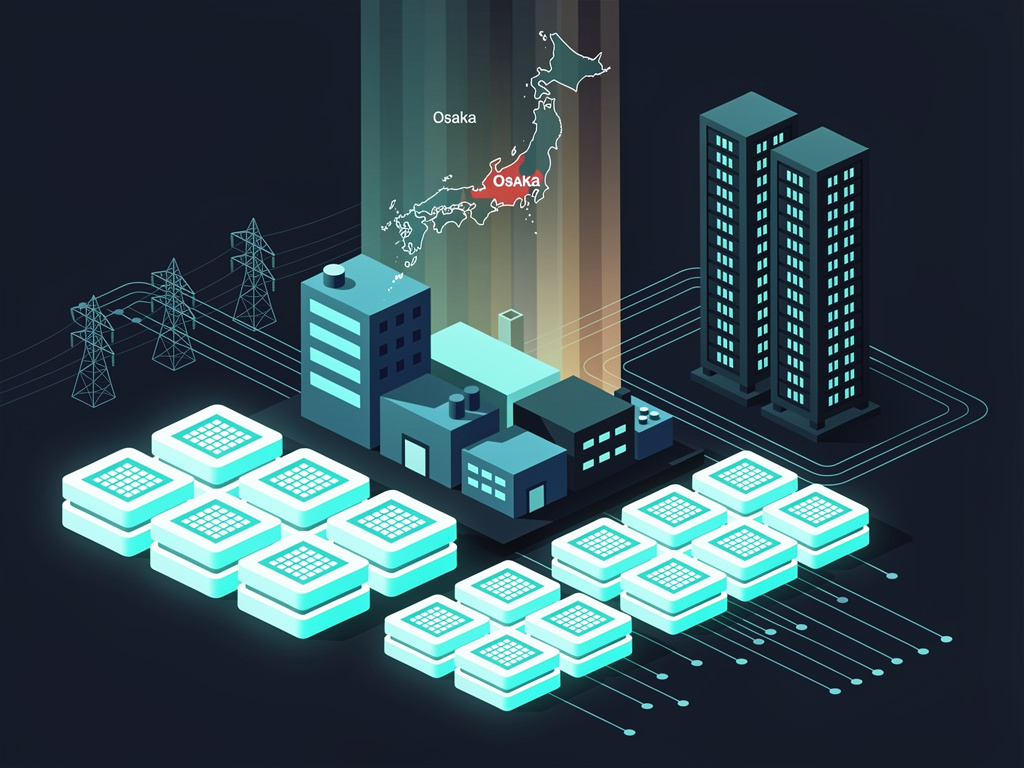
SoftBank Corp. just stepped deeper into the hardware that keeps AI running. The Japanese telecom operator, roughly 40% owned by SoftBank Group, announced Monday it will manufacture large-scale battery systems at a former Sharp factory in Sakai, Osaka. The goal: secure stable power for its own AI data centers while chasing more than ¥100 billion ($637 million) in annual domestic battery revenue by fiscal 2030.
Production begins in the fiscal year ending March 2028. Mass output at gigawatt-hour scale follows around the next year. These moves address the exploding electricity needs of AI infrastructure. They also mark a vertical push by a company already heavy in chips, data centers and AI models.
The site in Sakai will host an industrial cluster. One part, dubbed the AX Factory, focuses on data center operations and AI hardware manufacturing. The other, the GX Factory, will produce next-generation batteries along with solar panels and related gear. SoftBank plans to deploy the batteries first inside its own large-scale AI facilities there. Then it will roll them out for grid support across Japan, factories, industrial sites and eventually homes.
Overseas markets sit on the medium-term horizon. The company frames the effort as building “next-generation power infrastructure” for the AI era. “Through this domestic battery business, we will actively promote efforts to achieve a stable power supply and more efficient energy use,” SoftBank said in its official statement (SoftBank press release).
Partners bring specific expertise. South Korea’s Cosmos Lab contributes zinc-halogen battery cell technology. Its cells use pure water as the electrolyte. That design removes the fire risk tied to lithium-ion batteries. SoftBank calls these “innovative battery cells” with a halogen-based cathode and zinc anode. They deliver charge-discharge performance with minimal energy loss and efficiency on par with or better than lithium-ion, according to company research.
DeltaX, another South Korean firm, supplies systems know-how. Its Cell Connecting System and Cell to Pack technology pack cells more efficiently. The result? Energy density exceeding 5 MWh in a standard 20-foot shipping container. SoftBank says this setup, combined with the new cells, can hit or surpass 5.37 MWh per container. An AI-powered energy management system, drawn from SoftBank’s own electricity business, will forecast demand and optimize charge-discharge cycles.
Battery sizes vary by use. Commercial and industrial units range from 140 kWh to 560 kWh. Grid-scale or large systems stretch from 2,240 kWh to 5,380 kWh. The technology draws on locally available materials in Japan. Zinc and halogen compounds can be sourced domestically. That fact matters in a country worried about supply chain security and the environmental footprint of digital expansion.
News of the battery initiative landed alongside broader AI hardware plans. Bloomberg reported that SoftBank Corp. aims to sell AI computing power through neocloud services tailored for training workloads (Bloomberg). The listed company expects to pour ¥1 trillion ($6.4 billion) into AI-related businesses — data centers, batteries, network upgrades — over the three years through March 2029.
Power has become the binding constraint for AI. Hyperscalers and cloud providers race to secure electricity. Data centers consume vast amounts. Intermittent renewables add complexity. Batteries that store and dispatch power cleanly gain appeal. SoftBank’s approach integrates storage directly with its AI sites. It also positions the company to sell into Japan’s grid and industrial sectors where demand for stable, high-density storage grows.
The Register first detailed the battery manufacturing scale and non-flammable chemistry last week, noting the conversion of the Sharp LCD plant into this dual-purpose hub (The Register). Data Center Dynamics added that the production plant will sit alongside a large AI data center and hardware facility, with output starting in 2028 (Data Center Dynamics).
Nikkei Asia highlighted the safety and localization advantages. Zinc-halogen cells sidestep flammable organic electrolytes. They also reduce reliance on imported materials common in lithium-ion supply chains (Nikkei Asia). Energy Storage News pointed to the chemistry as intriguing for scale-up to 1 GWh annual production (Energy Storage News).
SoftBank brings serious AI skin in the game. It holds a majority stake in Arm. It owns Ampere Computing, which makes Arm-based server chips aimed at AI. The group committed $22.5 billion to OpenAI and plans a 10-gigawatt data center campus in Ohio. The Sakai project ties those pieces together on home soil. Batteries support the compute. The compute drives demand for more batteries. And the whole stack sits under one corporate roof.
But questions remain. SoftBank has not disclosed the capital cost for the GX Factory build-out. A spokesperson declined to comment when asked by The Register. Scaling aqueous zinc-halogen cells to gigawatt-hour volumes brings technical risks. Manufacturing yield, cycle life and cost must compete with established lithium-ion players. Integration of the AI forecasting software into real-world grid and industrial settings will take time to prove.
Still, the bet looks strategic. AI training clusters need reliable power 24/7. Grid operators face peak loads from thousands of GPUs. Non-flammable storage reduces safety overhead in dense facilities. Local production aligns with Japan’s industrial policy priorities. And revenue of ¥100 billion by 2030, while modest for SoftBank Group, creates a new line of business tied directly to the AI boom.
Other technology giants eye similar territory. Hyperscalers sign direct power purchase agreements. Some explore nuclear options. Battery makers race to improve density and safety. SoftBank’s end-to-end play — from cell chemistry through systems integration to deployment inside its own AI data centers — stands out for vertical control.
Junichi Miyakawa, SoftBank Corp.’s CEO, has pushed the company toward AI infrastructure services. The battery announcement fits that shift. It moves the firm from telecom provider and investor to manufacturer of critical power hardware. Success depends on execution at the factory floor and adoption beyond its own sites.
The announcement comes as AI electricity demand forecasts keep rising. BloombergNEF data cited in coverage positions the Sakai facility among Japan’s largest battery plants once at full 1 GWh annual output, with potential to scale several times higher. That capacity won’t solve national power shortages alone. It does, however, give SoftBank a tangible asset in the infrastructure arms race.
Deployment starts internally. That reduces customer acquisition risk in early years. Grid and industrial sales follow. Residential and global markets come later. The timeline — manufacturing in FY2027, scale in FY2028, meaningful revenue by FY2030 — leaves room for delays. Yet the direction is clear. Power storage has joined chips and compute as core to SoftBank’s AI thesis.
Industry watchers will track two metrics most closely. First, actual energy density and safety performance once cells leave the lab. Second, whether the integrated AI energy management system delivers measurable efficiency gains in live data center or grid operations. Early results from the Osaka Sakai site could set the tone for expansion.
For now, SoftBank has placed a sizable wager on its ability to build safer, denser batteries at scale. The payoff, if realized, extends beyond revenue. It secures power for its AI ambitions and carves out a role in the physical backbone of the artificial intelligence economy.


 WebProNews is an iEntry Publication