
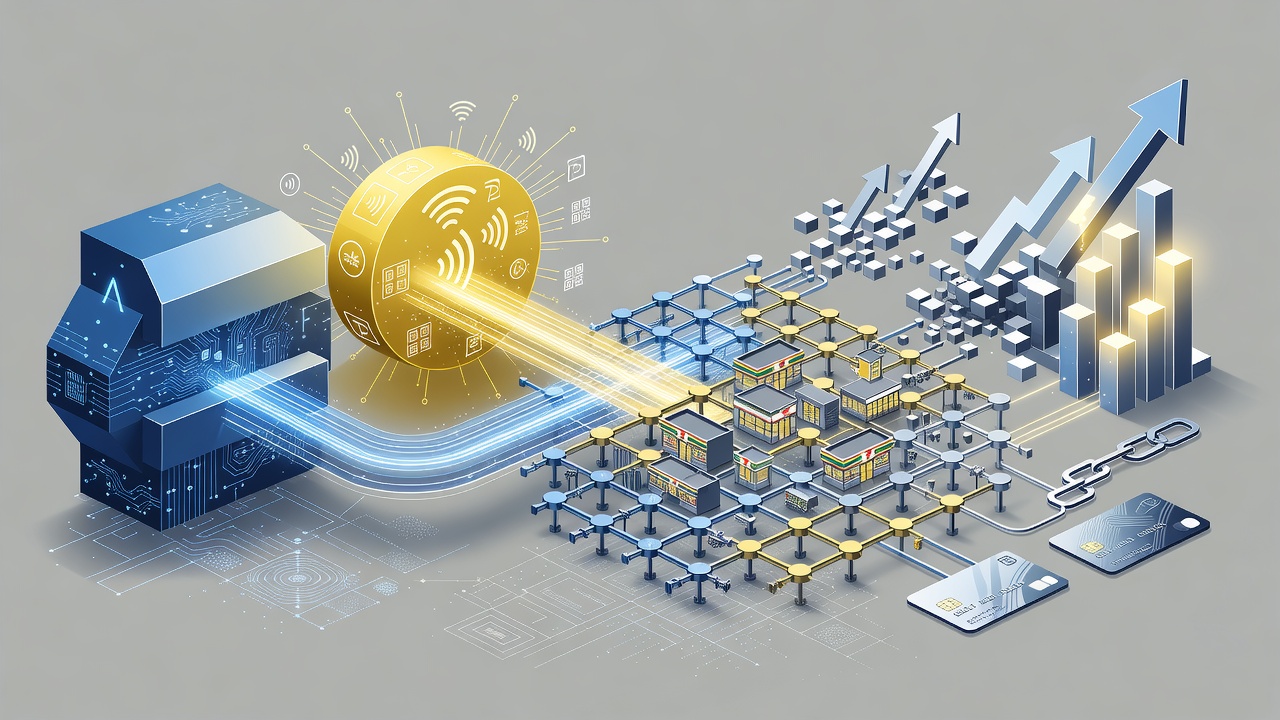
Tokyo’s corporate corridors buzzed Friday with word of a potential alliance that joins one of the world’s most aggressive technology investors with Japan’s iconic convenience store empire. SoftBank Corp. and its payments powerhouse PayPay are in talks to buy a stake in Seven & i Holdings, the parent of 7-Eleven. The discussions, first reported by Bloomberg, point to an investment totaling several hundred billion yen. Later updates from Nikkei Asia put the figure as high as 300 billion yen, or roughly $1.9 billion.
Neither side has confirmed the negotiations. SoftBank, Seven & i, PayPay and Sumitomo Mitsui Financial Group all declined to comment, according to Reuters. Yet the logic behind such a move feels immediate. PayPay already partners with Seven-Eleven Japan. Shoppers link accounts. They earn points across both platforms. A formal equity tie would lock those connections tighter. It would feed transaction data straight into PayPay’s growing financial services machine.
PayPay itself has transformed rapidly. The company listed on Nasdaq in March. It raised close to $880 million in the largest U.S. flotation by a Japanese firm in a decade. Its debut valuation hit about $12.7 billion. SoftBank retains roughly 90 percent ownership. So any strategic step by PayPay carries the parent’s unmistakable imprint. Just weeks ago PayPay agreed to buy a 70.2 percent stake in T&D Financial Life Insurance. The move, reported by The Next Web, pushes the payments app deeper into insurance. It already offers credit, banking and securities to more than 74 million registered users.
Seven & i arrives at these talks from a position of recent upheaval. The retailer spent two years beating back a takeover bid from Canada’s Alimentation Couche-Tard. That effort ultimately collapsed. Since then Seven & i has sold assets and restructured. It handed its former supermarket unit to Bain Capital. The company now focuses harder on its core convenience store business. More than 20,000 7-Eleven outlets operate in Japan alone. Tens of thousands more span the globe. The U.S. and Japan remain the largest markets.
The proposed investment could arrive through new shares issued by Seven & i. Bloomberg’s sources described that structure. Sumitomo Mitsui Card, a unit of Sumitomo Mitsui Financial Group, may also participate. The exact split stays unclear. Still, the capital would give Seven & i breathing room. It rejected a foreign buyer. Now it can court domestic partners who bring both cash and customer reach.
For SoftBank the bet stands out. Masayoshi Son has poured tens of billions into artificial intelligence. That spending spree recently helped SoftBank overtake Toyota as Japan’s most valuable company. A stake in physical retail marks a departure. Or perhaps an extension. Son calls the current posture “total offence mode.” He dismisses talk of an AI bubble as an insult. Deploying capital across sectors fits the pattern. Here the target is everyday consumer spending. The data that flows from millions of small, frequent purchases.
Convenience stores generate exactly the transaction volume a payments company craves. Tie PayPay more closely to those tills and the network gains scale. It gains stickiness. Seven & i operates a footprint that touches a huge share of daily Japanese spending. For a mobile app already on tens of millions of phones, deeper integration promises real advantage. Points programs expand. Loyalty loops tighten. Store operations improve through data analytics.
SoftBank also eyes technology upgrades. AI tools could optimize inventory. Customer analytics might sharpen offerings. Some talk even mentions autonomous robots to ease labor shortages in stores. Such ideas surfaced in social media discussion on X today, where users noted the potential for modernization after years of investor pressure on Seven & i.
The backdrop matters. Seven & i has committed to returning 2 trillion yen in capital to shareholders by fiscal 2030. It pursues an IPO for its North American 7-Eleven business in the second half of 2026. Management changes continue. Steve Dacus serves as president and CEO to speed execution. After fending off Couche-Tard, the company signals openness to partnerships that unlock value without full control shifting abroad.
PayPay’s own trajectory adds momentum. Its insurance acquisition, funded from existing cash reserves, closes in October 2027. The $840 million deal, detailed in SEC filings and covered by TheStreet, shows ambition. IPO proceeds from March get deployed fast. Investors notice. The message is clear. PayPay isn’t content to remain only a QR-code checkout app.
Yet risks surround the talks. They remain preliminary. Single-sourced reporting leaves room for shifts. Japanese negotiations often stretch for months. Some end without fanfare. No terms have been disclosed. Valuation questions linger. Seven & i’s stock performance, its competitive position against other retailers, and integration challenges with PayPay’s 74 million users all require careful handling.
Still. The combination carries obvious appeal. A dominant payments network meets one of the busiest retail footprints in the country. Data from those transactions feeds AI models. Loyalty programs cross-sell financial products. Store layouts adapt in real time. For Son, it represents another front in the offensive. For Seven & i, fresh capital and technology partners arrive at a moment when proving standalone value feels urgent.
Markets reacted with interest Friday. Shares in the involved companies moved on the news. Analysts will spend coming days modeling scenarios. How much ownership changes hands? What governance rights follow? Does the deal accelerate Seven & i’s planned U.S. listing or complicate it?
One thing feels certain. Japan’s retail and fintech sectors are converging faster than many expected. Physical stores still dominate daily commerce. Digital wallets and points systems now sit at the center of customer relationships. A deal between these two giants would underline that shift. It would bind them in ways that go beyond today’s existing partnership.
Whether the talks produce a signed agreement remains unknown. But the very fact they are happening says plenty about where both companies see their next phase of growth. Capital. Data. Technology. Convenience on every corner. The pieces are aligning.


 WebProNews is an iEntry Publication