
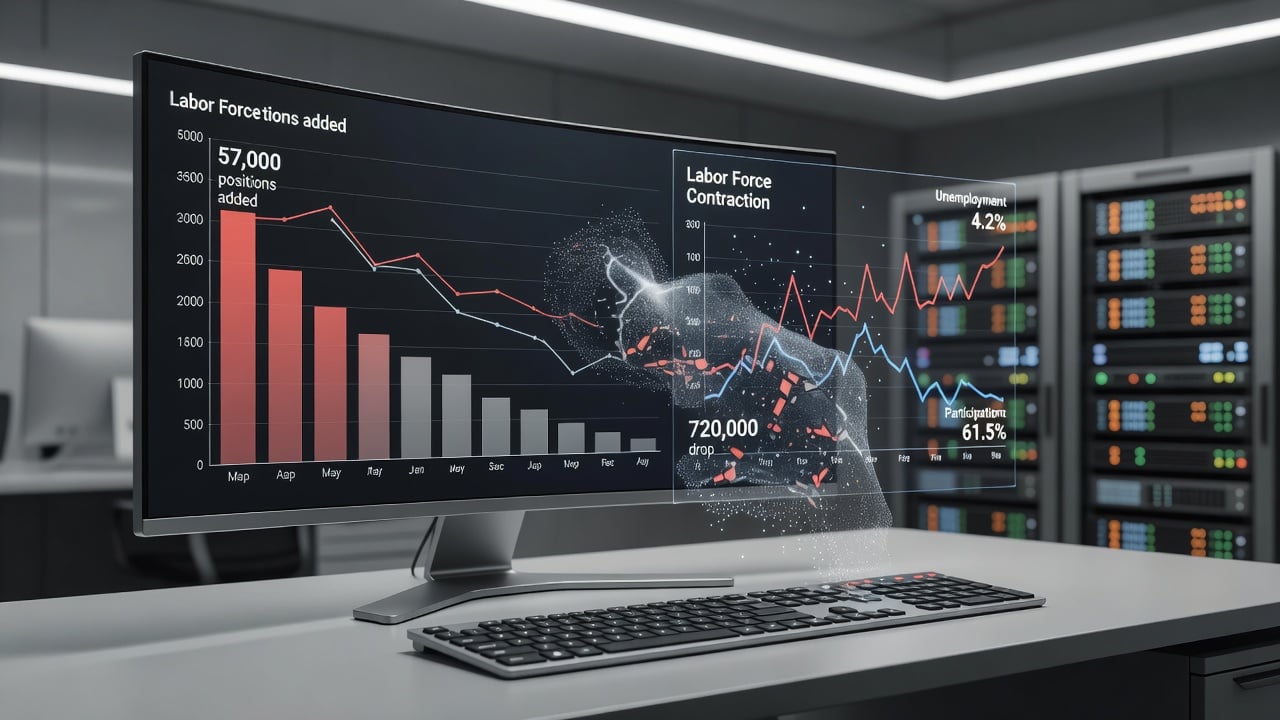
The numbers came in softer than expected. U.S. employers added just 57,000 jobs in June. That fell well short of the roughly 110,000 forecast by economists. And revisions to prior months painted an even weaker picture.
According to the Bureau of Labor Statistics, nonfarm payrolls rose by only 57,000 last month after a downwardly revised 129,000 gain in May. April and May together saw substantial cuts to earlier estimates. The unemployment rate, meanwhile, edged down to 4.2% from 4.3%. Yet the drop carried a caveat. It stemmed not from broad hiring gains but from a sharp contraction in the labor force.
Some 720,000 people left the labor force in June. Participation rate slipped to 61.5%, its lowest since March 2021. The employment-population ratio fell to 59.0%. These figures suggest many Americans stopped looking for work. Or never started. And that reality complicates any straightforward read of labor market health.
Reuters reported the moderation likely reflects payback after three straight months of stronger gains. It may also align payroll figures more closely with other surveys that showed less optimism. Small business hiring plans, for instance, have looked less buoyant. Consumers in a Conference Board survey viewed jobs as “hard to get” near a five-and-a-half-year high.
But the labor force shrinkage stands out. The civilian labor force has fallen by about 1.3 million since the start of the current administration. Roughly 1.5 million fewer people are working than in January 2025. Analysts point to an aging population and stricter immigration policies as key drivers. The so-called break-even job growth rate needed to hold the unemployment rate steady has dropped accordingly. Companies need to add far fewer positions than in recent years just to keep pace.
Daniel Zhao, chief economist at Glassdoor, captured the tension. “The unemployment rate’s decline to 4.2% is a case of good news for the wrong reasons: it was driven by people leaving the labor force, not by more hiring. This points to a labor market that’s stubbornly refusing to reaccelerate, despite recent optimism.” His assessment, highlighted in coverage by Investing.com, underscores the diagnostic challenge facing policymakers.
Fed officials have acknowledged the mixed signals. Chair Kevin Warsh has noted that potential growth appears to have trended higher thanks to productivity gains. “Potential growth looks like it’s trended up,” he observed, while adding that “labor market hours worked are relatively flat.” Hours data in the report showed the average workweek holding at 34.3 hours. Average hourly earnings rose 0.3% in June to $37.64. Year-over-year wage growth remains moderate but steady.
The central bank held its benchmark rate steady last month in the 3.50%-3.75% range. Updated projections from that meeting pointed to possible rate increases later this year amid persistent inflation concerns. Before the June jobs data, markets assigned roughly a 50% probability to a September hike. That conviction has since eased. Lower oil prices following an Iran ceasefire have also reduced some perceived downside risks to the economy.
Yet the report does not settle the debate. It renews it. On one side, low layoffs and a historically tight labor market argue against premature easing. On the other, anemic hiring and a shrinking pool of workers raise questions about underlying demand. San Francisco Fed President Mary Daly has spoken of uncertainty around the balance between inflation and growth risks. Fed watchers say officials feel uncomfortable with a “curious kind of balance” where job growth stays soft but the headline unemployment rate holds or improves for technical reasons.
Sector details add nuance. Professional and business services added 36,000 jobs. Social assistance and health care contributed 25,000 and 22,000 respectively. Those areas continue to show resilience. Leisure and hospitality, however, lost 61,000 positions. That decline stands out. It may reflect seasonal factors or lingering effects from earlier uncertainties tied to tariffs and geopolitical tensions.
The number of marginally attached workers held near 1.8 million. Discouraged workers numbered 477,000. These groups, who want jobs but have stopped searching, rarely make headlines. Their stability suggests the labor force drop involves more than temporary discouragement.
Economists caution against reading too much into a single month. June reports have often proven volatile and subject to large revisions in subsequent releases. Still, the pattern over recent months shows slowing momentum. Earlier in 2026, monthly gains averaged higher. The three months before June delivered stronger prints before this pullback.
Broader context matters. Last year brought a noticeable slowdown in job creation amid higher unemployment. Immigration changes appear to have tightened labor supply. Productivity improvements, meanwhile, may allow the economy to grow with fewer workers. Warsh has pointed to such dynamics as a reason for measured optimism. “Nothing is in the bank at this time of consequence, but if the last four quarters are an indication… there’s reason to be optimistic. Does that optimism convey into policy in the next six or nine months? Still too soon to say.”
Markets reacted swiftly to the data. Bond yields fell. Equity futures edged higher. The dollar weakened. Traders dialed back expectations for near-term rate hikes. Gold prices gained ground. These moves reflect a view that the Fed now has more room to remain patient. A weaker labor market reading takes some pressure off officials focused primarily on bringing inflation back to target.
But patience cuts both ways. If the labor force continues to shrink because workers see limited opportunities, that could weigh on future growth. Consumer spending, which drives much of the economy, depends on income and confidence. A labor market that looks stable on the surface yet fails to draw people in carries hidden risks.
Analysts at U.S. News echoed the theme that this report could prompt fresh discussion inside the Federal Open Market Committee. The combination of soft hiring, downward revisions, and a contracting labor force leaves policymakers without a clean narrative. Is the market simply normalizing after a period of catch-up hiring? Or does it signal something more persistent about demand?
Recent academic and think tank assessments align with this ambiguity. A Stanford Institute for Economic Policy Research brief on the 2026 economy described a low-hire, low-fire equilibrium. Job openings have eased. Hiring remains sluggish. Unemployment has stabilized but without the robust job creation seen in prior expansions. Forecasters generally expect modest payroll gains ahead with the jobless rate holding near current levels.
The Fed’s dual mandate requires attention to both price stability and maximum employment. When those goals appear to pull in different directions, decisions grow harder. Inflation concerns tied to earlier supply disruptions have eased with falling energy prices. At the same time, a labor market that adds fewer than 60,000 jobs in a month falls below even conservative estimates of what’s needed to absorb new entrants.
So the conversation continues. Officials will parse incoming data on inflation, consumer spending, and business investment over the coming weeks. The July jobs report, due in early August, will carry extra weight. Any further downward revisions to recent months could reinforce the softer trend.
For now, the June snapshot offers no easy answers. Hiring slowed. The workforce contracted. Unemployment ticked lower for reasons that give pause. And the central bank once again finds itself assessing a labor market that defies simple categorization. Stability or stall? The distinction will shape policy in the months ahead.


 WebProNews is an iEntry Publication