
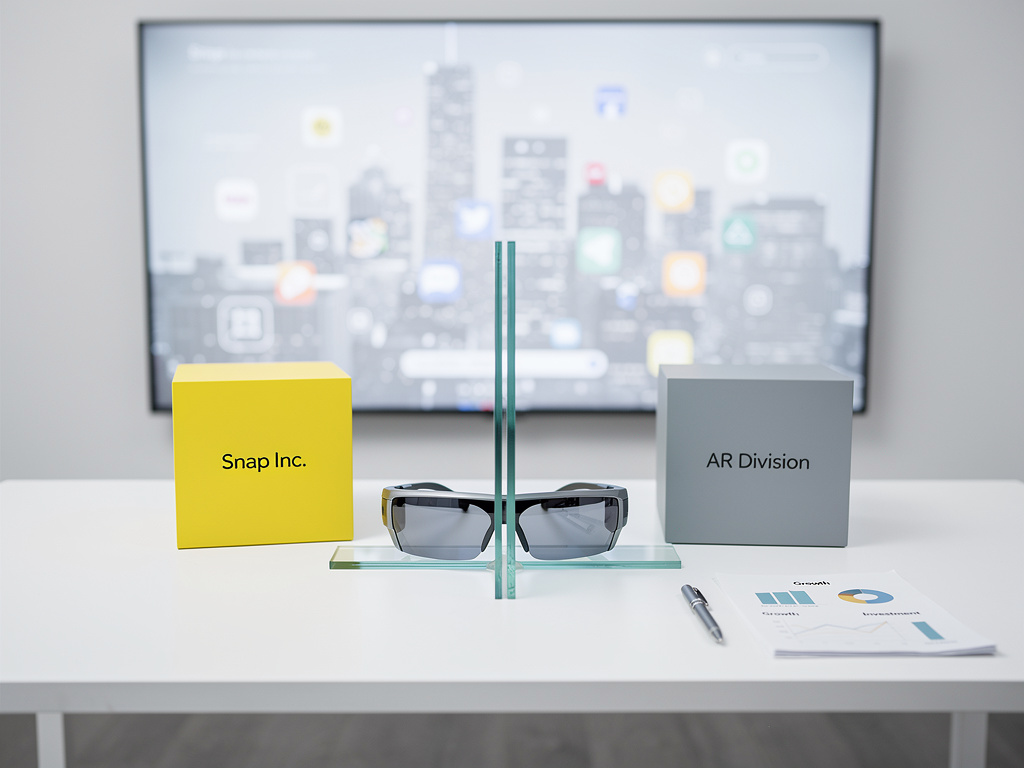
In a strategic pivot that signals both ambition and pragmatism, Snap Inc. has announced plans to spin off its augmented reality glasses division into a separate business entity, a move that industry observers say could fundamentally reshape how social media companies approach hardware innovation. The decision, reported by Engadget, represents a significant departure from the integrated product strategy that has defined Snap’s approach since the company’s ill-fated Spectacles debut in 2016.
The spinoff comes at a critical juncture for Snap, which has invested hundreds of millions of dollars into AR technology while simultaneously grappling with intense competition from Meta Platforms, TikTok, and other social media rivals. By creating a standalone AR hardware company, Snap is effectively acknowledging what many tech executives have long suspected: that the timeline for consumer-ready AR glasses extends far beyond the quarterly earnings cycles that dominate public company decision-making. The move also provides Snap with greater financial flexibility, allowing the core social media business to focus on profitability while the AR division pursues longer-term moonshot ambitions without the constant scrutiny of Wall Street analysts.
The Financial Calculus Behind the Split
According to Engadget’s reporting, the new entity will operate independently with its own leadership structure and funding mechanisms, though Snap will retain significant ownership and strategic control. This arrangement mirrors successful spinoff models in other technology sectors, where parent companies maintain equity stakes while granting operational autonomy to capital-intensive hardware ventures. The structure could prove particularly advantageous for attracting specialized investors who focus on hardware and optics technology rather than social media advertising models.
Financial analysts have long viewed Snap’s AR investments as a double-edged sword. While the technology demonstrates genuine innovation—particularly in areas like waveguide optics and miniaturized computing—the development costs have weighed on the company’s overall profitability metrics. By segregating these expenses into a separate entity, Snap’s core business can present cleaner financials to investors, potentially driving up the parent company’s valuation even as the AR subsidiary pursues a longer development runway. This financial engineering reflects a broader trend in Silicon Valley, where companies increasingly separate experimental divisions from their cash-generating core operations.
Learning From Past Hardware Missteps
The decision carries particular weight given Snap’s rocky history with consumer hardware. The company’s first-generation Spectacles, launched with considerable fanfare in 2016, became a cautionary tale about hardware hubris when Snap was forced to write down nearly $40 million in unsold inventory. Subsequent iterations showed technical improvement but failed to achieve mainstream adoption, with the devices remaining primarily tools for creators and developers rather than everyday consumers. The latest Spectacles models, unveiled in 2024, featured impressive AR capabilities but were not made available for general purchase, instead being distributed to developers and partners.
Industry insiders suggest that Snap’s willingness to restructure its AR ambitions demonstrates a maturity that was absent during the original Spectacles launch. Rather than forcing hardware products to market before the technology and consumer demand align, the spinoff structure allows for patient capital and longer development cycles. This approach stands in stark contrast to Meta’s aggressive push into mixed reality hardware, where the company has reportedly lost billions annually on its Reality Labs division while maintaining it as an integrated part of the corporate structure. The different strategies reflect fundamentally different philosophies about how to commercialize next-generation computing platforms.
The Competitive Dynamics of AR Hardware
Snap’s spinoff decision cannot be separated from the broader competitive dynamics in the AR hardware market. Meta has invested over $50 billion in its metaverse and AR initiatives since 2019, while Apple’s Vision Pro represents a $3,500 bet on spatial computing that has generated mixed consumer response. Google, after abandoning its Google Glass consumer product, has refocused on enterprise AR applications. Meanwhile, startups like Magic Leap and Nreal (now Xreal) continue to push forward with varying degrees of market traction, each pursuing slightly different technical approaches and target markets.
The fragmentation of the AR hardware market suggests that no single company has yet cracked the code on mainstream consumer adoption. Technical challenges remain formidable: battery life, processing power, optical quality, field of view, and form factor all require simultaneous optimization to create a product that consumers will wear regularly. By creating a focused entity dedicated solely to solving these problems, Snap may be positioning itself to move more quickly than competitors who must balance AR investments against other corporate priorities. The spinoff structure could also facilitate partnerships with other technology companies that might be reluctant to work closely with Snap’s social media business due to competitive concerns.
Implications for Snap’s Developer Ecosystem
The spinoff carries significant implications for Snap’s extensive AR developer ecosystem, which has grown to include thousands of creators building Lenses and AR experiences for the Snapchat platform. These developers have invested considerable time and resources learning Snap’s AR tools, including Lens Studio and the company’s various AR SDKs. The creation of a separate hardware entity raises questions about how these development tools will be maintained, updated, and integrated across both the social media platform and the standalone AR glasses business.
However, the separation could ultimately benefit developers by providing clearer technical roadmaps and more stable development environments. When AR hardware development is integrated within a social media company subject to rapid pivots based on user engagement metrics and advertising performance, long-term technical planning becomes challenging. A dedicated AR hardware company can establish multi-year technology roadmaps that give developers confidence to build more sophisticated applications. This stability could prove crucial as AR experiences become more complex, requiring deeper integration with hardware capabilities like spatial mapping, hand tracking, and environmental understanding.
The Talent War and Organizational Culture
Behind the financial and strategic considerations lies a critical human capital dimension. Building cutting-edge AR hardware requires specialized expertise in optics, materials science, electrical engineering, and industrial design—skill sets that differ substantially from the software engineering and product management capabilities that drive social media success. By creating a separate entity, Snap can potentially attract and retain hardware talent that might otherwise gravitate toward companies like Apple, Meta, or specialized hardware startups.
The organizational culture of hardware development also differs markedly from software-centric social media companies. Hardware requires longer development cycles, more rigorous testing protocols, and different risk management approaches due to the physical nature of products and the complexities of manufacturing at scale. A standalone entity can cultivate a culture optimized for hardware innovation without the constant pressure to ship features on software-style sprint cycles. This cultural separation may prove as important as the financial restructuring in determining whether Snap’s AR ambitions ultimately succeed.
Market Timing and the Road Ahead
The timing of Snap’s spinoff announcement reflects broader market conditions that have forced technology companies to rationalize their experimental investments. After years of cheap capital and investor tolerance for speculative ventures, the technology sector has entered a period demanding clearer paths to profitability and more disciplined capital allocation. By spinning off its AR hardware division, Snap is essentially telling investors: judge our social media business on its operational merits while allowing the AR venture to pursue a separate trajectory with appropriate expectations.
This bifurcation of expectations could prove prescient if AR hardware follows a similar adoption curve to previous computing platform shifts. The smartphone revolution took nearly a decade from the iPhone’s introduction to reach true mass-market saturation. AR glasses, with their additional technical challenges and social acceptance hurdles, may require an even longer gestation period. By creating a corporate structure that accommodates this extended timeline, Snap is positioning itself to remain viable in the AR race even if mainstream adoption doesn’t materialize until the 2030s. The question now is whether this patient approach will be vindicated by eventual market success or whether competitors with deeper pockets and integrated strategies will ultimately dominate the emerging AR ecosystem.
For industry observers, Snap’s spinoff represents a fascinating experiment in corporate structure and innovation strategy. If successful, it could establish a new template for how public technology companies pursue transformative hardware platforms without sacrificing their core business performance. If unsuccessful, it may serve as a cautionary tale about the challenges of maintaining strategic coherence across separated entities. Either way, the decision marks a significant moment in the evolution of augmented reality from laboratory curiosity to potential mass-market technology, with implications that will reverberate throughout Silicon Valley for years to come.


 WebProNews is an iEntry Publication