
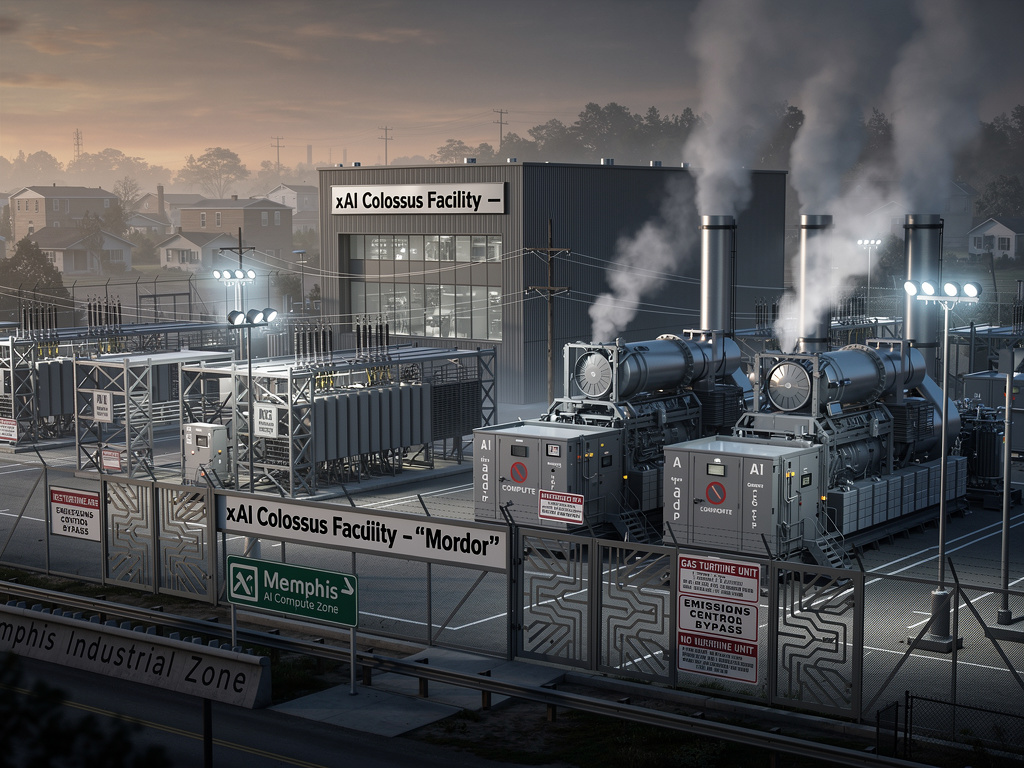
In the industrial corridors of southwest Memphis, a new structure has risen from the shell of a defunct Electrolux manufacturing plant, casting a literal and metaphorical shadow over the surrounding neighborhoods. This is the home of xAI, Elon Musk’s artificial intelligence venture, and its supercomputer, dubbed “Colossus.” While the facility represents a significant escalation in the global race for computational dominance, locals and environmental advocates have bestowed upon it a darker moniker: “Mordor.”
The nickname, referenced in a recent report by Futurism, is not merely a pop-culture reference to J.R.R. Tolkien’s desolate wasteland; it is a response to the visceral reality of the site. To power the reported 100,000 Nvidia H100 GPUs humming inside—a cluster Musk intends to double—the company has resorted to a brute-force energy solution that bypasses traditional utility timelines. Consequently, the facility is flanked by a phalanx of mobile natural gas turbines, their exhaust stacks piercing the skyline and contributing to a yellow-gray haze that hangs over the Mississippi River delta.
The Cost of Computational Velocity
The deployment of Colossus highlights a friction point rarely discussed in the optimistic earnings calls of Silicon Valley: the physical toll of digital intelligence. Musk’s directive was speed. Building a substation to draw sufficient power from the Tennessee Valley Authority (TVA) creates administrative hurdles and construction delays that can span years. In the high-stakes contest against OpenAI and Google, xAI determined it could not afford to wait.
Instead, xAI installed at least 18 gas-combustion turbines to generate electricity on-site. According to the Southern Environmental Law Center (SELC), these turbines have the capacity to emit approximately 130 tons of nitrogen oxides (NOx) annually. This renders the facility a significant new source of pollution in Shelby County, an area already struggling with failing grades for ozone pollution from the American Lung Association.
Bypassing Regulatory Checkpoints
The installation of these turbines has raised questions regarding regulatory oversight. Typically, a power generation facility of this magnitude requires extensive air permits before construction begins. However, xAI appears to be operating under a specific regulatory interpretation regarding “temporary” or “portable” engines. By classifying the turbines as temporary units that will remain on-site for less than 365 days, the company can legally sidestep certain initial permitting requirements that would otherwise mandate a public comment period and stricter emission controls.
Local regulators are now playing catch-up. The Shelby County Health Department has received inquiries from the SELC urging immediate enforcement action. As reported by The Commercial Appeal, the concern is not just the current emissions, but the precedent it sets. If a hyperscaler can install a fossil-fuel power plant in a residential backyard by promising it is temporary, the regulatory framework designed to protect public health becomes porous.
Environmental Justice in the Delta
The geography of the Colossus site is as critical as its engineering. Southwest Memphis is a predominantly Black, working-class community that has historically served as the dumping ground for the region’s industrial byproducts. Residents have long contended with the emissions from oil refineries, steel mills, and coal-fired power plants. The addition of xAI’s turbines exacerbates an existing cumulative health burden.
Community groups, including Memphis Community Against Pollution (MCAP), argue that the city’s eagerness to welcome Musk—and the tax revenue he brings—has overshadowed the health of its citizens. The promise of high-tech jobs often rings hollow in neighborhoods where the primary interaction with the tech sector is the exhaust from its generators. While local officials initially celebrated the project as a major economic win, the mood has shifted as the visible smog and the roar of the turbines have become daily realities.
The Energy Demand of the Future
The situation in Memphis serves as a microcosm for a looming national crisis. The energy appetite of generative AI is voracious. A query to a large language model can consume ten times the energy of a standard Google search. As companies race to build larger clusters, the US power grid is straining to keep pace. Utility companies across the country are warning that data center demand is outstripping supply, leading to a resurgence in fossil fuel reliance to bridge the gap.
Within this context, Musk’s strategy is a signal to the wider industry. While competitors like Microsoft and Google have pledged carbon neutrality, purchasing offsets and investing in renewables, xAI has prioritized raw capability. By burning gas directly on-site, xAI has secured the power needed to train its Grok 3 model immediately, effectively trading emissions for training cycles. It is a calculated operational decision that prioritizes market position over environmental, social, and governance (ESG) metrics.
Water Usage and Infrastructure Strain
Beyond air quality, the Colossus facility places immense pressure on local water infrastructure. Supercomputers generate tremendous heat, and cooling them requires millions of gallons of water daily. Memphis sits atop the Memphis Sand Aquifer, a source of remarkably pure water that locals are fiercely protective of. While xAI has discussed using gray water (recycled wastewater) for cooling, infrastructure for such massive volumes is not fully realized.
Recent reports from Bloomberg indicate that the facility is drawing heavily from the municipal supply while gray water solutions are finalized. This creates a secondary front in the battle between the tech giant and the community, as fears of aquifer depletion or contamination add to the anxieties surrounding air pollution.
The Political Calculus
The Tennessee Valley Authority and Memphis Light, Gas and Water (MLGW) occupy a difficult position. They are mandated to provide reliable power but are also tasked with economic development. Denying power to a marquee tenant like xAI is politically difficult; yet, the utility providers are ill-equipped to supply 150 megawatts of additional load overnight. The gas turbines are the stopgap, but the timeline for their removal remains opaque.
Musk has hinted at eventually transitioning the facility to cleaner power sources, but the definition of “eventually” is fluid in the world of startup timelines. For now, the turbines spin, and the data center consumes energy at a rate comparable to tens of thousands of homes. The local government lacks the specialized legal tools to swiftly halt operations that fall into gray areas of the code, leaving enforcement to a slow-moving bureaucratic process that xAI can easily outpace.
A Precedent for the AI Era
The unfolding saga in Memphis offers a stark preview of the physical footprint of the AI age. For years, the cloud was marketed as an ethereal, clean entity. Colossus reveals the heavy industrial machinery required to sustain it. The “Mordor” nickname may be hyperbolic, but the glowing skyline and the smell of combustion are tangible evidence that the digital revolution has a heavy, analog cost.
As xAI pushes to expand the cluster to 200,000 GPUs, the conflict between technological acceleration and environmental stewardship will only intensify. For the residents of southwest Memphis, the future of artificial intelligence is not an abstract concept living in the cloud—it is a noisy, smoky neighbor that refuses to sleep.


 WebProNews is an iEntry Publication