
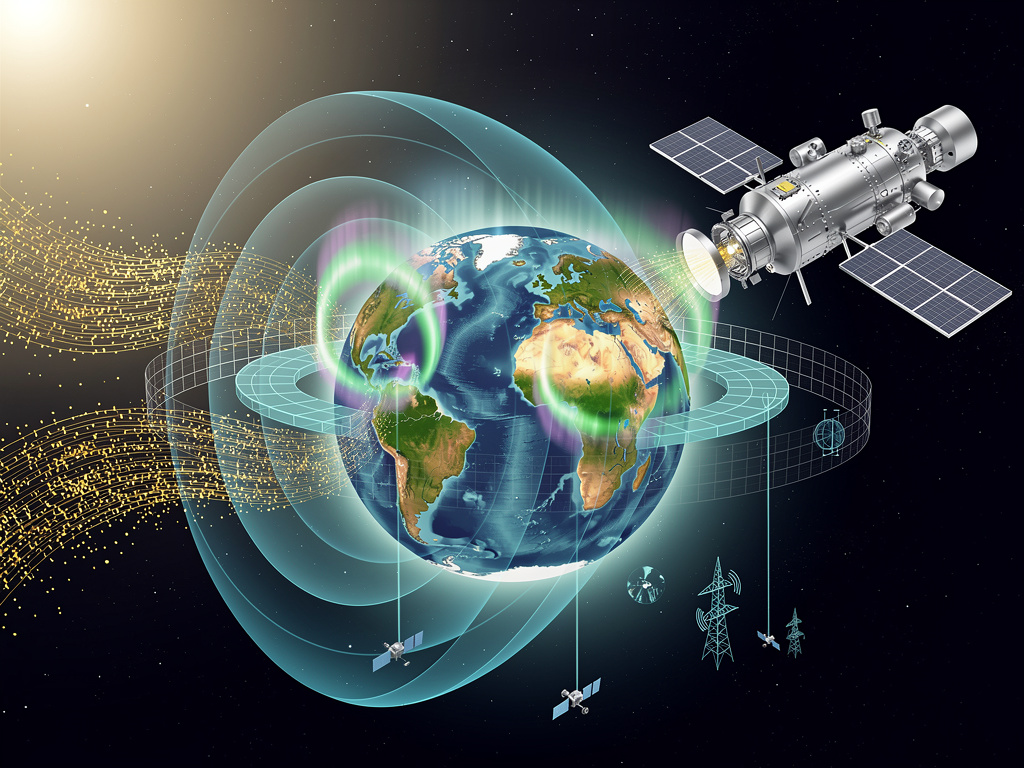
Earth sits inside a vast magnetic bubble. For more than 70 years scientists have known it exists. Yet no one has seen the full structure respond in real time to the Sun’s barrage of particles. That changed this week.
On May 19, 2026, a Vega-C rocket lifted off from Europe’s Spaceport in French Guiana at 00:52 local time. Aboard rode SMILE, the Solar wind Magnetosphere Ionosphere Link Explorer. The joint European Space Agency and Chinese Academy of Sciences mission now heads toward a highly elliptical orbit that will let it stare down at our planet’s protective bubble from 75,300 miles away. The images it returns promise to rewrite models of space weather.
From Theory to First Light
Spacecraft have flown through parts of the magnetosphere since the 1960s. They sampled particles, measured fields, traced individual events. None captured the entire system at once. SMILE does something different. Its soft X-ray imager will detect emissions produced when solar wind ions collide with neutral atoms in Earth’s outermost atmosphere. The resulting pictures will show exactly where and how the solar wind presses against the magnetosphere.
An ultraviolet imager will watch the auroras for up to 45 hours straight. Together the two cameras create a synchronized movie. Scientists will watch solar wind hit the dayside shield and, minutes later, see the resulting energy funnel toward the poles and ignite glowing skies. Cause and effect, finally linked in one dataset.
“We are about to witness something we’ve never seen before—Earth’s invisible armour in action,” said ESA Director General Josef Aschbacher. (ESA) The mission builds on decades of prior work. Earlier probes such as Cluster mapped local conditions. SMILE steps back for the wide shot.
Development took more than a decade. Original launch targets slipped past technical problems and the pandemic. The spacecraft separated from the rocket’s upper stage 57 minutes after liftoff, deployed its solar arrays, and began a monthlong series of engine burns. It will reach its final science orbit in July. Data collection starts soon after.
From that vantage, SMILE spends long periods high above the North Pole. Every two days it swings back down to within 3,100 miles of the South Pole to beam data home. The orbit gives nearly continuous coverage of the sunward face of the magnetosphere. No previous mission offered that perspective.
And the timing matters. Modern society runs on satellites, power grids, and GPS. A severe geomagnetic storm can knock out transformers, scramble signals, and expose astronauts to higher radiation. Better forecasts require better physics. SMILE supplies the missing global context.
Carole Mundell, ESA’s Director of Science, put it plainly. “For the first time ever, we will be able to understand cause and effect. This is critically important scientifically, but even more importantly, because nowadays modern life depends very much on our space infrastructure.” (Gizmodo)
The magnetosphere forms where Earth’s magnetic field meets the supersonic solar wind. On the dayside the pressure compresses the field into a blunt nose. On the nightside it stretches into a long tail. Magnetic reconnection—when oppositely directed field lines break and snap together—powers much of the drama. Energy stored in the tail releases suddenly. Particles rain down. Auroras flare. Sometimes the grid flickers.
NASA’s TRACERS mission, scheduled for launch in July 2025, will fly directly through the polar cusps where reconnection funnels particles Earthward. Twin spacecraft will capture rapid measurements of these explosive events. John Dorelli, TRACERS science lead at NASA’s Goddard Space Flight Center, compared the magnetosphere to “a bar magnet that’s rotating and floating around in space.” When solar wind slams into it, he explained, energy builds until field lines “snap and explosively fling away nearby particles at high speeds.” (University of Iowa TRACERS site)
SMILE and TRACERS will operate at the same time. One watches from afar. The other dives into the action. Their combined observations could close the loop on how local reconnection scales to global behavior.
SMILE carries four instruments total. The X-ray and ultraviolet imagers sit at the heart. Two others measure particles and fields in situ as the spacecraft passes through the solar wind and magnetosheath. Chinese partners built the magnetometer and particle analyzer. European teams, led by the University of Leicester, delivered the X-ray camera.
Project scientist Philippe Escoubet said the data will sharpen models of Earth’s magnetic environment. Those models, in turn, could protect astronauts and satellites for decades. David Agnolon, SMILE project manager, called the mission the first time ESA and China jointly selected, designed, built, launched, and will operate a science spacecraft. The partnership has lasted 25 years.
Yet gaps remain. Current space weather forecasts often rely on single-point measurements or simulations that lack full validation. When a coronal mass ejection slams into Earth, operators can issue warnings. They cannot yet say with confidence how big the storm will grow or exactly where its effects will hit hardest. Global X-ray movies should change that.
SMILE also arrives at a moment when other missions expand the picture. NASA’s IMAP, launched in 2025, maps the broader heliosphere—the Sun’s own magnetic bubble. ESCAPADE, en route to Mars, recently passed through Earth’s distant magnetotail on its way outward. The heliophysics fleet grows more coordinated.
Still, SMILE stands apart. It is the first to image the magnetosphere boundary itself in X-rays. The soft X-ray signal comes from charge exchange between solar wind ions and exospheric hydrogen. Bright patches will mark the nose of the magnetosphere and the cusps. Dimmer regions may reveal plasma depletion or unusual solar wind conditions. Researchers have never had such a direct diagnostic.
The ultraviolet camera builds on heritage from missions that glimpsed auroras from high altitude. This time the view lasts days instead of minutes. Scientists can track how auroral ovals expand and contract as the solar wind varies. They can correlate those changes with the X-ray signatures arriving from the dayside. The full chain of energy transfer comes into focus.
But. Success is not guaranteed. The highly elliptical orbit brings its own challenges. Radiation exposure, thermal swings, long periods without ground contact. Engineers built in redundancy. Early operations will test every system before science begins in earnest.
Even if instruments perform perfectly, interpretation will take time. X-ray images require careful modeling to convert brightness into physical parameters. Teams across Europe and China will work together on that analysis. Results will flow into international databases for broader use.
So the launch marks only the start. Over the next three years SMILE will collect thousands of images. Each one will show our planet’s shield bending, rippling, sometimes cracking under solar pressure. The pictures will reach screens in mission control, research labs, and eventually classrooms.
Engineers have prepared the spacecraft for its task. Now nature supplies the test. Solar activity is climbing toward the peak of the current cycle. Chances are good that SMILE will witness at least one major storm. When that happens, the world will see—for the first time—how Earth’s invisible armor holds.
Or doesn’t. Either way, the data arrives at a moment when dependence on space-based systems has never been greater. The magnetosphere no longer hides in the dark. Its behavior, long inferred, will soon stand revealed in light.


 WebProNews is an iEntry Publication