
Slate Auto opened preorders Wednesday for a bare-bones electric pickup that starts at $24,950. The company promises every vehicle it builds will turn a gross profit. Deliveries start late this year. And the bet rests on a simple idea. Strip the truck to its essentials. Let owners add only what they want.
The numbers sound almost too good in a market where new vehicles average near $50,000. Base model delivers an estimated 205 miles of range from a 65-kilowatt-hour lithium-iron-phosphate battery. A single rear motor produces 181 horsepower and 195 pound-feet of torque. Zero to 60 miles per hour takes about eight seconds. Towing maxes at 2,000 pounds. Payload reaches 1,550 pounds. Nothing flashy. Nothing unnecessary.
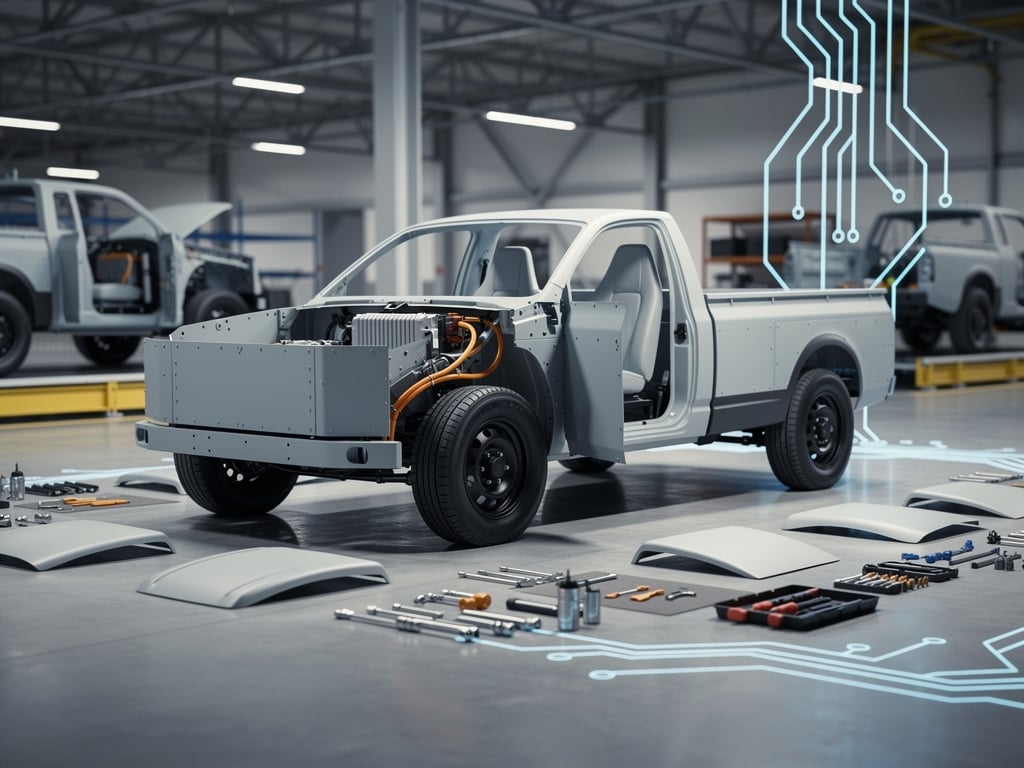
Buyers get a two-seat pickup with hand-crank windows. No infotainment screen. No embedded cellular modem. Speakers are optional. The body arrives in a single gray composite finish. Owners choose vinyl wraps instead of factory paint. More than 100 colors and designs sit ready. Over 175 accessories fill the catalog. Eighty percent cost less than $500. Roof racks, light bars, even stereo systems. A $5,000 conversion kit turns the truck into a five-seat SUV. Fastback or squared-off tops mimic a Jeep Wrangler look. The company calls it the Blank Slate. Customers make it their own.
Peter Faricy, Slate’s CEO and a former Amazon Marketplace executive, told CNBC that the approach delivers a different cost structure. “We have a different cost structure and a different business model than other automakers have,” he said. The company targets break-even at roughly 80,000 vehicles a year. Its Warsaw, Indiana plant holds capacity for 150,000. Faricy expects positive cash flow and earnings before interest, taxes, depreciation and amortization in 2027. “It’s an ambitious goal,” he added. “No other automotive company has been able to do that before.”
Slate has raised more than $1.4 billion across three funding rounds. Backers include Jeff Bezos through his family office, Los Angeles Dodgers owner Mark Walter’s TWG Global, General Catalyst and others. The company emerged from stealth in April 2025 after years of quiet development inside Re:Build Manufacturing. Production will happen in a former printing plant in Warsaw. Workers currently build about three vehicles a day by hand with some automation. Normal line operations begin in August. Federal certification for range, safety and other standards continues.
The design philosophy sets Slate apart in sharper ways. Engineers trimmed the vehicle to just 600 parts. That minimalism extends inside. Two seats. Manual windows. A small digital gauge cluster. No large touchscreen. Drivers mount their own phones or tablets for navigation and music. The absence of a modem means the truck cannot phone home. Ars Technica highlighted the privacy stance. Slate states it collects data only when it directly improves ownership. The company does not sell that data. “Privacy is paramount,” executives said. “For Slate, privacy is not a compliance footnote. It is part of the product experience.” Owners can leave smartphones behind and drive something as untraceable as an old Toyota pickup from 1985.
This stands in direct contrast to the connected-car trend. Most modern vehicles carry cellular modems that track location, behavior and more. Data has become a revenue stream for many automakers. Slate rejects that model. The app connects locally for diagnostics, maintenance guidance and charging status. Nothing more. The choice reflects a broader ownership focus. “We are building it around ownership value,” the company explained. “We collect data to make ownership better, not to turn the owner into the product.”
DIY repair sits at the center too. Panels swap easily. Parts stay accessible. Free manuals and video guides live on Slate U. The company wants owners to fix, modify and maintain the truck themselves. That ethos echoes early Tesla thinking but pushes further into simplicity. No paint shop. No complex body panels. Injection-molded composites keep costs low and repairs straightforward.
Comparisons help frame the value. The base Slate undercuts a new Chevrolet Bolt or Nissan Leaf. It sits well below the average transaction price for new cars. Ford’s upcoming affordable EV pickup carries expectations near $30,000. Hybrid Ford Mavericks start around there with four doors, power windows and built-in screens. Some early commenters worry the Slate feels too stripped down for $25,000. Yet others see the modular approach as refreshing. Electrek called the price reveal “genuinely refreshing” in today’s market.
More than 180,000 reservations already exist. Those required a $50 refundable deposit. Actual preorders ask for $300 nonrefundable. The company sells direct to consumers. No franchised dealers. That mirrors Tesla and Rivian but arrives with its own execution risks. Slate President of Vehicles Chris Barman, an early employee and former CEO, expects the SUV configuration to claim 60 percent of sales despite the pickup’s lower base price.
Production timelines have held steady. Initial reveal happened in 2025. Deliveries target the fourth quarter of 2026. The company continues validation testing. Executives express confidence the simplified manufacturing process will hit targets on time and on budget. Faricy, recruited by Slate co-founder Jeff Wilke, another Amazon veteran, brings retail and scaling experience to the launch phase.
Questions remain. Will enough buyers accept crank windows and no radio in 2026? Can the two-door-only format appeal beyond a niche? Small pickups like the Ford Maverick sell mostly as four-door crew cabs. All-wheel drive is absent. Rear-drive only. Yet the low price, domestic manufacturing and customization options could attract fleet buyers, tradespeople and enthusiasts who want to personalize without paying for unwanted features.
Slate positions the truck as the most affordable in America. The claim holds for now. Whether it scales profitably will test if the industry truly needs a vehicle this basic. Faricy acknowledges the challenge. “Nothing’s guaranteed in life,” he said. “But you have to have ambitious goals if you want to achieve big things.”
The coming months will show if hundreds of thousands of Americans agree. Preorders are open. The Blank Slate sits ready. What owners choose to add remains entirely up to them.


 WebProNews is an iEntry Publication