
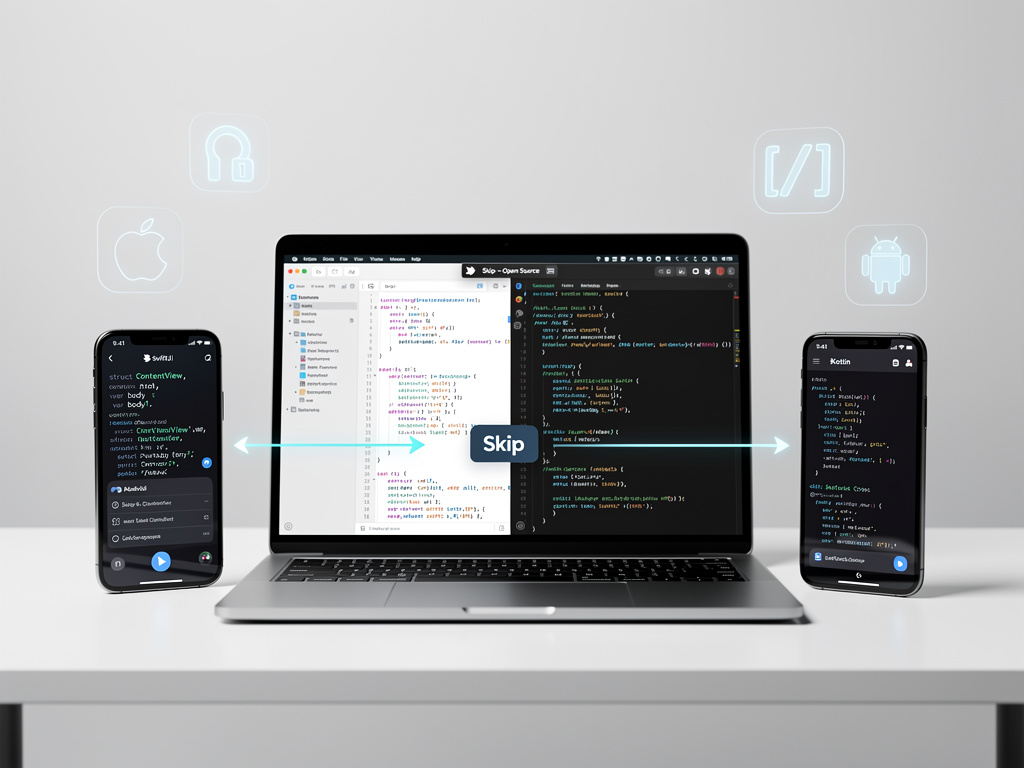
In a pivotal shift for mobile development, Skip, the innovative tool that transpiles Swift and SwiftUI code into native Android apps using Kotlin and Jetpack Compose, has gone fully open source. Announced on January 21, 2026, via its official blog, the move eliminates all subscription fees and licensing requirements, opening the core engine “skipstone” to community contributions under a free license. This bootstrapped project, free from venture capital influence, now relies on GitHub Sponsors for sustainability.
Skip enables developers to write a single codebase in Xcode for iOS, with its plugin automatically generating equivalent native Android projects. No runtimes or bloat: iOS apps remain pristine SwiftUI, while Android leverages Jetpack Compose for authentic Material Design experiences. The GitHub repository at skiptools/skip has garnered 2.5k stars and active commits, including the 1.7.0 release adding the LICENSE.txt file.
“Incredible news: Skip is now free and open-source for everyone!” posted the official Skip account on X, linking to the announcement that drew over 1,000 likes. Developers praised the decision, with Joannis Orlandos noting, “Skip for Swift on Android is now opensource! Go and try it out today!”
From Paid Tool to Community Asset
Launched in 2023 as a paid service—$99/month for professional tiers—Skip evolved through versions like 1.0 in August 2024, which introduced free indie licenses. The Swift Forums thread on that release hailed it as an “amazing achievement,” though some questioned pricing. By Skip 1.7, all barriers vanished: no license keys, no trials. Existing subscribers transitioned to sponsor tiers, as detailed in the Skip blog post.
The core “skipstone” engine, now on GitHub, manages everything from project creation and Xcode integration to transpilation via SwiftSyntax, resource bundling, JNI bridges, and APK exports. This powers seamless support for SwiftPM, Gradle, SwiftUI animations, transitions, and even unit tests via SkipUnit over JUnit.
ItsFoss reported, “Skip converts Swift code to run natively on both iOS and Android,” highlighting the shift from subscription to open source, crediting the project’s commitment to modern toolchains.
Technical Engine Under the Hood
Skip’s transpiler uses Apple’s open-source SwiftSyntax to parse Swift into Kotlin, preserving value semantics—Swift structs map to custom immutable Kotlin classes, avoiding reference-type pitfalls. Platform bridges handle divergences: #if SKIP blocks allow Android-specific code, like permissions in AndroidManifest.xml alongside iOS Info.plist. The Swift Android SDK, from the workgroup Skip co-founded, compiles Swift natively for Android.
WebProNews explained, “Skip operates as a transpiler, converting Swift code into Kotlin and mapping SwiftUI components to Jetpack Compose.” Examples include porting TMDB apps, with iOS navigation adapting to Compose stacks automatically. Binary sizes remain lean: iOS ships with zero Skip dependencies via SkipZero, Android uses open-source libs only.
Documentation at skip.dev/docs covers integration with thousands of cross-platform Swift packages via Swift Package Index, plus fallbacks for unsupported APIs using conditional compilation.
Developer Workflow Revolutionized
Installation is straightforward: brew install skiptools/skip/skip, then skip create opens a dual-platform project in Xcode. The plugin builds Android continuously, with ejection to standalone Gradle projects possible. Testing spans platforms, running XCTest on iOS and JUnit on Android. Community frameworks like skip-firebase extend functionality.
On Reddit’s r/swift, users lauded Skip 1.0 for halving dual-platform efforts, though noting custom code needs for edge cases. Hacker News threads called it a “game-changer for solo creators,” contrasting it with Flutter or React Native by emphasizing true nativity—no engines, full accessibility compliance.
The Swift Language X account endorsed earlier indie support: “Indie developers now have more tools… thanks to @skiptools.” Recent X buzz post-open source shows Japanese and Italian coverage, signaling global traction.
Strategic Pivot and Funding Future
Skip’s team, led by contributors like Marc Prud’hommeaux, bootstrapped without big tech backing, founding the Swift Android Workgroup for SDK release. “Opening Skip to the community marks the next step in its evolution,” the blog states. “Software is never finished—especially a tool that supports modern Swift and Kotlin… sustaining this work depends on the support of developers.”
Corporate sponsorships offer homepage visibility, funding infrastructure and frameworks. Even if the core team steps back, “the community could continue supporting the technology.” This model mirrors successful open-source sustainability, avoiding “rug pulls” plaguing paid tools.
WebProNews noted endorsements from Swift figures expanding the language beyond iOS, with indie devs on X reporting halved development times and seamless UIs.
Challenges and Competitive Edge
While 95% of code ports cleanly, the remaining requires handling platform quirks—e.g., UserNotifications scheduling limited on Android initially. First builds compile Skip libs, inflating times slightly due to source distribution. Yet, ejection yields production-ready apps.
Swift Forums discussions addressed value types, permissions, and in-app purchases via platform conditionals. Critics on Reddit worried about long-term maintenance versus native Kotlin, but proponents highlight shared logic slashing bugs.
Skip positions against incumbents: native vs. Flutter’s Skia rendering, Swift-centric for Apple’s ecosystem. As Material Expressive and iOS Liquid Glass advance, Skip commits to parity.
Broader Ecosystem Ripples
Over 94 open GitHub issues signal engagement, with forums at community.skip.dev and Slack for support. Sample apps like Hello Skip demonstrate basics. DEV Community tutorials guide migrations, noting challenges in legacy codebases but ease for greenfield projects.
X reactions exploded: Skip’s post hit 88k views, 1k likes. “Swift’s Android Awakening,” headlined NewsBreak, echoing WebProNews on ripples through communities. Linuxiac (before access issues) confirmed AGPL-3.0 for skipstone.
Founded by engineers frustrated with compromises, Skip bets on community for acceleration—AI UI generation, AR/VR, enterprise tools on horizon. Marc Prud’hommeaux’s commits ensure momentum.
Path Forward for Universal Apps
This open-sourcing accelerates Swift’s multi-platform march, empowering iOS devs to claim Android without Kotlin ramps. With Xcode as the hub, Android Studio for tweaks, Skip fades into the background, delivering uncompromised apps. As sponsorships grow, expect rapid evolution matching SwiftUI and Compose advances.
The GitHub repo’s 1,407 commits and CI workflows underscore durability. Developers, from indies to firms, gain a no-compromise foundation. “Together, we will continue building toward Skip’s vision,” the team vows, inviting contributions to redefine mobile development.


 WebProNews is an iEntry Publication