
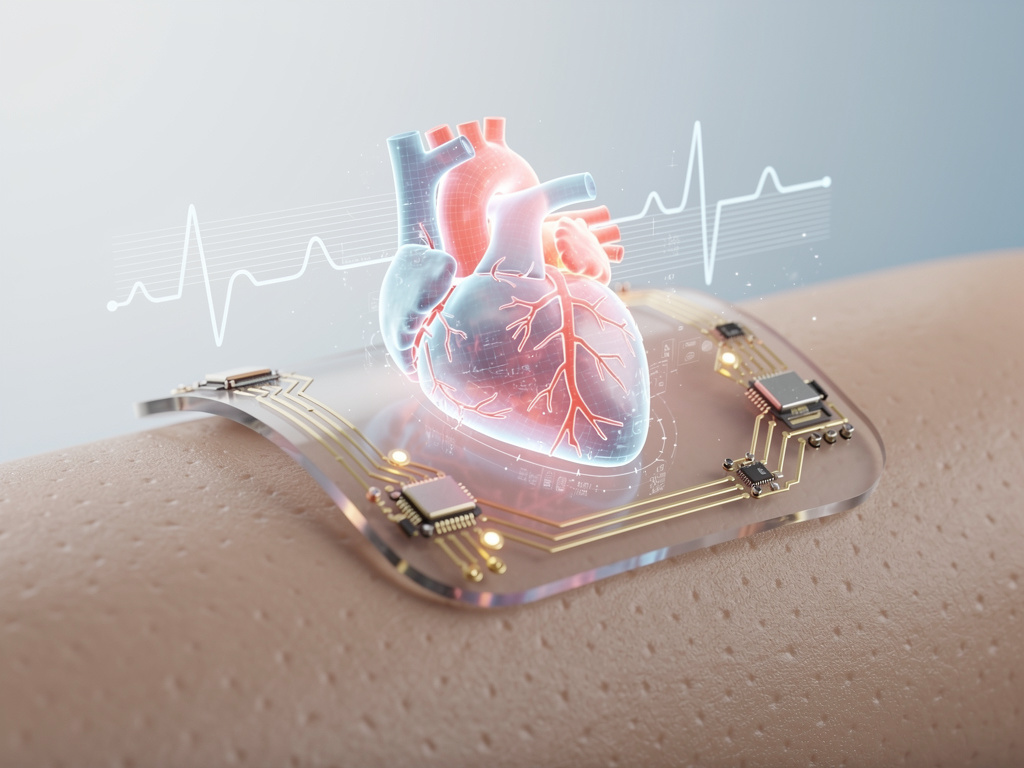
Engineers at the University of Chicago have created a stretchable computing patch that performs artificial intelligence calculations on human skin. The device analyzes health signals in milliseconds. No cloud connection required.
Current wearables collect data then ship it elsewhere for processing. This patch does the work where it sits. The advance, detailed in University of Chicago News, points toward wearables that act less like monitors and more like on-body diagnosticians.
The patch relies on organic electrochemical transistors printed at high density onto flexible material. Researchers achieved 10,000 transistors per square centimeter. That density allows complex neural networks to run locally despite the soft, stretchable form factor.
But how does it hold up when skin moves? The team designed manufacturing processes that keep circuits intact during bending and stretching. Collaboration with Argonne National Laboratory helped refine the fabrication. The result stands up to real-world motion while delivering fast computation.
Tests showed striking performance. Using real cardiac mapping data, the array located wavefront positions with 99.6 percent accuracy. Consider that number. It suggests the system can pinpoint irregular heart activity almost as well as stationary hospital equipment.
In another demonstration the encoded neural network combined vital signs and personal data. Cholesterol levels. Blood sugar. Maximum heart rate. ECG readings. From those inputs it assessed heart attack risk at 83.5 percent accuracy. The patch delivered these insights without sending information to a remote server.
Privacy improves. Latency drops. Power use stays low enough for continuous wear. These gains matter in scenarios where seconds count. A patient experiencing dangerous heart rhythms could receive immediate analysis and alerts. No waiting for a smartphone to upload readings.
The TechRadar article frames the concept as a personal instantaneous doctor integrated into devices. That vision aligns with the University of Chicago work. Yet the researchers avoid overstatement. They present measured results from specific tasks rather than sweeping promises.
Earlier electronic skin research laid groundwork. Papers from 2023 and 2024 explored AI integration with flexible sensors. A 2024 review in ACS Chemical Reviews outlined how e-skin could support health monitoring and robotics. The new patch builds on those ideas by moving full neural network inference onto the body itself.
Market forecasts reflect growing interest. Analysts at Precedence Research project the electronic skin patches sector to expand from $6.96 billion in 2025 toward $17.10 billion by 2034. AI capabilities drive much of that optimism. A July 2025 report from Future Markets Inc. highlights edge AI processing as a key factor in predictive healthcare platforms.
Still, challenges remain. The current prototype handles targeted tasks well. Scaling to broader diagnostic ranges will demand more sophisticated models and better sensor fusion. Power sources must evolve for days-long operation. Biocompatibility over extended periods needs further validation.
And the regulatory path looks complicated. Devices that analyze data and suggest medical actions cross from wellness into diagnostic territory. Agencies will scrutinize accuracy claims, especially at 83.5 percent for heart attack risk. False positives or negatives carry consequences.
Lead researchers, including those behind the Nature Electronics paper published in 2026, emphasize the foundational nature of the work. The citation reads: “A large-scale stretchable neuromorphic circuit for on-body edge computing,” Li et al, Nature Electronics, 2026. That title captures the core contribution. Neuromorphic design mimics brain-like efficiency on stretchable hardware.
Recent coverage echoes the excitement. An Earth.com story from May 2026 notes the patch pushes wearable health tech beyond step counting. It processes medical data directly on the body in milliseconds. Similar reports in HT World and The Brighter Side of News from late May repeat the core metrics while stressing the shift from clunky watches to nearly invisible electronic skin.
One short sentence says it clearly. This changes the equation. Longer reflection reveals why. Traditional systems create data bottlenecks and privacy vulnerabilities. On-body computation removes those frictions. Doctors gain richer, real-time insights. Patients experience less intrusion.
Integration with existing health records could follow. Imagine a patch that not only detects anomalies but feeds verified summaries into electronic medical files. Clinicians receive prioritized alerts rather than raw streams. The 99.6 percent cardiac mapping accuracy hints at such precision.
Of course implementation will take time. Manufacturing at scale. Clinical trials. Reimbursement models. Those steps separate laboratory success from pocket-sized products. Yet the technical barrier has lowered noticeably.
Parallel research in multimodal sensing and self-healing materials may accelerate progress. A 2026 review in the Journal of Biological Engineering discusses smart patches that analyze biofluids and immune responses. Another paper in The Innovation from 2026 explores wearable AI for proactive care and privacy-preserving edge computing.
The University of Chicago patch stands out for its immediate focus on life-critical signals. Heart attack risk assessment. Arrhythmia detection. These applications carry urgency that general fitness trackers lack.
So what comes next? Teams will likely test the technology in larger human cohorts. They will refine algorithms for additional conditions. Diabetes management. Seizure prediction. Respiratory distress. Each new capability expands the patch’s role from observer to active guardian.
Industry insiders watch the transistor density and accuracy numbers closely. Ten thousand per square centimeter on flexible substrate sets a benchmark. Future designs may push higher. They may incorporate multimodal sensors in the same thin layer. The combination could yield even richer inferences.
Privacy advocates note another benefit. Data never leaves the body. No transmission means fewer interception risks. In an era of heightened health data sensitivity, that feature alone justifies attention.
The work also feeds into larger conversations about human-machine interfaces. Prosthetics. Augmented reality. Robotic surgery assistants. A stretchable AI layer that conforms to skin could enhance all of them.
But the medical angle feels most immediate. Patients with chronic conditions. Elderly individuals living alone. First responders in remote areas. Each group stands to gain from analysis that happens instantly, locally, accurately.
Researchers caution that the 83.5 percent figure represents one demonstration. Real-world performance will vary with patient diversity and data quality. Rigorous validation must follow.
Even so, the direction looks promising. A patch thinner than a bandage that thinks. That computes. That warns. The gap between consumer wearable and clinical tool narrows.
Publication of the full Nature Electronics study will invite deeper scrutiny from materials scientists and cardiologists alike. Their feedback will shape the second generation of devices. Expectations run high but stay grounded in the published numbers.
For now the breakthrough offers a concrete step. On-body edge computing has moved from concept to functioning prototype. The skin itself becomes part of the computer. And that computer pays attention to the body it covers.


 WebProNews is an iEntry Publication