
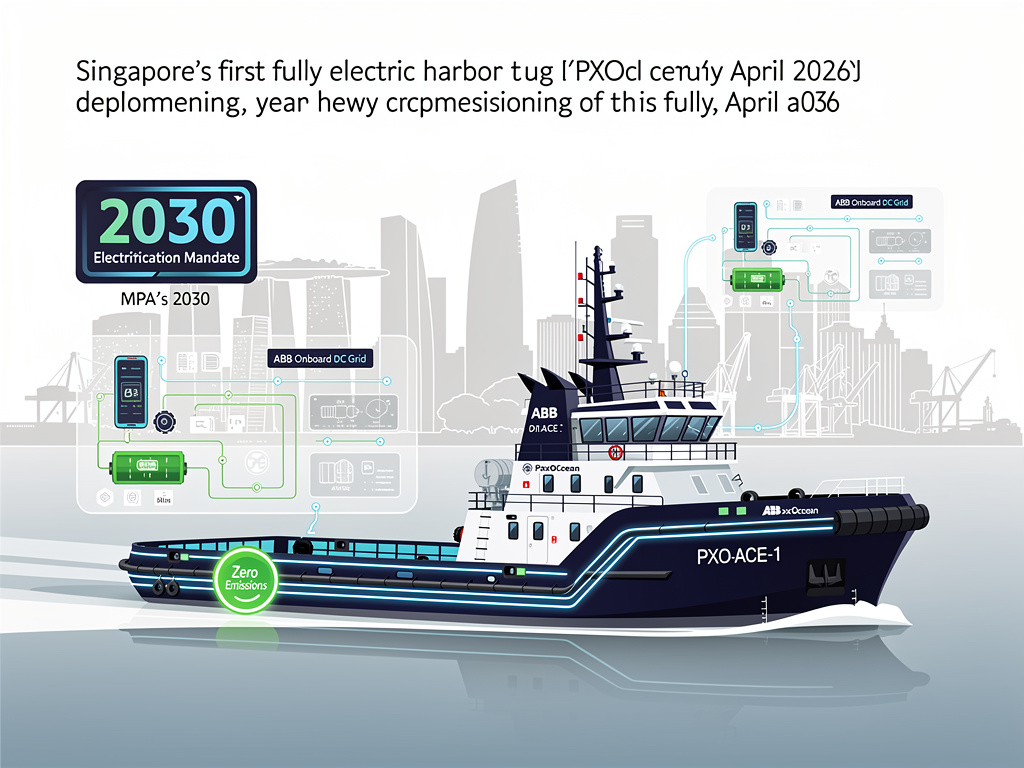
SINGAPORE—In a pivotal move for Asia’s busiest port, PaxOcean Group and ABB announced that their jointly developed PXO-ACE-1, Singapore’s inaugural fully electric tugboat, has completed commissioning, clearing the path for deployment in April 2026. This 50-ton bollard pull vessel, equipped with ABB’s cutting-edge Onboard DC Grid and a three-megawatt-hour battery pack, stands as the vanguard in the city-state’s aggressive push to electrify its fleet of over 1,600 harbor craft by 2030.
The Maritime and Port Authority of Singapore (MPA) mandates that all newbuild harbor craft must be fully electric, compatible with B100 biofuels, or ready for net-zero fuels by the end of the decade. PXO-ACE-1, built by PaxOcean—a subsidiary of Kuok Maritime Group—delivers emissions-free operations, slashing noise and vibrations that plague diesel tugs, thereby enhancing crew safety and local air quality. ABB News Center detailed how the tug’s propulsion system optimizes power from its batteries to handle sudden high-torque demands during towing.
“Developing Singapore’s first fully electric tug is a significant achievement and an important step in advancing maritime decarbonization,” said Tan Thai Yong, Managing Director and Chief Executive Officer of PaxOcean Group. ABB’s role as systems integrator fused power, propulsion, and bridge systems into a seamless whole, ensuring operational reliability.
Technical Backbone: Onboard DC Grid Revolution
At the heart of PXO-ACE-1 lies ABB’s Onboard DC Grid with PEMS power and energy management system. This setup minimizes energy conversions between batteries, propulsion, and auxiliary loads, boosting drivetrain efficiency and extending range per charge. Unlike traditional AC systems, the DC architecture supports modular battery scaling, ideal for tugs cycling between high-intensity pulls and idle periods. India Shipping News highlighted the system’s ability to manage wide power fluctuations, a boon for harbor operations.
The three-MWh battery pack provides ample endurance for daily routines in Singapore’s congested waters, where tugs operate near shore-based charging stations. ABB’s integrated propulsion—encompassing Azipull thrusters and permanent magnet motors—delivers instant torque without the lag of diesel engines, improving maneuverability in tight port maneuvers. Reduced mechanical complexity also cuts maintenance costs, a key metric for fleet operators eyeing total ownership economics.
“We are proud to be part of this groundbreaking project for Singapore, supporting the world’s maritime capital in its journey towards fully electric harbor operations,” noted Olli Tuunainen, Local Business Line Manager for ABB’s Marine & Ports division in Singapore. He emphasized tugs’ suitability for electrification due to predictable routes and proximity to infrastructure.
Regulatory Imperative Drives Fleet Overhaul
MPA’s 2030 mandate stems from Singapore’s Green Port Programme, targeting net-zero emissions by 2050. Currently, harbor craft account for about 5% of the port’s carbon footprint, but their dense operations amplify local pollution impacts. PXO-ACE-1’s success could accelerate retrofits and newbuilds, with analysts projecting a $2 billion market for electric harbor vessels in Asia by 2035. Container News reported the commissioning as a blueprint for regional adoption.
Beyond emissions, electrification yields operational edges: electric tugs boast 20-30% lower fuel costs over their lifecycle, per industry benchmarks, and quieter decks reduce crew fatigue, potentially lowering insurance premiums. Singapore’s investment in megawatt-scale shore power and hydrogen pilots complements this shift, positioning the port as a global testbed.
PaxOcean’s rapid build—commissioned ahead of schedule—underscores Singapore’s shipbuilding prowess, with the yard leveraging digital twins for system integration. ABB’s 140-year legacy in electrification, now with 110,000 employees worldwide, bolsters confidence in scalability.
Market Ripples and Competitive Edge
The PXO- ACE-1 milestone reverberates across Asia, where ports in Shanghai, Hong Kong, and Rotterdam eye similar transitions. In Europe, Norled’s electric ferries have proven battery longevity in harsh conditions, informing ABB’s designs. Singapore’s model, however, prioritizes high bollard pull for VLCCs and container giants, demanding robust torque delivery. Ocean News & Technology noted the vessel’s role in decarbonizing the 1,600-vessel fleet.
Challenges persist: battery supply chains face cobalt shortages, and ultrafast charging infrastructure lags in some hubs. Yet, PXO-ACE-1’s deployment will yield real-world data on cycle life and total cost of ownership, critical for skeptics. Kuok Maritime’s backing ensures commercial viability, with contracts already in negotiation for sister vessels.
Industry insiders view this as more than a tug; it’s a harbinger of electric fleets reshaping port economics. As Tan Thai Yong affirmed, ABB’s integration expertise was pivotal, setting a high bar for future projects.
Global Precedents Fuel Asian Momentum
Norway leads with over 100 electric ferries, but tugs trail due to power needs. Denmark’s Svitzer ordered hybrid tugs in 2024, while China’s COSCO trials batteries in Shanghai. Singapore’s pure-electric bet, powered by ABB’s proven tech from offshore wind vessels, leapfrogs hybrids. MarineLink covered the commissioning as a fleet renewal catalyst.
Financially, electric tugs amortize via fuel savings and carbon credits under IMO’s CII framework. MPA subsidies sweeten the deal, covering up to 30% of capex for green vessels. PaxOcean’s orderbook swells, signaling investor appetite.
Posts on X from ABB and maritime accounts buzz with optimism, citing PXO-ACE-1 as Asia’s electrification pacesetter amid COP30 pressures.
Future-Proofing Singapore’s Port Dominance
With 40 million TEUs annually, Singapore can’t afford downtime. PXO-ACE-1’s redundant battery architecture and ABB’s digital diagnostics minimize risks. Crew training on electric systems, already underway, emphasizes safety amid high-voltage ops.
Looking ahead, hybrid hydrogen stacks could extend range for inter-port tows. ABB’s roadmap includes AI-optimized energy use, potentially adding 15% efficiency. As Olli Tuunainen stated, tugs’ profiles make them prime electrification targets, with PXO-ACE-1 proving the thesis.
This commissioning isn’t just a milestone—it’s Singapore’s declaration of port supremacy in the electric era, challenging rivals to catch up.


 WebProNews is an iEntry Publication