
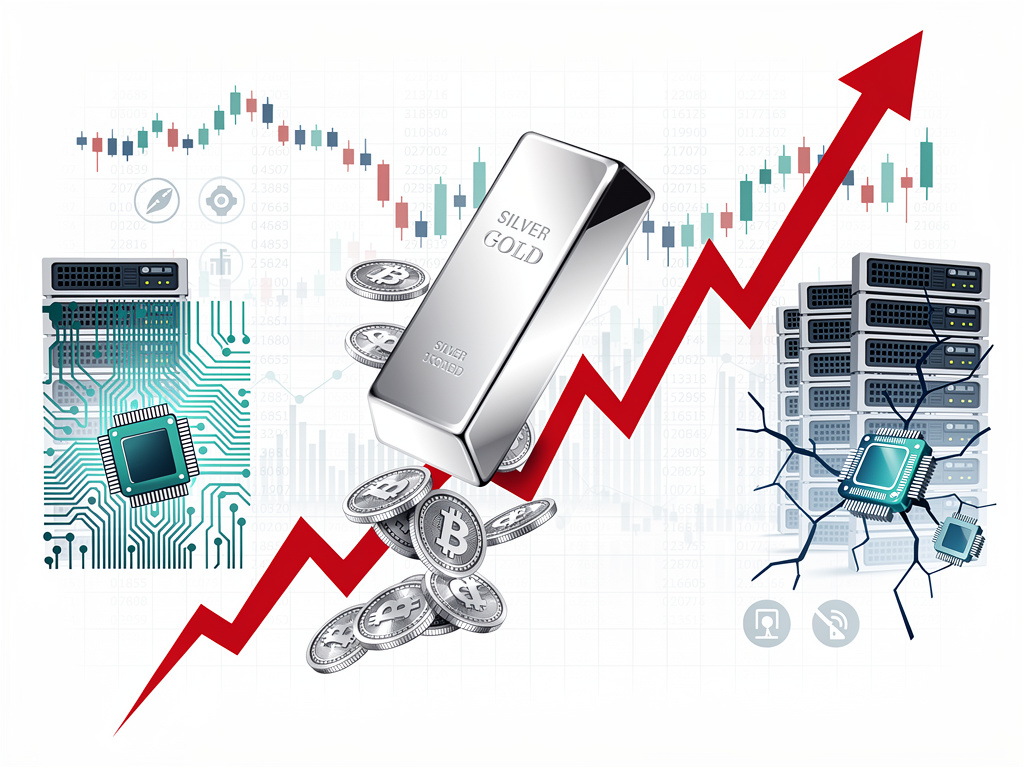
The precious metals market experienced a seismic shock in early 2025 as silver prices plummeted in lockstep with a broader technology sector selloff, exposing the intricate connections between traditional safe-haven assets and modern equity markets. The white metal’s dramatic descent has left traders scrambling to reassess long-held assumptions about portfolio diversification and the role of commodities during periods of market stress.
Silver futures tumbled nearly 8% in a single trading session, marking one of the steepest single-day declines in recent memory and catching even seasoned commodities traders off guard. According to Business Insider, the selloff coincided with a massive rotation out of technology stocks, particularly software companies that had been market darlings throughout the previous bull run. This simultaneous collapse challenged the conventional wisdom that precious metals serve as reliable hedges during equity market turbulence.
The correlation between silver’s decline and the tech sector’s troubles stems from several interconnected factors that have fundamentally altered how commodities respond to market dynamics. Industrial demand for silver in electronics manufacturing, solar panels, and semiconductor production has created an unprecedented linkage between the metal’s price trajectory and the fortunes of technology companies. When tech stocks began their precipitous fall, concerns about reduced industrial consumption sent silver prices spiraling downward alongside equity valuations.
Industrial Demand Meets Financial Engineering
The modern silver market bears little resemblance to its historical role as purely a monetary metal or jewelry component. Today’s silver consumption is dominated by industrial applications, with technology manufacturers accounting for more than half of annual demand. Solar panel production alone consumes approximately 20% of global silver supply, while electronics and semiconductor fabrication require increasingly sophisticated silver-based components for conductivity and thermal management.
This industrial concentration has transformed silver from a traditional safe-haven asset into something more akin to an industrial commodity with exposure to cyclical economic forces. When major technology companies announced spending cuts and scaled back capital expenditure plans amid the recent market turmoil, analysts immediately revised their silver demand forecasts downward. The ripple effects were swift and brutal, as futures traders unwound positions and exchange-traded funds experienced significant outflows.
The Rotation Trade Unravels
Market participants had been positioning for a rotation out of overvalued technology stocks into alternative assets, including precious metals, for months leading up to the crash. However, the actual rotation played out far differently than anticipated. Rather than flowing into gold and silver, capital fled toward cash equivalents and short-term government securities as risk appetite evaporated across all asset classes. The violent repricing of technology stocks created margin calls and forced liquidations that extended far beyond the equity markets.
Hedge funds and institutional investors who had built leveraged positions across multiple asset classes found themselves compelled to sell their most liquid holdings to meet margin requirements. Silver, with its deep futures markets and high trading volumes, became a prime candidate for forced selling. This dynamic created a self-reinforcing cycle where declining prices triggered additional margin calls, leading to further liquidations and accelerating the downward spiral.
Central Bank Policies and Currency Dynamics
The Federal Reserve’s monetary policy stance has played a crucial role in silver’s recent volatility. After maintaining elevated interest rates to combat inflation, the central bank’s communications regarding future policy direction have whipsawed markets. Higher interest rates traditionally pressure precious metals by increasing the opportunity cost of holding non-yielding assets. When the tech selloff intensified fears of an economic slowdown, traders initially expected the Fed to pivot toward rate cuts, which should have supported silver prices.
However, persistent inflationary pressures in certain sectors, combined with a resilient labor market, complicated the Fed’s calculus. The resulting policy uncertainty created a hostile environment for precious metals, as traders struggled to position for an unclear monetary trajectory. Currency markets added another layer of complexity, with the dollar strengthening against major currencies as investors sought safety, further pressuring dollar-denominated commodity prices including silver.
Technical Breakdown and Algorithmic Amplification
The technical picture for silver deteriorated rapidly as prices breached key support levels that had held for months. Algorithmic trading systems, which account for a substantial portion of commodity futures trading volume, identified these technical breakdowns and initiated programmed selling strategies. The cascade of automated sell orders amplified the decline, overwhelming buy-side interest and creating air pockets where prices fell with minimal resistance.
Market microstructure played a significant role in the severity of the selloff. As high-frequency trading firms withdrew liquidity during the most volatile periods, bid-ask spreads widened dramatically. This liquidity vacuum meant that even modest sell orders moved prices substantially, creating the appearance of panic selling when the reality was simply an absence of willing buyers at prevailing price levels. The situation was exacerbated by options market dynamics, where gamma hedging by dealers contributed to increased volatility in the underlying futures contracts.
Mining Sector Implications and Production Economics
Silver mining companies watched their equity valuations crater alongside the metal’s price decline, with some junior miners losing more than 30% of their market capitalization in a matter of days. The selloff has forced mining executives to reassess project economics and capital allocation priorities. Projects that were marginally profitable at higher silver prices suddenly face scrutiny, and exploration budgets are being slashed across the sector.
The production cost curve for silver remains relatively flat across a wide range of output, meaning that even significant price declines are unlikely to trigger major supply disruptions in the near term. Most silver is produced as a byproduct of base metal mining operations, where the economics are driven primarily by copper, lead, and zinc prices rather than silver alone. This supply inelasticity means that price adjustments must occur primarily through demand destruction rather than production cuts, potentially prolonging the adjustment period.
Investor Positioning and Sentiment Indicators
Sentiment indicators for precious metals have reached levels not seen since the depths of previous bear markets. The gold-to-silver ratio, which measures the relative value between the two metals, spiked to multi-year highs as silver underperformed its monetary cousin. Historically, extreme readings in this ratio have marked turning points, though the timing of reversals remains notoriously difficult to predict. Contrarian investors view the current pessimism as a potential buying opportunity, while momentum traders continue to favor the short side.
Exchange-traded fund flows provide insight into retail and institutional positioning. Silver ETFs experienced their largest weekly outflows on record during the peak of the selloff, with investors liquidating positions across both physical-backed and futures-based products. Options markets reflected the bearish sentiment, with put-call ratios skewing heavily toward protective puts and outright bearish bets. The futures market showed a similar picture, with speculative short positions reaching levels that historically have preceded sharp short-covering rallies.
Geopolitical Factors and Supply Chain Considerations
While financial market dynamics dominated the recent price action, underlying geopolitical factors continue to influence the silver market’s structural outlook. Trade tensions between major economies have disrupted established supply chains for technology products, creating uncertainty about future industrial demand patterns. Mining operations in key producing countries face ongoing challenges from regulatory changes, environmental restrictions, and community opposition that could constrain future supply growth.
The energy transition toward renewable power generation remains a long-term supportive factor for silver demand, despite the recent price volatility. Solar panel installations continue to grow globally, driven by policy mandates and improving cost competitiveness with fossil fuel alternatives. However, the pace of this transition has become increasingly uncertain as governments reassess subsidy programs and utilities grapple with grid integration challenges. These longer-term demand drivers provide a floor under prices, even as short-term financial factors dominate trading activity.
Looking Forward: Market Structure and Price Discovery
The recent turmoil has exposed fragilities in precious metals market structure that regulators and market participants will need to address. The concentration of trading activity in futures markets, combined with the growing influence of algorithmic trading strategies, has created conditions where liquidity can evaporate rapidly during stress periods. Some market observers have called for reforms to position limits and margin requirements to reduce the potential for destabilizing price swings.
Price discovery mechanisms in silver markets face challenges from the proliferation of derivative products and the growing disconnect between paper trading volumes and physical market flows. Daily futures trading volumes often exceed annual mine production by orders of magnitude, raising questions about whether prices accurately reflect underlying supply and demand fundamentals. The relationship between futures prices and physical premiums has become increasingly unstable, with regional markets experiencing significant dislocations from benchmark prices during periods of stress. As markets digest the recent volatility and participants reassess their positioning, the path forward for silver prices remains highly uncertain, dependent on the resolution of both cyclical factors affecting technology demand and longer-term structural shifts in how commodities are traded and valued in modern financial markets.


 WebProNews is an iEntry Publication