
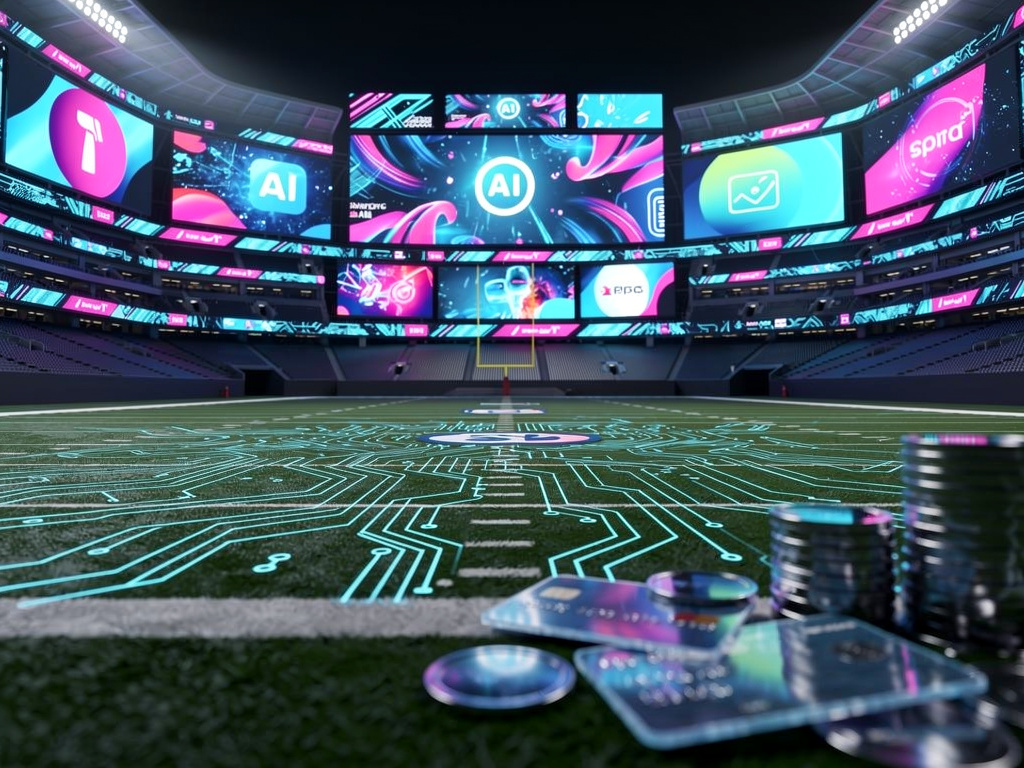
The Super Bowl has long been the ultimate proving ground for America’s biggest brands — a place where automakers, beer companies, and snack conglomerates have historically battled for consumer attention during the most-watched television event of the year. But in 2026, a new class of advertiser is muscling its way onto the field, and it is armed with something far more disruptive than a clever jingle or a celebrity cameo: artificial intelligence.
AI companies are pouring unprecedented sums into Super Bowl advertising this year, marking a dramatic escalation in the race to win mainstream consumer recognition in one of the most competitive and fast-evolving sectors in technology. According to CNBC, multiple artificial intelligence firms have committed tens of millions of dollars to secure coveted ad slots during the big game, signaling that the industry has moved well beyond the confines of Silicon Valley pitch decks and developer conferences and into the living rooms of everyday Americans.
From Developer Tools to Living Room Screens: AI’s Consumer Awakening
The shift is as much about perception as it is about product. For years, AI companies operated largely in the background, powering enterprise software, automating back-office workflows, and selling their services to other technology firms. The explosion of generative AI — kicked off by the public release of OpenAI’s ChatGPT in late 2022 — changed everything. Suddenly, artificial intelligence was not just a business-to-business proposition; it was a consumer product, one that hundreds of millions of people around the world were using daily. That transformation has created an imperative for AI companies to build brand awareness at a scale that only the Super Bowl can deliver.
The numbers involved are staggering. A 30-second ad spot during the Super Bowl now commands upwards of $7 million to $8 million, a figure that has climbed steadily over the past decade and shows no signs of plateauing. For AI companies — many of which are still burning through venture capital and have yet to turn a profit — the decision to spend that kind of money on a single television appearance represents a calculated bet that brand recognition will translate into user growth, enterprise contracts, and ultimately, market dominance. As CNBC reported, the AI sector’s collective Super Bowl spend this year is expected to rival or even exceed that of traditional advertising heavyweights like the automotive and beverage industries.
A Crowded Field of Contenders Vying for the Spotlight
The roster of AI companies buying into the Super Bowl is both broad and telling. OpenAI, the Microsoft-backed creator of ChatGPT, is widely expected to be among the most prominent advertisers, seeking to cement its position as the household name in generative AI. But it is far from alone. Competitors across the AI spectrum — from enterprise-focused platforms to consumer chatbot makers and AI-powered search engines — are all angling for their moment in front of an audience that regularly exceeds 120 million viewers in the United States alone.
This is not entirely without precedent. The tech industry has a storied history with the Super Bowl, dating back to Apple’s legendary “1984” commercial that introduced the Macintosh computer. In more recent years, companies like Google, Amazon, and Microsoft have used the game to showcase their AI-adjacent products, from smart speakers to cloud computing services. But 2026 marks the first year in which pure-play AI companies — firms whose entire value proposition is built around artificial intelligence — are showing up in force as major advertisers. It is a milestone moment that underscores how rapidly the industry has matured and how fiercely companies are competing for consumer mindshare.
The Strategic Calculus Behind Spending Millions on 30 Seconds
The strategic logic behind these massive advertising investments is multifaceted. At the most basic level, AI companies are locked in a brutal competition for users. The generative AI market has exploded with options — ChatGPT, Google’s Gemini, Anthropic’s Claude, Meta’s Llama-based products, and a growing array of specialized tools — and consumer loyalty remains fluid. Unlike established product categories where brand preferences are deeply ingrained, the AI space is still in its formative stages. A single, well-executed Super Bowl ad can shift perception and drive millions of downloads or sign-ups in a matter of hours.
Beyond raw user acquisition, there is a deeper play at work. AI companies are acutely aware that public trust remains a significant barrier to widespread adoption. Surveys consistently show that while consumers are curious about AI, many harbor concerns about privacy, job displacement, and the reliability of AI-generated content. A Super Bowl ad — with its massive reach and cultural cachet — offers a unique opportunity to humanize the technology, frame it in aspirational terms, and address skepticism head-on. The best Super Bowl ads do not just sell products; they tell stories. And for an industry that is often perceived as opaque and intimidating, storytelling may be the most valuable currency of all.
Venture Capital’s Fingerprints on the Ad Budget
The willingness of AI companies to spend so lavishly on advertising also reflects the extraordinary flow of capital into the sector. AI startups raised more than $100 billion globally in 2025, according to multiple industry estimates, and that capital is increasingly being deployed not just on research and development but on go-to-market strategies designed to capture market share before the window of opportunity narrows. For venture-backed companies, a Super Bowl ad is not just a marketing expense — it is a signal to investors, partners, and the broader market that the company is playing at the highest level.
There is a risk, of course, that the spending is premature. The history of Super Bowl advertising is littered with cautionary tales of companies that spent big on game-day spots only to flame out shortly thereafter. The dot-com era of the late 1990s and early 2000s produced a memorable wave of Super Bowl ads from companies like Pets.com and Webvan — firms that are now remembered more for their spectacular failures than for their products. Critics have drawn parallels between that era and the current AI advertising boom, warning that not all of the companies buying Super Bowl airtime will survive the inevitable shakeout that comes when hype gives way to sustainable business models.
Lessons from the Dot-Com Super Bowl and Why This Time May Be Different
But proponents of the AI ad blitz argue that the comparison is imperfect. Unlike many dot-com companies, which were selling unproven concepts to skeptical consumers, today’s leading AI firms already have products with hundreds of millions of active users. ChatGPT alone surpassed 200 million weekly active users in 2025, and competitors are posting similarly impressive growth numbers. The products are real, the usage is real, and the revenue — while still evolving — is substantial and growing. The Super Bowl ads, in this view, are not about creating demand from scratch but about capturing and directing demand that already exists.
The creative strategies being deployed by AI advertisers are also worth examining. According to industry insiders and advertising executives, many of the AI-focused Super Bowl ads this year are deliberately avoiding the kind of technical jargon and futuristic imagery that has characterized much of the industry’s marketing to date. Instead, the ads are expected to focus on relatable, everyday use cases — helping a parent plan a family vacation, assisting a small business owner with bookkeeping, or enabling a student to study more effectively. The goal is to demystify AI and position it not as a threatening force but as a helpful, accessible tool that fits seamlessly into people’s daily lives.
Madison Avenue Adapts to a New Kind of Client
The influx of AI money is also reshaping the economics of Super Bowl advertising more broadly. Traditional advertisers are being forced to compete with deep-pocketed tech firms for a finite number of premium ad slots, driving up prices and intensifying the bidding wars that precede each game. Some longtime Super Bowl advertisers have reportedly scaled back their presence this year, either priced out by the surging demand or choosing to redirect their budgets to digital channels where targeting is more precise and costs are more manageable.
For the television networks that broadcast the Super Bowl, the AI advertising boom is an unalloyed windfall. Ad revenue from the game is expected to set new records in 2026, with AI companies accounting for a significant share of the total haul. The networks have been aggressively courting AI firms, offering package deals that bundle game-day spots with pre-game programming, digital extensions, and social media integrations. It is a relationship that benefits both sides: the networks get premium ad dollars, and the AI companies get the kind of mass-market exposure that no amount of targeted digital advertising can replicate.
What the AI Super Bowl Moment Means for the Industry’s Future
Perhaps the most significant implication of the AI industry’s Super Bowl moment is what it reveals about the competitive dynamics within the sector. The race to build the best AI model is increasingly inseparable from the race to build the best AI brand. Technical superiority alone is no longer sufficient to win the market; companies must also win hearts and minds. The Super Bowl, with its unparalleled combination of reach, cultural relevance, and emotional resonance, has become the arena where that battle is being fought.
As the final seconds tick down on game day and the confetti falls, the real scoreboard for AI companies will not be measured in touchdowns or field goals. It will be measured in app downloads, website traffic, brand recall surveys, and — ultimately — in the billions of dollars of enterprise and consumer revenue that flow to the companies that manage to make artificial intelligence feel less like science fiction and more like an indispensable part of everyday life. The Super Bowl has always been about more than football. In 2026, it is also about the future of technology itself.


 WebProNews is an iEntry Publication