
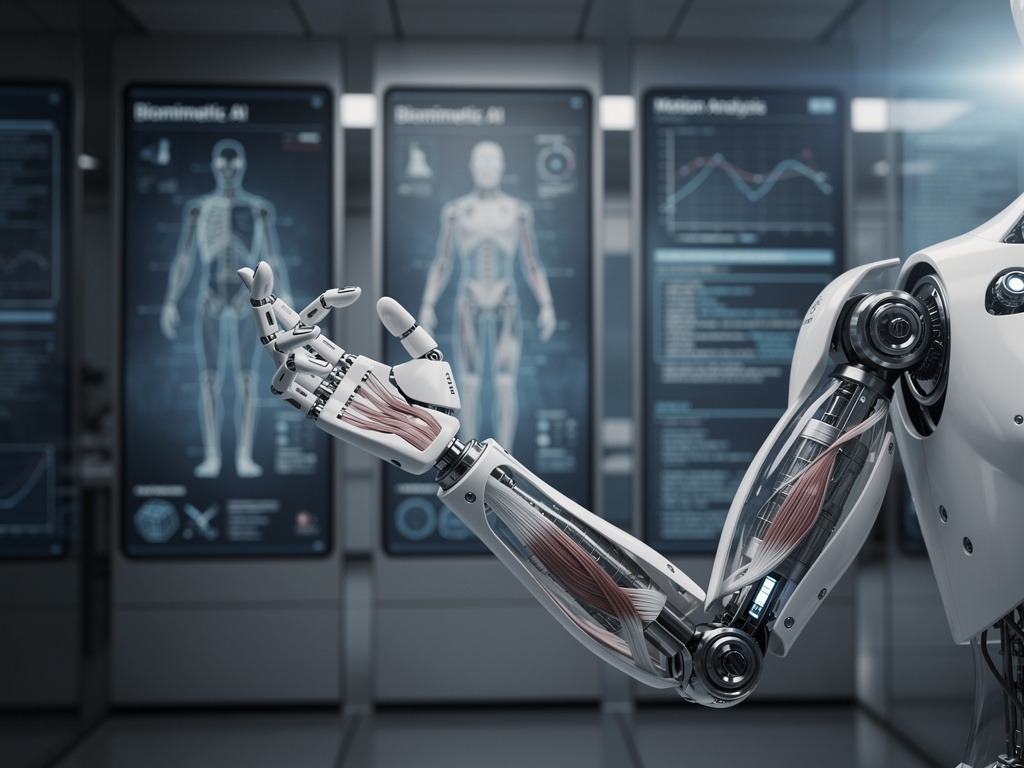
The robotics industry has crossed a threshold that many hoped would remain in science fiction for at least another decade. A Chinese robotics company has unveiled what it claims is the world’s first biomimetic AI robot—a humanoid machine that moves, gestures, and even breathes with such human-like precision that it has triggered widespread unease across social media platforms and technology forums. The robot, developed by Ex-Robots, represents a quantum leap in biomimetic engineering, but its eerily lifelike appearance has reignited debates about the uncanny valley phenomenon and whether humanity is truly ready for machines that blur the line between artificial and organic life.
According to TechRadar, the robot demonstrates capabilities that extend far beyond previous humanoid designs. Unlike earlier iterations of social robots that relied on rigid, mechanical movements, this biomimetic creation employs sophisticated actuators and artificial muscles that mimic human musculature. The result is a machine that can perform subtle facial expressions, natural head tilts, and breathing motions that are virtually indistinguishable from those of a living person. Industry observers note that Ex-Robots has achieved what Boston Dynamics and other robotics pioneers have long pursued: the seamless integration of movement, expression, and artificial intelligence in a single platform.
The technology underlying this breakthrough involves multiple layers of innovation. Ex-Robots has developed proprietary soft robotics materials that simulate human skin texture and elasticity, combined with advanced servo systems that enable micro-movements in facial features. The robot’s AI system processes visual and auditory inputs in real-time, allowing it to respond to human interaction with appropriate facial expressions and body language. This integration of hardware and software represents years of research in fields ranging from materials science to machine learning, creating a convergence point that many experts believed was still five to ten years away from commercial viability.
The Uncanny Valley Returns With Vengeance
The concept of the uncanny valley, first proposed by Japanese roboticist Masahiro Mori in 1970, suggests that humanoid objects that appear almost, but not exactly, like real human beings elicit feelings of eeriness and revulsion. For decades, this phenomenon has served as a natural barrier in robotics development—a warning sign that told engineers they had pushed too far too fast. Ex-Robots’ creation appears to have planted itself firmly in the deepest part of this valley, triggering visceral reactions from viewers who encounter videos of the robot online. Social media platforms have erupted with commentary ranging from fascination to outright horror, with many users expressing discomfort at the robot’s ability to maintain eye contact and mirror human emotional states.
The psychological impact of such realistic humanoid robots extends beyond mere aesthetic discomfort. Cognitive scientists have long studied why humans react negatively to near-human replicas, and current theories suggest that our brains are hardwired to detect subtle inconsistencies in human appearance and behavior as a survival mechanism. When a robot achieves 95% human likeness but fails in that final 5%, our neural systems register a threat response—something that appears human but fundamentally is not. This biomimetic robot from Ex-Robots seems to have achieved such a high degree of realism that it triggers these ancient defensive mechanisms in observers, creating a profound sense of unease that transcends rational analysis.
Commercial Applications and Market Positioning
Despite the discomfort it generates, Ex-Robots is positioning its biomimetic creation for multiple commercial applications. The company has identified healthcare, hospitality, and customer service as primary target markets, arguing that human-like robots can provide more effective interaction in scenarios requiring empathy and emotional intelligence. In healthcare settings, for instance, such robots could serve as companions for elderly patients or assist in mental health therapy sessions where human-like presence is beneficial but human staff is unavailable or cost-prohibitive. The hospitality industry has already shown interest in deploying humanoid robots as receptionists and concierges, particularly in high-end hotels and corporate environments where first impressions matter.
The economic implications of this technology are substantial. The global humanoid robot market is projected to reach $17.3 billion by 2027, according to various industry analysts, and biomimetic robots represent the premium segment of this market. Ex-Robots is competing directly with established players like SoftBank Robotics, Hanson Robotics, and emerging Chinese competitors who have made significant investments in humanoid development. However, the company’s focus on biomimetic realism—rather than functional utility alone—suggests a strategic bet that consumers and businesses will pay premium prices for robots that can navigate human social environments with minimal friction. This approach contrasts sharply with companies like Boston Dynamics, which have prioritized functional capabilities over human-like appearance.
Technical Challenges and Engineering Breakthroughs
The engineering required to create a truly biomimetic robot involves solving problems across multiple disciplines simultaneously. Ex-Robots has had to develop new materials that can withstand repeated flexing while maintaining realistic skin-like properties, create power systems compact enough to fit within a human-sized frame while providing sufficient energy for complex movements, and design AI systems capable of processing social cues in milliseconds. The company’s approach to artificial musculature represents a particular breakthrough, using pneumatic systems and shape-memory alloys to create movements that accelerate and decelerate in patterns matching human muscle contractions.
Thermal management presents another significant challenge in biomimetic robotics. Human skin maintains a relatively constant temperature and responds to environmental conditions through perspiration and blood flow regulation. Ex-Robots has incorporated heat dissipation systems that prevent the robot from feeling unnaturally cold or hot to the touch, adding another layer of realism to human-robot interactions. The company has also addressed the challenge of eye movement, developing ocular systems that can track objects, dilate in response to light conditions, and even simulate the micro-movements that human eyes make during conversation. These technical achievements, while impressive from an engineering standpoint, contribute directly to the unsettling realism that has made the robot simultaneously fascinating and disturbing to observers.
Ethical Considerations and Regulatory Questions
The emergence of biomimetic robots raises profound ethical questions that regulators and ethicists are only beginning to address. If a robot can convincingly simulate human emotional responses, what obligations do we have to disclose its artificial nature to those who interact with it? In healthcare settings, should patients be informed that their companion or therapist is a machine, even if that knowledge might reduce the therapeutic benefit? These questions become more urgent as the technology improves and the distinction between human and machine becomes harder to detect. Some ethicists argue that creating machines designed specifically to exploit human social instincts constitutes a form of deception that should be regulated or even prohibited in certain contexts.
Privacy concerns also loom large in discussions about biomimetic robots. These machines necessarily collect vast amounts of data about the humans they interact with—facial expressions, vocal patterns, emotional states, and behavioral tendencies. Ex-Robots and similar companies must navigate complex data protection regulations while building the databases necessary to train their AI systems. The potential for misuse is significant: a robot designed to read and respond to human emotions could also be used to manipulate those emotions for commercial or political purposes. As these technologies mature, lawmakers will need to develop frameworks that balance innovation with protection of human autonomy and dignity.
The Competitive Race in Humanoid Robotics
Ex-Robots’ biomimetic creation arrives amid intensifying global competition in humanoid robotics development. Chinese companies have emerged as formidable competitors to traditional leaders in Japan, the United States, and Europe, benefiting from substantial government support and access to manufacturing infrastructure. The Chinese government has identified robotics as a strategic priority in its industrial policy, providing funding and regulatory support that has accelerated development timelines. This geopolitical dimension adds urgency to Western companies’ efforts to maintain technological leadership in a field with obvious military and economic implications.
The race to achieve human-like robotics is not merely about technical bragging rights. Companies that establish early dominance in biomimetic robotics stand to capture significant market share in industries ranging from elder care to entertainment. Japan, facing a severe demographic crisis with a rapidly aging population, has invested heavily in care robots that can assist with daily living activities. South Korea has similarly prioritized robotics development as part of its economic strategy. Ex-Robots’ achievement suggests that China may be pulling ahead in at least some dimensions of this competition, particularly in the integration of realistic appearance with functional capability. Whether this technological lead translates into commercial success remains to be seen, as consumer acceptance of uncanny valley robots is far from assured.
Future Trajectories and Industry Implications
The unveiling of Ex-Robots’ biomimetic creation marks a inflection point in robotics development, but questions remain about whether the industry will continue pushing toward ever-greater realism or pull back from the uncanny valley’s edge. Some robotics companies have deliberately chosen to make their robots obviously mechanical, arguing that humans are more comfortable interacting with machines that don’t pretend to be human. This philosophy has guided the design of robots like Pepper and NAO, which feature stylized, cartoon-like appearances that signal their artificial nature while still enabling social interaction. The market will ultimately decide whether Ex-Robots’ approach—maximum realism despite psychological discomfort—represents the future of the industry or a technological dead end.
Looking ahead, improvements in AI capabilities may help biomimetic robots cross the uncanny valley entirely, achieving such perfect replication of human behavior that the discomfort disappears. Alternatively, society may establish norms and regulations that limit how human-like robots can appear, preserving clear boundaries between artificial and organic beings. What seems certain is that the technology will continue advancing rapidly, driven by commercial incentives, scientific curiosity, and geopolitical competition. Ex-Robots has demonstrated that the technical barriers to creating convincingly human-like robots are falling faster than many anticipated. The question now is not whether such robots can be built, but whether they should be—and if so, how society will adapt to sharing space with artificial beings that look, move, and perhaps soon think in ways indistinguishable from our own.


 WebProNews is an iEntry Publication