
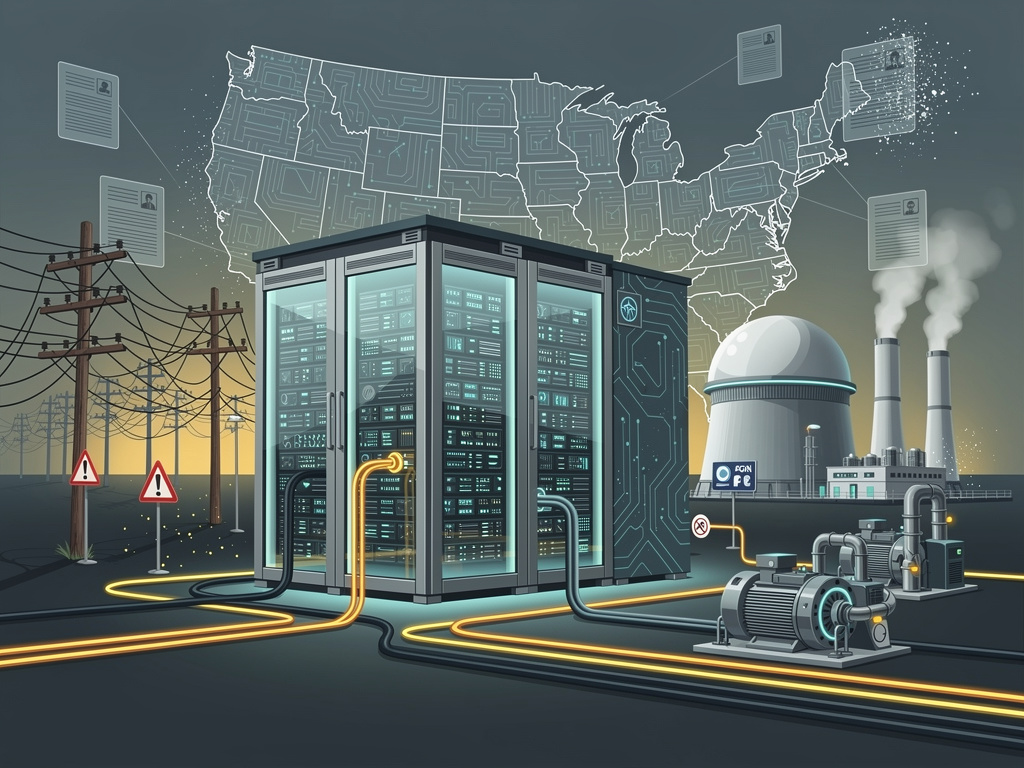
In a consequential meeting that underscores the shifting power dynamics between Washington and Silicon Valley, top technology executives have presented President-elect Donald Trump with a bold proposition: the industry will construct and fund its own electrical generation capacity to support the voracious appetite of artificial intelligence, rather than relying on the overburdened public grid. This commitment, detailed during a recent gathering of the newly formed AI infrastructure consortium, marks a significant departure from the traditional utility model and signals a new era where hyperscalers effectively become power producers.
The meeting, which included heavyweights such as Nvidia CEO Jensen Huang and OpenAI’s Sam Altman, centered on the physical constraints threatening American dominance in the AI sector. As reported by the Washington Examiner, the executives conveyed that reliance on existing municipal and regional power grids is no longer tenable. The current waiting periods for grid connection—often stretching five to seven years—pose an existential risk to the rollout of next-generation models. In response, the industry offered a pledge of self-sufficiency, promising to power their massive data centers independently if the administration clears the regulatory thicket currently strangling energy development.
The strategic pivot from public utility reliance to private infrastructure ownership
This pledge represents a fundamental restructuring of the digital economy’s supply chain. Historically, technology firms operated as high-volume customers of regulated utilities. However, the sheer density of power required for modern GPU clusters—often demanding gigawatts of capacity for a single campus—has outpaced the planning capabilities of regional transmission organizations. By volunteering to go “off-grid” or “behind-the-meter,” these companies are attempting to bypass the queue entirely. This strategy aligns with the incoming administration’s focus on privatization and infrastructure acceleration.
The proposal hinges on a transactional relationship with the federal government. The tech sector is willing to deploy tens of billions of dollars into capital expenditures for power plants—likely a mix of natural gas and advanced nuclear—but requires immunity from the slow-moving permitting processes that have historically stalled such projects. Industry insiders suggest that the Wall Street Journal has identified this dynamic as a potential “permit reform” catalyst, where the urgent need for AI supremacy forces legislative changes that the energy sector has sought for decades.
Nuclear aspirations meet the reality of regulatory timelines and construction delays
Central to this self-powering strategy is a heavy bet on nuclear energy, specifically Small Modular Reactors (SMRs) and the reactivation of dormant fission sites. Microsoft has already signaled its intent by striking a deal to restart Three Mile Island’s Unit 1, while Google and Amazon have invested heavily in SMR startups like Kairos Power and X-energy. However, the ambition to use nuclear power faces a stark reality: the Nuclear Regulatory Commission (NRC) has not licensed a new design at the speed required by Silicon Valley product roadmaps.
During the meeting with Mr. Trump, the discussion reportedly turned to how the executive branch could expedite NRC reviews. The tech leaders argued that without a fast-track for nuclear licensing, the United States risks ceding AI leadership to China, which is rapidly building out both coal and nuclear capacity to support its own compute clusters. According to a recent analysis by Reuters, U.S. data center power demand is projected to triple by 2030, a trajectory that renewable sources alone cannot sustain without compromising grid stability for residential consumers.
The resurgence of natural gas as the pragmatic bridge to a nuclear future
While nuclear energy offers a carbon-free promise for the future, the immediate solution for self-powered data centers will almost certainly be natural gas. To fulfill their pledge of not straining the public grid in the near term, tech companies will need to construct on-site gas turbines. This creates a friction point with their previous environmental, social, and governance (ESG) commitments. The industry is effectively wagering that the public and shareholders will accept a temporary spike in carbon emissions as the price of maintaining technological hegemony.
Energy executives present at the meeting emphasized that the United States possesses abundant natural gas reserves, yet pipeline capacity remains a bottleneck. The “self-power” pledge implies that tech firms might also become investors in midstream energy infrastructure, partnering with pipeline operators to ensure fuel delivery to their secluded data campuses. This vertical integration—from gas well to GPU—would make entities like Amazon and Microsoft some of the most complex industrial conglomerates in modern history.
Financial implications of the trillion-dollar infrastructure buildout
The capital requirements for this undertaking are staggering. The shift from paying monthly utility bills to financing power plant construction moves operational expenditure (OpEx) to massive upfront capital expenditure (CapEx). This transition is already visible in the swelling balance sheets of the “Hyperscalers.” Bloomberg recently reported on investment vehicles such as the partnership between BlackRock and Microsoft, aimed at mobilizing up to $100 billion specifically for data centers and power infrastructure. These funds are designed to de-risk the energy assets, separating the power generation business from the core software operations.
Investors have reacted cautiously. While the promise of energy independence insulates tech firms from grid volatility, it exposes them to commodity price risks and the operational complexities of running power plants. Creating a distinct asset class for “AI Infrastructure” allows these companies to attract sovereign wealth funds and private equity capital, spreading the risk while retaining control over the electrons needed to train models like GPT-5 and beyond.
Regulatory friction and the Federal Energy Regulatory Commission hurdles
Despite the optimism at the meeting with Mr. Trump, significant hurdles remain at the independent agency level. The Federal Energy Regulatory Commission (FERC) recently rejected an interconnection agreement involving an Amazon data center and a nuclear plant in Pennsylvania, citing concerns about grid reliability and cost-shifting to regular ratepayers. This decision highlights the tension between the administration’s deregulatory goals and the mandates of independent oversight bodies protecting consumer interests.
The tech leaders’ pledge to “power their own” facilities is partly a maneuver to skirt FERC’s jurisdiction. By operating behind the meter—where the power plant and the data center sit on the same property and do not interact with the wider transmission system—companies can theoretically avoid transmission fees and some federal oversight. However, this creates a fragmented energy map, leading to “energy islands” where massive industrial activity occurs disconnected from the national system, potentially complicating long-term grid planning.
The geopolitical stakes of the artificial intelligence arms race
The meeting’s undertone was undeniably geopolitical. The narrative presented to the President-elect framed energy policy as national security policy. If the U.S. cannot power the largest training runs, those clusters will be built elsewhere—potentially in the Middle East, where sovereign funds are aggressively courting American tech firms with promises of cheap energy and lax regulation. A report from CNBC earlier this year highlighted Sam Altman’s global tour to secure trillions in investment, underscoring that capital and energy are global commodities that will flow to the path of least resistance.
By pledging domestic self-sufficiency, Silicon Valley is attempting to anchor the physical layer of the AI economy within American borders. This aligns with the “America First” economic doctrine, offering a domestic boom in construction, engineering, and energy jobs. In exchange, the tech sector expects the federal government to clear the way, likely through executive orders or legislation that limits the ability of local groups to challenge energy projects in court.
The path forward for an industry turning into a utility provider
As the administration prepares to take office, the formation of the AI infrastructure council suggests a formalized channel for this public-private partnership. The pledge to self-power is not merely an offer of assistance; it is a declaration of independence from a legacy grid that the tech sector views as obsolete. The success of this gambit depends entirely on whether the administration can deliver on its promise to dismantle the regulatory state.
If successful, the result will be a bifurcated energy market: a public grid for residential and commercial use, and a series of private, high-capacity industrial grids powering the intelligence of the future. The meeting with Mr. Trump may well be remembered as the moment the technology sector stopped asking for permission to plug in and decided to build the socket themselves.


 WebProNews is an iEntry Publication