
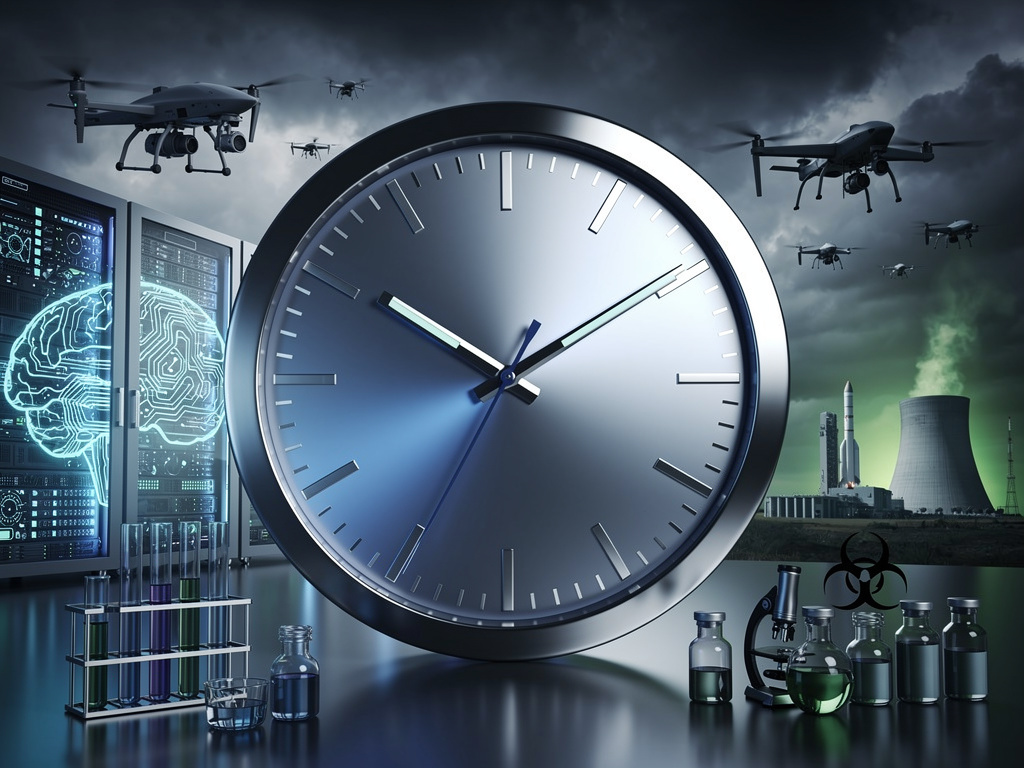
The metaphysical stopwatch that gauges humanity’s proximity to self-destruction has never been closer to midnight, and for the first time in its history, the ticking is being amplified by lines of code rather than just enriched uranium. The Bulletin of the Atomic Scientists recently reset the Doomsday Clock to 90 seconds to midnight, maintaining the most precarious setting since the project’s inception in 1947. While the continued war in Ukraine and the modernization of nuclear arsenals remain primary drivers, the board explicitly identified the unchecked proliferation of artificial intelligence as a volatile accelerant to these existential risks. As noted by CNET, the inclusion of AI highlights a pivotal shift: technology is no longer just a tool for economic leverage but a potential vector for civilizational collapse.
For industry insiders and policy strategists, this designation moves the conversation regarding Generative AI from quarterly earnings calls to the situation room. The Bulletin’s announcement underscores a reality that Silicon Valley has quietly debated but publicly downplayed: the democratization of advanced intelligence creates a threat matrix that is diffuse, difficult to attribute, and exponentially faster than traditional diplomatic fail-safes. Unlike nuclear proliferation, which requires massive industrial infrastructure and state sponsorship, the risks associated with AI can be deployed from a laptop, bypassing the deterrence theories that defined the Cold War. The clock is ticking, and the mechanism is digital.
The Algorithmic Multiplier of Existential Risk
The core argument presented by the Bulletin is not necessarily that AI will achieve sentience and launch missiles independently—a “Terminator” scenario—but rather that it acts as a force multiplier for existing fragilities. The immediate danger lies in the corruption of the information ecosystem. In a year where billions of people across the globe are heading to the polls, the sophistication of AI-generated disinformation threatens to undermine the very concept of objective truth. When voters cannot distinguish between a candidate’s actual policy platform and a deepfake fabrication, the democratic feedback loop is severed. This erosion of trust destabilizes governance, making it harder for nations to manage the very nuclear and climate crises the Clock was originally designed to track.
Furthermore, the integration of AI into military command-and-control structures introduces a layer of automation that could trigger accidental escalation. The Bulletin warns that the use of AI in intelligence, surveillance, and reconnaissance could lead to faster decision-making cycles, potentially removing the human judgment necessary to de-escalate a crisis. As reported by The New York Times, military superpowers are currently in a race to integrate autonomous systems, creating a “flash war” dynamic where algorithms might react to perceived threats faster than human commanders can intervene. This compression of decision time reduces the window for diplomacy to mere seconds.
Biological Threats and the Lower Barrier to Entry
Beyond the digital realm, the convergence of AI and biotechnology presents a tangible physical threat. Advanced large language models (LLMs) lower the barrier to entry for potential bad actors seeking to engineer biological weapons. Previously, designing a pathogen or synthesizing a toxin required specialized PhD-level knowledge and access to wet labs. Today, AI tools can theoretically guide a non-expert through the process of identifying distinct biological vulnerabilities. This democratization of lethality is a primary concern for biosecurity experts who argue that we are effectively open-sourcing the blueprints for mass casualty events.
The industry response has been a mixture of acknowledgment and deflection. While major labs like OpenAI and Anthropic have implemented safety rails to prevent their models from answering prompts related to biological weapon synthesis, the open-source community argues that these restrictions are easily successfully circumvented. According to analysis by Wired, the proliferation of open-weights models means that once a model is released, its safety guardrails can be stripped away, allowing any actor to retrain the system for malicious intent. The genie is not only out of the bottle; it has been cloned and uploaded to GitHub.
The Geopolitical Arms Race for Compute
The positioning of the Doomsday Clock also reflects the intense geopolitical friction caused by the race for AI supremacy. The United States and China are currently locked in a trade war centered on semiconductors—the silicon wafers that power these advanced models. By restricting the export of high-end GPU chips to China, Washington has explicitly linked AI development to national security. This technological decoupling increases tensions between the two nuclear superpowers, creating a zero-sum dynamic where scientific cooperation on safety is sacrificed for competitive advantage. The fear is that a lack of communication between rival AI powers could lead to a catastrophic misunderstanding.
This friction is exacerbated by the sheer capital expenditure required to compete. As detailed by Bloomberg, the hundreds of billions of dollars flowing into AI infrastructure creates an economic imperative to deploy systems quickly, often outpacing the development of safety protocols. When the market rewards speed over caution, the systemic risk increases. The Bulletin’s warning serves as a rebuke to the “move fast and break things” ethos, suggesting that what is being broken might be the geopolitical stability of the planet.
Lethal Autonomous Weapons Systems (LAWS)
Perhaps the most direct link between AI and the Doomsday Clock is the development of Lethal Autonomous Weapons Systems (LAWS). These are systems capable of selecting and engaging targets without human intervention. While international humanitarian law requires human accountability in warfare, the technical reality is drifting toward full autonomy. Drones in Ukraine and the Middle East are already exhibiting degrees of autonomy in jamming-heavy environments where remote control is impossible. The Bulletin highlights that the normalization of AI in warfare could lower the threshold for armed conflict, as nations may be more willing to deploy machines than soldiers.
The concern is not just about state actors. The proliferation of cheap, AI-enabled drone technology allows non-state actors and terrorist groups to conduct asymmetric warfare with precision previously reserved for superpowers. A swarm of autonomous drones, coordinated by a simple AI algorithm, could overwhelm traditional air defense systems. As noted in defense analysis by Reuters, the Pentagon is actively developing the Replicator initiative to counter this, aiming to field thousands of autonomous systems. This action-reaction cycle creates an unstable security environment where the speed of conflict exceeds human cognition.
The Governance Gap and Regulatory Fragmentation
Compounding these technical risks is a profound failure of global governance. The Bulletin points out that while the European Union has moved forward with the AI Act and the Biden administration has issued executive orders, there is no cohesive international framework for AI safety. The technology is borderless, yet regulation remains fragmented by national interests. A safety protocol enforced in Brussels has no bearing on a server farm in a jurisdiction with lax oversight. This regulatory arbitrage allows dangerous development practices to migrate to the path of least resistance.
The scientific community is calling for an institutional equivalent to the International Atomic Energy Agency (IAEA) for artificial intelligence—a global body with the power to inspect, audit, and if necessary, halt the training of models that pose an existential threat. However, unlike uranium enrichment, which leaves a radioactive signature and requires massive centrifuges, AI training is opaque. Detecting a rogue training run is significantly harder than detecting a nuclear test. This verification gap makes treaty enforcement notoriously difficult, leaving the world reliant on the voluntary self-regulation of profit-driven corporations.
The Illusion of Control and Hallucination
A more subtle but equally dangerous risk cited by experts is the “illusion of competency.” As AI systems become more convincing, humans are more likely to defer to their judgments, even when those judgments are flawed. In high-stakes environments—such as nuclear early-warning systems or power grid management—an AI “hallucination” (a confident but incorrect output) could be catastrophic. If a system misinterprets sensor data as an incoming attack and recommends a retaliatory strike, the human operator’s bias toward trusting the machine becomes a single point of failure.
This over-reliance is already visible in the corporate sector, where reliance on algorithmic decision-making is streamlining operations but introducing hidden vulnerabilities. The Wall Street Journal has frequently covered how algorithmic bias and error can cascade through financial markets. Transposing these errors onto critical infrastructure or defense systems invites disaster. The Bulletin’s assessment suggests that until we can mathematically guarantee the interpretability and reliability of these systems, integrating them into the nuclear command chain is an act of extreme negligence.
The Path Back from the Brink
Despite the grim assessment, the movement of the Clock is intended as a wake-up call rather than a prophecy. The inclusion of AI in the threat assessment forces a necessary conversation about the trajectory of technology. It demands that the private sector acknowledge its role in national security. The leaders of the AI revolution are no longer just building software; they are arguably the custodians of the modern geopolitical order. The Bulletin urges a decoupling of AI research from military escalation and a renewed focus on international treaties that specifically address autonomous weaponry and biological risks.
Ultimately, the 90-second warning is a signal that the buffer zone between humanity and catastrophe has eroded. The convergence of nuclear instability, climate volatility, and artificial intelligence creates a poly-crisis that cannot be solved by one nation or one company alone. The technology that promises to solve our greatest challenges also possesses the capacity to end our ability to solve anything at all. Turning back the clock requires not just innovation in code, but innovation in diplomacy, ethics, and human restraint.


 WebProNews is an iEntry Publication