
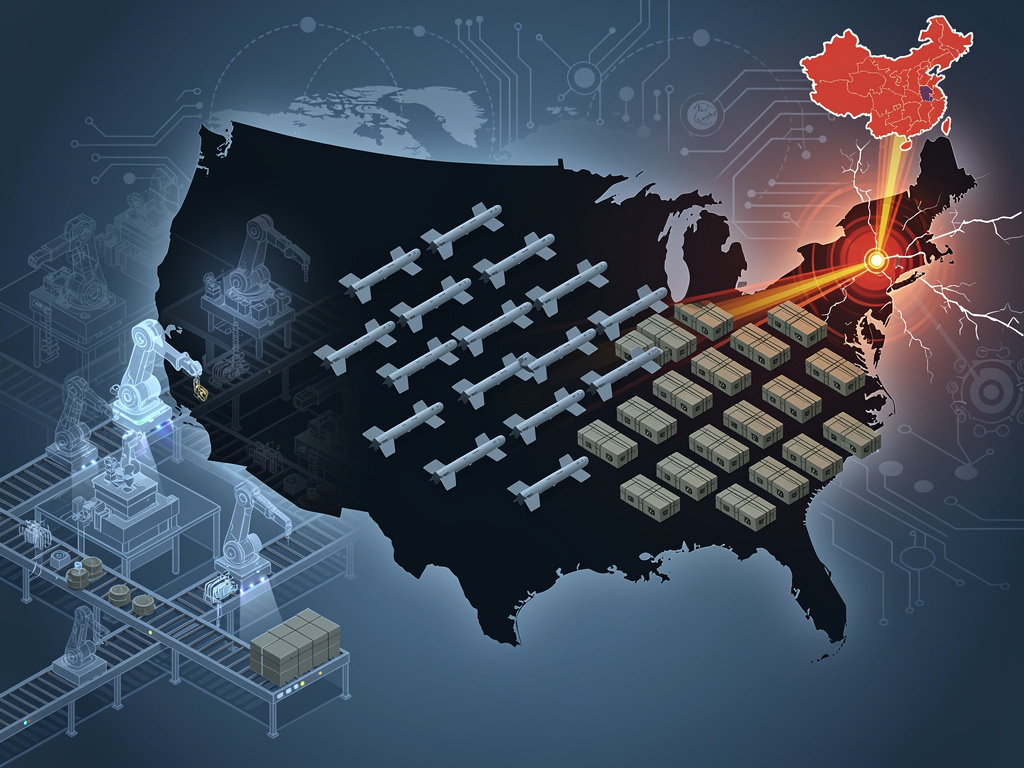
Jon Garrity didn’t mince words. The chief executive of Tagup told a room of technology and defense leaders last week that America’s military logistics system sits dangerously exposed. One prolonged conflict could exhaust key munitions faster than factories refill them. The warning, delivered at Fortune’s Brainstorm Tech conference, echoed sentiments heard days earlier from Anduril CEO Brian Schimpf. Both men described a defense production apparatus still tuned for short, decisive campaigns rather than the grinding attritional fights that define today’s battles.
Recent operations against Iran laid bare the scale of the problem. U.S. forces launched roughly 850 Tomahawk cruise missiles over four weeks. That pace overwhelmed inventories the Pentagon had been rebuilding at a rate of about 90 missiles per year. The Fortune article reporting these figures captured the stunned reaction among attendees. Stockpiles evaporated. Replenishment timelines stretched into years. And that was one theater.
But the missiles tell only part of the story. The deeper trouble lies in the intricate web of suppliers, raw materials and specialized components that feed final assembly lines. Decades of outsourcing left critical links dependent on foreign sources, some in nations that could become adversaries. Nearly one in ten major subcontractors to top U.S. defense primes are Chinese firms, according to analysis by Govini. Tara Murphy Dougherty, the firm’s CEO, called the data unequivocal. “The United States is not prepared for the war that we may have to enter if China said, ‘today is the day.’”
Her comments, featured in a detailed examination by Defense.info, highlight how semiconductors, rare earth elements and machined parts flow through networks that lack redundancy. A single export restriction from Beijing could halt production of guidance systems for everything from Patriot interceptors to submarine components. The vulnerability isn’t theoretical. It’s measurable in lead times that already stretch four years for some complex weapons.
And the recent fighting only accelerated the drawdown. Support for Ukraine combined with strikes on Iranian targets consumed thousands of Javelins, a sizable share of Stinger missiles and significant quantities of precision-guided munitions. Production lines, many idled or scaled back after the Cold War, struggled to respond. Retired engineers were called back to restart Stinger output. The entire episode reinforced what analysts have warned about for years. The U.S. defense industrial base simply lacks the surge capacity required for sustained high-intensity combat.
Schimpf put it plainly in his own remarks at the same event. Modern conflict has shifted. Economic warfare and industrial output now decide outcomes as much as battlefield tactics. His solution goes beyond redesigning weapons for easier manufacture. It demands movement upstream into raw materials and the commercial supply chains that could accelerate output. “We have critical gaps on a lot of the constituent parts of the supply chain,” he said in a separate discussion. “This is a national security issue.” Those observations, reported in Fortune’s coverage of his appearance, underscore a growing consensus among newer defense entrants. Traditional primes alone cannot solve the capacity problem.
The Trump administration appears to recognize the urgency. Officials plan to convene executives from Lockheed Martin, RTX, Boeing and L3Harris at the White House as soon as this week. The agenda centers on accelerating production after recent operations depleted stocks sent to Ukraine and expended in the Iran campaign. A Reuters report relayed by MSN quoted White House spokeswoman Anna Kelly asserting that current munitions levels suffice for strategic goals. Yet sources familiar with the planning described a clear focus on ramping output before any further drawdowns occur.
Industry gatherings reflect the same pressure. At the Defense Logistics Agency’s 2026 symposium, Lt. Gen. Gavin Lawrence, deputy commanding general of Army Materiel Command, laid out the strategic reality. Adversaries accelerate and adapt faster than at any point in recent memory. “In order to match and ultimately overmatch that pace, we must invest deliberately and urgently into our defense industrial base and supply chains,” he said, according to the DLA’s own account of the event. Without that foundation, scaling for crisis becomes impossible.
Numbers paint a sobering picture. The U.S. shipped more than 7,000 Javelins to Ukraine in three months, roughly one-third of its stockpile. At then-current production rates, replenishment would take over three years. Similar shortfalls appeared in other systems. A New Yorker profile of the broader readiness challenge quoted former Pentagon official David Ochmanek. “We are not moving fast enough.” The piece, published last year but still cited in current discussions, noted how sophisticated platforms designed for limited conflicts now face threats from cheap, mass-produced drones and proliferating precision weapons.
China’s dominance in global manufacturing compounds every weakness. Govini’s research traced nearly 45,000 suppliers based in China contributing to U.S. weapons programs, including parts for the B-2 bomber, Patriot missiles and Ohio-class submarines. In a conflict, those lines could go silent overnight. Jeb Nadaner, a senior vice president at Govini, told The New Yorker that the risk is obvious. “Of course, in the event of a conflict, the Chinese could cut us off.”
Efforts to address these gaps have produced mixed results. The Pentagon has spent billions over the past decade on industrial base initiatives. Yet Government Accountability Office reports continue to document persistent problems: Army ammunition inventories that go untracked, vehicle fleets missing readiness targets, F-35 deliveries running hundreds of days behind schedule. Michael Cadenazzi, a senior Defense Department official, acknowledged in February that many difficulties from 10 or 15 years ago have grown worse, as covered by Kharon.
Labor shortages add another constraint. More than 800,000 manufacturing positions sit open across the United States, with projections of a four-million-job gap within a decade. Factories that once produced munitions at scale have aged. Tooling and expertise have atrophied. Even when money flows, the human and physical infrastructure required to convert dollars into delivered weapons lags.
Newer entrants like Anduril argue for a different model. Schimpf and colleagues push to tap commercial industrial capacity, shorten design cycles and onshore critical inputs. Their approach treats software and manufacturing agility as equal to traditional hardware advantages. Yet scaling these ideas across the entire defense enterprise will take time. And time is the one resource that depletes fastest once missiles start flying.
Recent congressional and executive actions signal awareness. The 2026 National Defense Strategy calls for supercharging the defense industrial base. It frames the sector as foundational to deterrence and allied support. Implementation, though, collides with the same structural obstacles executives described at Brainstorm Tech. Long procurement cycles. Risk-averse contracting. Fragmented oversight of lower-tier suppliers.
Analysts at CSIS and RAND have modeled these dynamics repeatedly. Their simulations show U.S. forces burning through long-range precision munitions in days or weeks against a peer adversary. Resupply cannot match consumption. The result is reduced operational tempo, greater reliance on less capable systems and, ultimately, higher risk to forces and objectives.
So the conversation in Silicon Valley conference rooms and Pentagon briefing halls converges on the same point. The next war will test not only weapons but the factories that build them, the mines that feed them and the workers who assemble them. America’s military edge, long taken for granted, now rests on industrial resilience that has yet to be rebuilt.
Executives, generals and policymakers all say the same thing in different words. The warning signs are flashing. The question is whether the response will match the pace of the threat. History suggests that industrial mobilization takes years, not months. In an era of rapid technological change and assertive rivals, those years may no longer be available.


 WebProNews is an iEntry Publication