
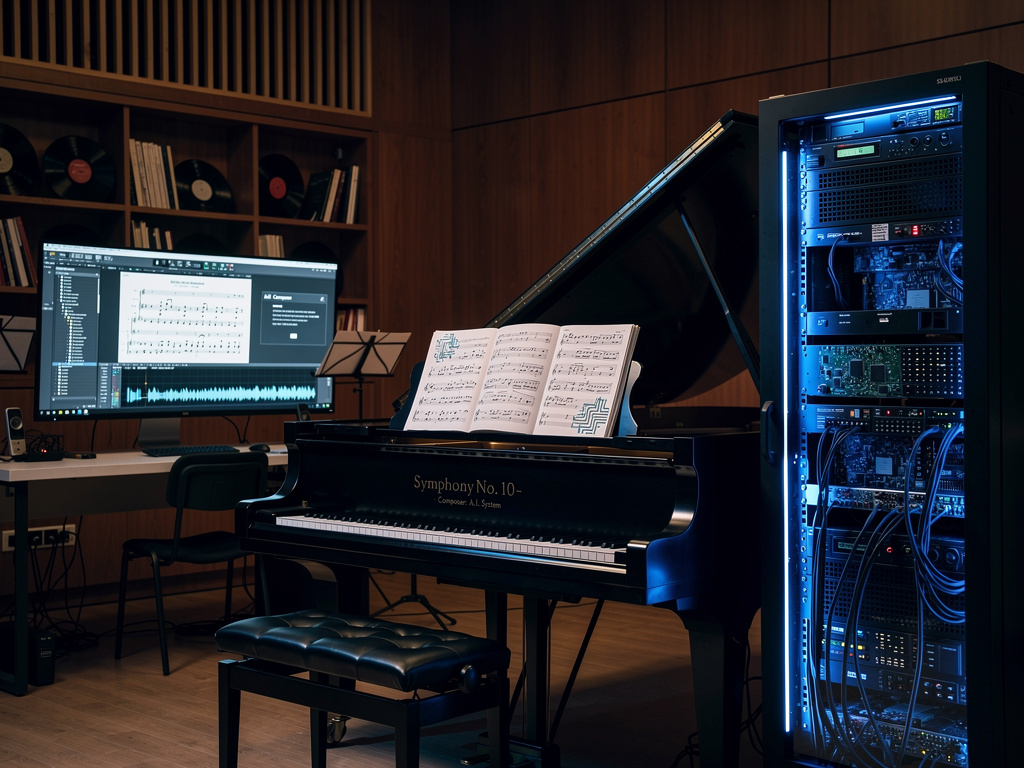
BONN, Germany — In a concert hall where Ludwig van Beethoven himself once walked, an unfamiliar melody filled the air in October 2021. It was the sound of his Tenth Symphony, a work the maestro left as mere sketches upon his death in 1827. For nearly two centuries, it remained a tantalizing ‘what if’. But on this night, a full orchestra performed its third and fourth movements, brought to life not by a rediscovered manuscript, but by an artificial intelligence that had painstakingly learned the composer’s unique musical soul.
The project, a complex collaboration between musicologists and computer scientists, represents a new frontier in one of humanity’s oldest art forms. As generative AI challenges the nature of creativity in visual art and literature, its arrival in the staid, traditional world of classical music is sparking a profound debate. The core question is no longer whether an AI *can* compose music that is technically proficient, but whether it can ever imbue its work with the emotional depth, intention, and lived experience that defines great art. The answer could reshape how music is created, valued, and even understood.
An Algorithm Takes the Podium, Challenging Centuries of Compositional Tradition
The technology driving this disruption has advanced at a breathtaking pace. At the forefront is AIVA (Artificial Intelligence Virtual Artist), a system developed in Luxembourg that has achieved a remarkable milestone. By training on a massive dataset of compositions from Bach to Stravinsky, AIVA learns the intricate rules of harmony, melody, and structure. Its prowess was formally recognized when it became the first AI to be registered as a composer with France’s influential collecting society, SACEM, granting it the ability to own its copyrights and earn royalties, as detailed by The Next Web. This move propelled AI from a mere experimental tool to a legitimate, legal entity in the creative economy.
These systems operate on deep learning principles, identifying statistical patterns in existing music to generate new pieces that are stylistically coherent. When tasked with completing Beethoven’s Tenth, the AI was not just mimicking his famous works. It was trained on his entire oeuvre and the music of his contemporaries to understand his creative process—how he developed a small melodic fragment into a grand symphonic statement. The result was a composition that many found compelling, a testament to the technology’s sophistication. As noted in a report by The Guardian, the project’s leader declared it a success, suggesting the AI had managed to continue Beethoven’s work in a way that the composer himself might have done.
The Unsettling Question of Authenticity and the Ghost in the Musical Machine
Despite the technical triumph, the AI-completed symphony was met with a mix of awe and skepticism. Critics and musicians questioned whether the result was a genuine extension of Beethoven’s genius or a sophisticated pastiche—a high-tech forgery that captures the style but misses the spirit. The project highlights a central philosophical impasse: can an algorithm, which has no consciousness, no emotional life, and no experience of joy or suffering, truly create art? Art, many argue, is a fundamentally human act of communication, a transmission of feeling and experience from creator to listener.
This skepticism is not unfounded. Some critics found the AI’s creation to be emotionally hollow, a collection of well-formed musical phrases lacking the essential spark of human ingenuity. Writing for The New York Times, one reviewer described the endeavor as an exploration of the “futility of A.I. art,” suggesting that while the machine could replicate Beethoven’s harmonic language and developmental techniques, it could not reproduce the fierce, defiant humanity that animates his greatest works. The algorithm can learn what Beethoven *did*, but it cannot know *why* he did it, a distinction that may prove to be the unbridgeable gap between simulation and creation.
Beyond Replacement: Composers Embracing AI as a Powerful Collaborative Tool
While the specter of AI replacing human composers captures headlines, a more nuanced reality is unfolding in studios and conservatories. Many forward-thinking artists view AI not as a competitor, but as a revolutionary new instrument or a tireless collaborator. It can be used to generate novel melodic ideas, break through creative blocks, or handle the laborious task of orchestration, freeing the human composer to focus on the broader emotional and structural arc of a piece. The AI becomes a partner in a creative dialogue, offering possibilities that a human might not have considered.
This collaborative model reframes the technology from an existential threat to an augmentation of human creativity. As explained by a music professor in an article for The Conversation, AI tools can democratize the basics of composition, giving aspiring creators a platform to experiment with complex musical structures without years of formal theory training. In this view, AI doesn’t diminish the role of the composer; it expands the very definition of what it means to compose, creating a hybrid artistry where human intention guides machine intelligence to explore uncharted musical territory.
The Sonic Boom of New Models and the Uncharted Legal Territory Ahead
The technology itself continues to evolve, moving beyond stylistic replication to on-demand generation from simple text prompts. Systems like Google’s MusicLM can now translate a descriptive phrase like “a calming violin melody backed by a distorted guitar riff” into a plausible audio clip. This leap, detailed by Ars Technica, points to a future where bespoke music generation is instantaneous and accessible to all, with profound implications for film scoring, game soundtracks, and personal entertainment. The focus is shifting from creating a single masterpiece to providing an endless stream of functional, customized audio.
This rapid progress is forcing a reckoning with complex legal and ethical questions. If an AI is trained on a library of copyrighted music, who owns the output? How should royalties be distributed when a human uses an AI-generated motif in their own prize-winning composition? The registration of AIVA with a collecting society was a first step, but it opened a Pandora’s box of unresolved issues around ownership, influence, and compensation. As algorithms become more integrated into the creative process, the music industry will need to establish new frameworks to navigate this unprecedented fusion of human and machine authorship, ensuring that human artists are not left behind in the rush toward automated creation.


 WebProNews is an iEntry Publication