
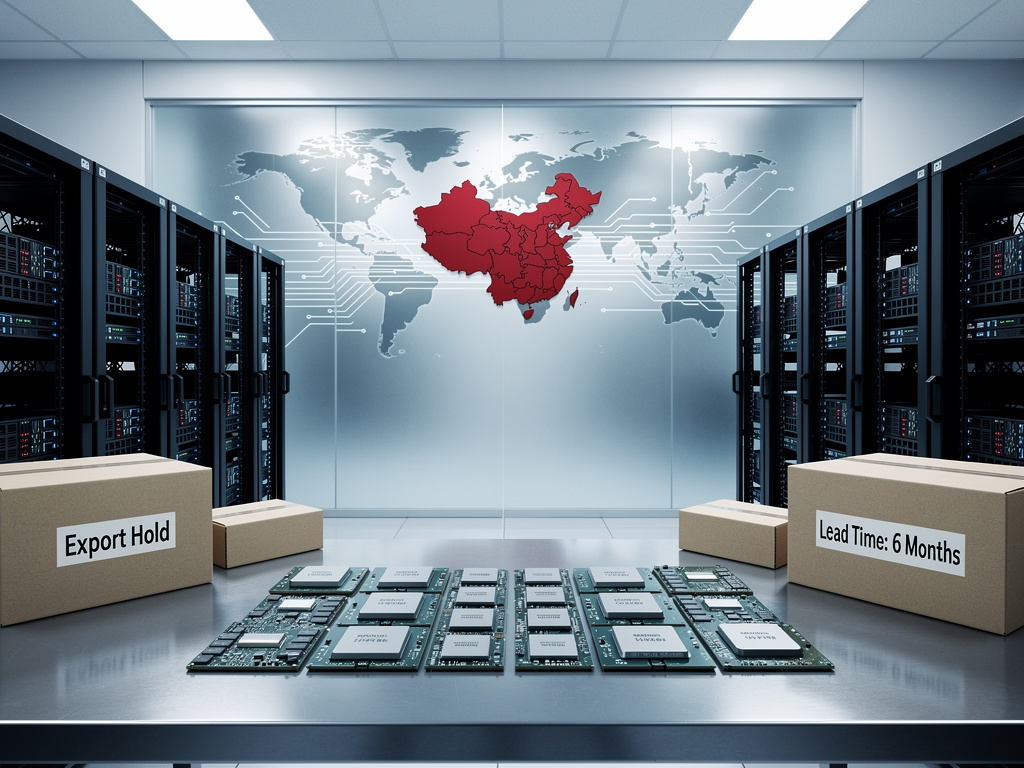
In a development that underscores the deepening fractures in global semiconductor supply chains, Intel and AMD have both notified their Chinese customers of significant supply shortages for server-grade central processing units, with Intel warning that delivery lead times could stretch as long as six months. The notifications, first reported by Reuters in an exclusive report, signal a new phase of strain between U.S. chipmakers and one of their largest international markets — a strain rooted not merely in manufacturing bottlenecks but in the increasingly complex web of export controls imposed by Washington.
The warnings come at a particularly sensitive moment for both companies. Intel, which has been navigating a multiyear turnaround effort under CEO Pat Gelsinger’s successor leadership, and AMD, which has been aggressively gaining market share in the data center segment, now find themselves caught between surging global demand for server processors — driven in large part by the artificial intelligence boom — and the regulatory constraints that limit what they can ship to China. For Chinese cloud providers, enterprise customers, and data center operators, the message is stark: plan for delays, or find alternatives.
Export Controls Tighten the Noose on China-Bound Shipments
The supply shortages are not the result of a traditional manufacturing crunch. Rather, they stem from the layered and evolving U.S. export control regime that has progressively restricted the sale of advanced semiconductors to China. Since October 2022, the U.S. Commerce Department’s Bureau of Industry and Security has rolled out successive rounds of restrictions targeting chips that exceed certain performance thresholds, particularly those used in AI training and high-performance computing. Server CPUs, while not always the primary target of these rules, have increasingly fallen under scrutiny as regulators seek to close loopholes that allowed modified or slightly downgraded chips to continue flowing to Chinese buyers.
As Benzinga reported, both Intel and AMD have been working through compliance processes that add significant time to order fulfillment. Each shipment to China now requires careful vetting to ensure it does not violate export control provisions, and in many cases, individual export licenses must be obtained — a process that can take weeks or months. The six-month lead time Intel has communicated to some customers reflects not just production scheduling but the bureaucratic overhead of navigating these regulatory requirements. AMD, while not specifying an identical timeline, has similarly warned customers of extended waits, according to the Reuters report.
A Market Already Under Pressure Faces New Headwinds
The timing of these supply warnings is particularly consequential for AMD, which has seen its stock come under significant pressure in recent months. As The Motley Fool detailed in an analysis published the same day as the supply shortage reports, AMD’s shares have experienced a steep sell-off driven by a combination of factors including investor concerns about the sustainability of its data center growth trajectory, competitive pressures from Nvidia in the AI accelerator market, and now the prospect that a significant portion of its server CPU revenue in China could be delayed or lost entirely. China has historically represented a meaningful share of both AMD’s and Intel’s server processor revenues, and any prolonged disruption to that market has direct implications for quarterly earnings.
For Intel, the situation is arguably even more fraught. The company has been attempting to stabilize its finances while investing heavily in new fabrication capacity through its IDM 2.0 strategy. Server CPUs remain one of Intel’s most profitable product lines, and the Data Center and AI group has been positioned as a critical engine for the company’s recovery. Losing ground in China — whether through regulatory restriction or customer defection to domestic alternatives — represents a strategic risk that extends well beyond a single quarter’s revenue miss. The six-month lead time warning, while framed as a supply chain notification, effectively tells Chinese customers that Intel cannot guarantee timely delivery of the processors they need to build out and maintain their data center infrastructure.
Chinese Customers Scramble for Alternatives as Domestic Chips Gain Ground
The supply constraints are accelerating a trend that has been building for years: the push by Chinese technology companies to develop and adopt domestically produced server processors. As Evertiq reported, Chinese customers facing long waits for U.S.-made server CPUs are increasingly evaluating processors from domestic suppliers such as Huawei’s HiSilicon division, Hygon Information Technology, and Phytium Technology. While none of these domestic alternatives yet match the performance or ecosystem maturity of Intel’s Xeon or AMD’s EPYC processors at the highest end, they are rapidly improving — and the reliability of their supply chains is becoming a decisive competitive advantage in a market where U.S. chips may arrive months late, if at all.
This dynamic creates a paradox for U.S. policymakers. The export controls are designed to slow China’s technological advancement, particularly in AI and military applications. But by making U.S. chips unreliable as a supply source, the restrictions are simultaneously providing the strongest possible market incentive for Chinese companies to invest in and adopt homegrown alternatives. Industry analysts have noted that each round of U.S. restrictions has been followed by an acceleration in Chinese domestic chip development funding and adoption. The current supply shortage notifications from Intel and AMD are likely to intensify this cycle, potentially costing American chipmakers permanent market share in what remains one of the world’s largest server markets.
The Broader Implications for Global Data Center Buildouts
The ripple effects of these supply shortages extend beyond the China market. Global data center capacity is expanding at an unprecedented rate, driven by the insatiable computational demands of large language models, generative AI applications, and the broader digitization of enterprise workloads. Server CPUs are a foundational component of this buildout, and any constraint on their availability — even if geographically targeted — has the potential to distort pricing and allocation globally. If Intel and AMD are diverting compliance resources and management attention to navigate China-related export controls, there is a legitimate question about whether this creates even marginal delays or inefficiencies in serving customers in other markets.
According to Digitimes, industry sources indicate that the supply notifications have already prompted some Chinese customers to place larger-than-normal orders in an attempt to secure inventory ahead of further restrictions — a pattern of panic buying that has historically exacerbated shortages in semiconductor supply chains. This hoarding behavior, if it materializes at scale, could create artificial scarcity that affects lead times for customers worldwide, not just those in China. The semiconductor industry’s painful experience with the COVID-era chip shortage, when double-ordering and inventory hoarding distorted demand signals for nearly two years, serves as a cautionary precedent.
Wall Street Weighs the Financial Fallout
Investors are now grappling with how to price the China risk into their models for both Intel and AMD. For AMD, as The Motley Fool’s analysis noted, the stock’s recent decline may already reflect some of this uncertainty, potentially creating a buying opportunity for investors with a longer time horizon — but only if AMD can demonstrate that its data center growth is not overly dependent on Chinese revenue. The company’s MI300 series AI accelerators have been a bright spot, but server CPUs remain a substantial revenue contributor, and any sustained disruption in China deliveries would be difficult to offset quickly.
Intel faces a different calculus. The company’s financial position is more precarious, and it has less room to absorb revenue shortfalls. The server CPU business, housed within the Data Center and AI group, is expected to be a key contributor to Intel’s path back to profitability. A six-month delay in fulfilling Chinese orders is not merely a logistics inconvenience — it is a potential revenue recognition problem that could affect multiple quarters of financial results. Analysts covering Intel have begun factoring in the possibility that some Chinese orders may never be fulfilled if customers find domestic alternatives during the extended wait period.
The Strategic Chessboard: Washington, Beijing, and the Future of Chip Trade
The supply shortage notifications from Intel and AMD are best understood not as isolated business events but as symptoms of a broader geopolitical realignment in the semiconductor industry. The U.S. government’s strategy of using export controls to maintain technological superiority over China is creating real and measurable consequences for American companies — consequences that include lost revenue, diminished market position, and the acceleration of a Chinese domestic semiconductor ecosystem that will eventually become a formidable competitor in its own right.
For Chinese technology companies, the message from Intel and AMD’s notifications is one they have been hearing with increasing clarity for several years: dependence on American chip suppliers carries unacceptable supply chain risk. The six-month lead time that Intel has communicated is, for a data center operator planning a major buildout, functionally equivalent to a denial of service. It forces a strategic rethinking of procurement that, once undertaken, may not easily be reversed even if export controls are eventually relaxed. The server CPU market in China is at an inflection point, and the decisions made by buyers and sellers in the coming months will shape the competitive dynamics of this critical industry for years to come.
Neither Intel nor AMD has publicly commented in detail on the specific contents of their customer notifications, though both companies have previously acknowledged the challenges posed by U.S. export controls on their China business. The Commerce Department has similarly declined to comment on individual company compliance matters, reiterating only that the export control framework is designed to protect U.S. national security interests. As the situation evolves, the tension between those security objectives and the commercial interests of America’s leading chipmakers shows no signs of easing — and the customers caught in the middle are already making plans to move on.


 WebProNews is an iEntry Publication