
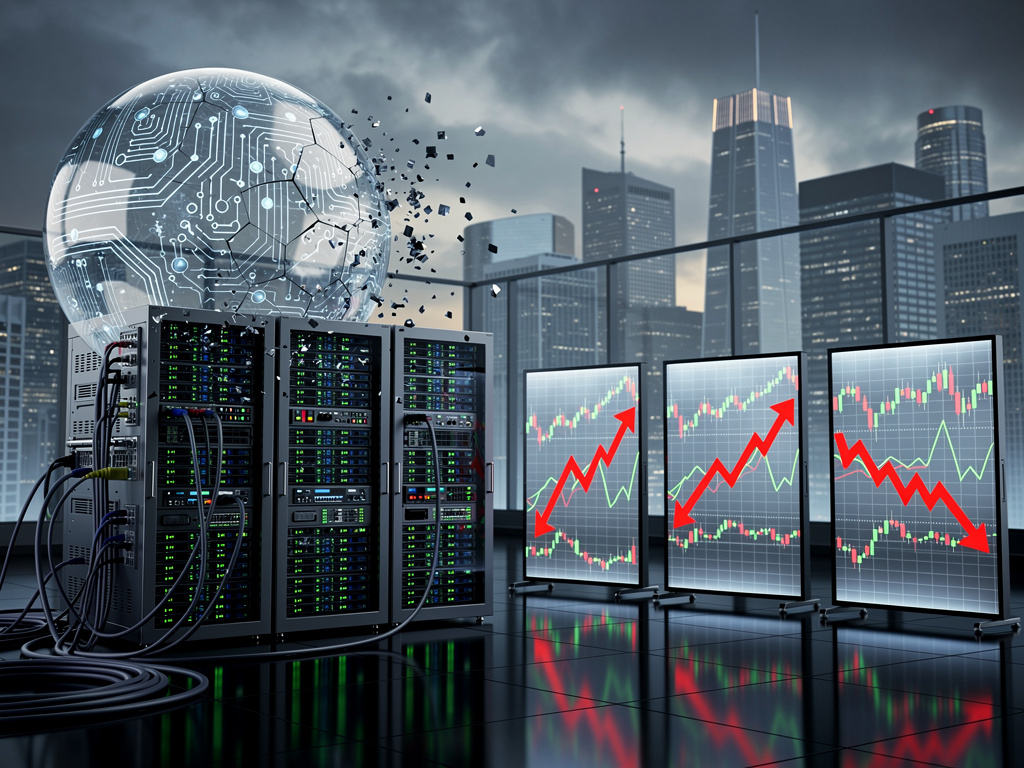
Bank of America strategist Michael Hartnett sees trouble ahead. The man who named the Magnificent Seven now warns clients to ready themselves for a post-bubble world. His latest report lays out red flags that echo the dot-com peak. The S&P 500 just hit another record. Yet only 21 stocks carried it there. One more than the 20 that led the index before the 2000 crash.
Hartnett points to speculative price action. Overvaluation of unprofitable names. Extreme concentration. Ten stocks make up two-fifths of the index. Meanwhile more than 330 S&P 500 members sit 20 to 40 percent below their highs. The message lands blunt. Prepare now. Bonds look like the safer bet once the correction hits. Yahoo Finance reported the details on June 5.
But is this truly a bubble? Or just the noisy early stage of something bigger? The numbers tell a story of staggering investment with returns that have yet to match. Four companies alone — Amazon, Alphabet, Meta and Microsoft — plan to spend $670 billion on AI infrastructure this year. J.P. Morgan Chase analysts project $5 trillion in total AI infrastructure outlays between now and 2030. Measured against U.S. GDP that outpaces every major American capital project in history except the Louisiana Purchase. The Time article from March laid out the scale.
On the other side sit the revenues. OpenAI shows about $25 billion annualized. Anthropic sits near $19 billion. The gap yawns wide. Unless those figures climb by orders of magnitude the math stops adding up. Executives and investors have started to voice the same worry. Sam Altman himself has flagged overinvestment risks. Bill Gurley at Benchmark called the reset inevitable. Michael Burry has taken shots at the circular financing and accounting tricks he sees propping up the frenzy.
History offers little comfort. Railway manias, the South Sea Bubble, the Roaring Twenties, dot-com. Each delivered genuine technological or economic progress. Each still produced spectacular busts when expectations ran too far ahead of reality. Ben Carlson at A Wealth of Common Sense noted the pattern on June 4. A reader asked him whether AI could prove transformative yet still spark a bubble. Carlson’s answer came simple. Yes. Excessive spending, hype and unrealistic forecasts make it almost certain. A Wealth of Common Sense.
Fidelity analysts took a more measured view early this year. They listed five markers worth tracking. Earnings growth rates. Quality of those earnings. Valuations versus history. Whether capital spending stays affordable and sustainable. The interest-rate backdrop. As of late 2025 data the picture looked less dire than 1999. S&P 500 forward price-to-earnings stood around 22.3. Below the dot-com peak of 24.4. The Magnificent Seven averaged 28 times earnings against 65.6 back then. Capital expenditures remained covered by free cash flow rather than debt. No clear signs of shrinking cash flows or rising cross-holdings on balance sheets. Fidelity.
Yet fresh data keeps the debate alive. Global AI spending could top $2.5 trillion in 2026 alone. Prediction markets on Polymarket give December 31, 2026, the highest odds for when a burst might arrive. A National Bureau of Economic Research paper from February found 90 percent of firms reporting no measurable workplace impact from AI. Executives still projected 1.4 percent productivity gains anyway. That disconnect smells like the productivity paradox of past technology waves.
Even optimists concede the risks. Nvidia’s Jensen Huang has pushed back hard against bubble talk. After strong earnings last fall he told investors his view differed sharply from the skeptics. The company’s market value has swung wildly. It crossed $5 trillion before pulling back. Peter Thiel sold his entire Nvidia stake. SoftBank trimmed billions. Michael Burry went further. He accused parts of the industry of self-reinforcing accounting that masks weak end demand. Nvidia quietly circulated a memo to analysts rebutting his points. The exchange made clear how raw the nerves have become.
Enterprise adoption tells a mixed tale. Some coding experiments now show nearly 20 percent faster task completion with the latest AI tools. Earlier studies had found almost no lift. That improvement matters. It suggests real capability gains. But surveys from Gartner, PwC and others still show most large companies reporting negligible ROI on large language model deployments. Losses at leading AI labs persist. Monetization remains elusive outside a handful of use cases.
The concentration worries many. Nearly 80 percent of 2025 stock gains came from seven names. They compete fiercely across the entire stack — chips, models, data centers, energy. This vertical integration creates both strength and vulnerability. A stumble at any layer could cascade. World Economic Forum economists polled in January found 52 percent expect AI-related U.S. stocks to fall this year. They sketched a timeline of irrational exuberance giving way to reckoning. Building phase. Peak. Then the unwind.
So what happens if it does pop? Two broad scenarios emerge. One resembles dot-com. Hundreds of companies fail. A short recession follows. Yet the infrastructure built during the boom — data centers, fiber, talent — remains and fuels the next leg of genuine productivity. The other looks uglier. Interconnected balance sheets and circular investment flows pull down broader markets. Global effects follow. Policymakers face pressure to act. Time argues they should start drafting responses today. Learn from 2008. Prioritize ordinary households over pure capital preservation. Pursue structural fixes. Hold fraud accountable.
Analysts at the World Economic Forum and Yale have mapped possible triggers. Governance conflicts that expose model shortcomings. Contagion from concentrated holdings. A sudden drying up of easy capital. Any could accelerate the decline. And yet the technology itself continues to advance. New coding agents show promise. Certain sectors report efficiency gains. The debate isn’t whether AI matters. It’s whether current prices bake in perfection that markets rarely deliver.
Hartnett’s roadmap offers one path. Shift toward bonds. Reduce exposure to the most stretched names. Others counsel patience. AI adoption cycles run long. Infrastructure buildouts take years to pay off. Carlson reminds readers that humility serves investors well. No one knows exactly when the music stops. Or whether the real returns arrive just in time to justify today’s valuations.
Either way the stakes sit high. Trillions have already deployed. More flows every quarter. Corporate balance sheets and public markets both ride the wave. A soft landing would validate the optimists and reset expectations without carnage. A hard pop could echo past manias in speed and pain. Investors, executives and policymakers all watch the same signals now. Earnings quality. Actual productivity data. Capital return timelines. The next few quarters will clarify which narrative wins.
One thing feels clear. The conversation has moved past denial. Even those who believe in the technology’s long-term power increasingly accept that excess has built up. The question is no longer if froth exists. It is how much must be wrung out. And who bears the cost when it happens.


 WebProNews is an iEntry Publication