
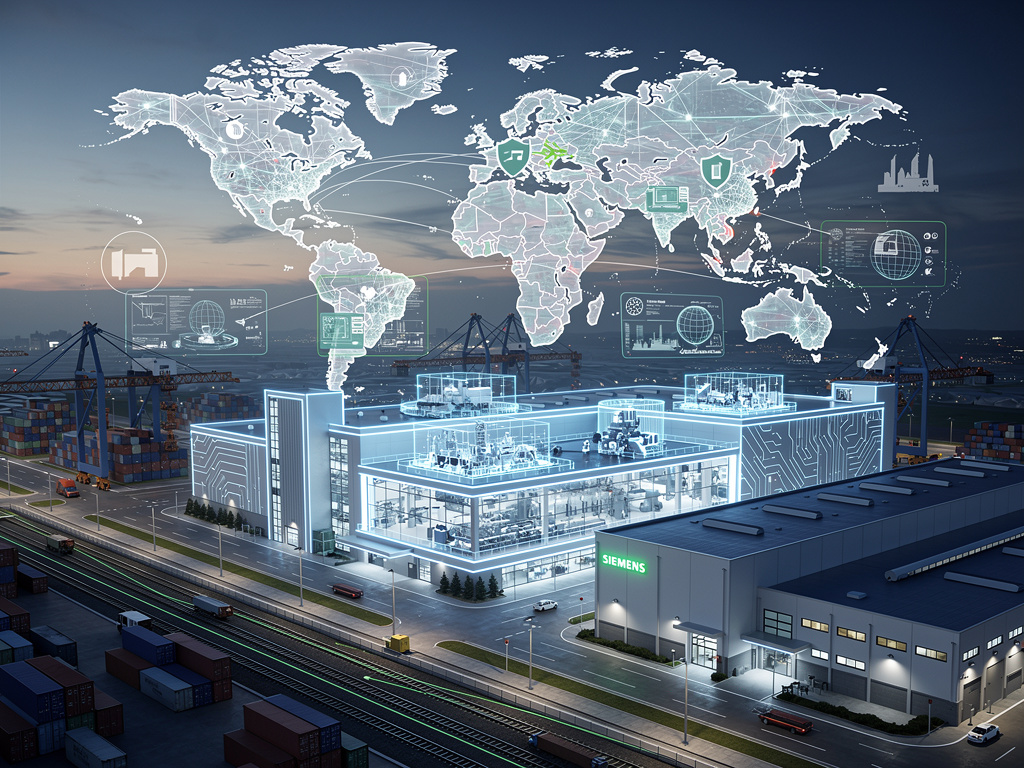
Roland Busch, the chief executive of Siemens AG, has spent the better part of the last decade transforming a 177-year-old German industrial conglomerate into what he envisions as the world’s preeminent technology company for manufacturing and infrastructure. In a wide-ranging conversation on The Verge’s Decoder podcast, Busch laid out a sweeping vision for how artificial intelligence, digital twins, and industrial automation will reshape how the world builds everything from factories to fighter jets — all while navigating a geopolitical environment roiled by tariffs, NATO defense spending pressures, and the accelerating re-industrialization of the West.
The interview, conducted by Decoder host Nilay Patel, offered a rare window into the strategic thinking of a CEO who sits at the intersection of nearly every major industrial and technological trend shaping the global economy. Siemens, which employs roughly 320,000 people worldwide and generated over €77 billion in revenue in its most recent fiscal year, is not a household name in the way that Apple or Google might be. But its software and hardware underpin an astonishing share of the world’s manufacturing output, power grids, building systems, and transportation networks. What Busch described is nothing less than an attempt to make Siemens the operating system for the physical world.
The Digital Twin Revolution and the Factory of the Future
At the heart of Siemens’ strategy is the concept of the digital twin — a precise, physics-based virtual replica of a physical product, production line, or even an entire factory. Busch explained that Siemens has been building this capability for years through a series of aggressive software acquisitions and internal development. The idea is deceptively simple: before a single bolt is turned or a single weld is made in the real world, the entire process is designed, simulated, tested, and optimized in a virtual environment. According to Busch, as reported by The Verge, this approach can reduce time to market by as much as 50% and dramatically cut waste and errors in manufacturing.
Busch pointed to the automotive industry as a prime example. Car manufacturers now use Siemens’ Xcelerator platform to design vehicles, simulate crash tests, model aerodynamics, plan factory layouts, and program the robots that will assemble the cars — all before physical production begins. The digital twin doesn’t stop at the factory door, either. It extends into operations, where sensor data from real-world equipment feeds back into the virtual model, enabling predictive maintenance and continuous optimization. Busch described this as a “closed loop” between the digital and physical worlds, a concept that he believes will become the standard for virtually all complex manufacturing within the next decade.
AI as the Catalyst for Industrial Transformation
What makes the current moment particularly potent, Busch argued, is the arrival of mature artificial intelligence capabilities that can be layered on top of these digital twin environments. Siemens has partnered with Microsoft to integrate generative AI tools, including copilot-style assistants, into its industrial software suite. The goal is to make it possible for engineers to interact with complex simulation and design tools using natural language, dramatically lowering the barrier to entry and accelerating workflows. Busch told The Verge that he sees AI not as a replacement for human engineers but as a “force multiplier” that allows smaller teams to accomplish what previously required vast departments of specialists.
Busch was notably specific about where AI delivers value in the industrial context versus where it remains limited. He emphasized that industrial AI must be grounded in physics — the models must respect the laws of thermodynamics, materials science, and mechanical engineering. This distinguishes industrial AI from the large language models that power consumer chatbots, which can hallucinate or produce plausible-sounding but incorrect answers. In a factory or a power grid, a hallucination isn’t an embarrassment; it’s a potential catastrophe. Siemens’ approach, Busch explained, combines data-driven AI with physics-based simulation to create what he called a more trustworthy and reliable form of machine intelligence.
Tariffs, Re-Industrialization, and the Geopolitics of Manufacturing
The conversation took a sharp turn into geopolitics when Patel pressed Busch on the impact of tariffs and trade tensions on Siemens’ global operations. Busch acknowledged that the current tariff environment — driven in large part by U.S. trade policy — creates significant uncertainty for multinational manufacturers. However, he also framed the situation as a potential tailwind for Siemens. As companies and governments seek to re-shore manufacturing capacity and build more resilient supply chains, the demand for the kind of factory planning, automation, and digital infrastructure that Siemens provides is surging.
Busch noted that the United States has become one of Siemens’ most important growth markets. The company has invested billions in U.S. operations, including major facilities for manufacturing rail equipment, electrical infrastructure, and industrial automation systems. He argued that Siemens’ strategy of localizing production — building in the markets where it sells — provides a natural hedge against tariff disruptions. But he was candid about the challenges: tariffs increase costs, create planning uncertainty, and can distort investment decisions in ways that ultimately harm productivity and innovation. As reported by The Verge, Busch expressed a clear preference for open trade while acknowledging the political realities that make protectionism increasingly attractive to governments on both sides of the Atlantic.
NATO, Defense Spending, and the Infrastructure of Security
Perhaps the most striking portion of the interview involved Busch’s comments on NATO and European defense spending. With European nations under intense pressure to increase military expenditures — a trend accelerated by Russia’s invasion of Ukraine and shifting U.S. foreign policy signals — Siemens finds itself in an unusual position. The company is not a defense contractor in the traditional sense; it doesn’t build tanks or missiles. But its technology is deeply embedded in the infrastructure that supports defense capabilities: power grids, communications networks, transportation systems, and the factories that produce military equipment.
Busch told The Verge that Siemens is actively engaged in discussions about how to support Europe’s defense industrial base. He pointed to the company’s role in helping to modernize and expand manufacturing capacity for defense-related production, using the same digital twin and automation technologies that it deploys in civilian industries. The logic is straightforward: if Europe needs to rapidly scale up production of ammunition, vehicles, or other military hardware, it will need the kind of advanced manufacturing infrastructure that Siemens specializes in building. Busch framed this not as a pivot toward defense but as a natural extension of Siemens’ core competencies into a domain of urgent national and continental need.
The Software-Defined Industrial Giant
One of the most important strategic threads running through Busch’s comments was the ongoing transformation of Siemens from a hardware-centric conglomerate into a software-defined technology company. This shift has been underway for more than a decade, accelerated by the acquisitions of companies like Mentor Graphics and Brightly Software, and by the development of the Xcelerator platform, which Siemens positions as an open digital business platform for industrial customers. Busch emphasized that software now represents a significant and rapidly growing share of Siemens’ revenue, and that the margins on software are substantially higher than those on traditional hardware products.
This transformation has required not just technological change but cultural change within Siemens. Busch described the challenge of reorienting a workforce steeped in engineering and manufacturing traditions toward a more software-centric, data-driven way of working. He credited the company’s deep domain expertise — its intimate knowledge of how factories, buildings, and grids actually work — as its most durable competitive advantage. In Busch’s telling, Silicon Valley companies may have superior AI algorithms, but they lack the decades of accumulated industrial knowledge that is necessary to apply those algorithms in environments where the stakes are measured in megawatts, structural integrity, and human safety.
Navigating Uncertainty With a Long-Term Playbook
Busch’s overall message was one of disciplined optimism. He acknowledged the profound uncertainties created by trade wars, geopolitical fragmentation, and the breakneck pace of AI development. But he argued that these disruptions are, on balance, creating more demand for what Siemens offers rather than less. Companies that need to reconfigure supply chains need digital twins. Nations that need to rebuild industrial capacity need automation. Grids that need to accommodate renewable energy need smart infrastructure. In each case, Busch positioned Siemens as the indispensable partner.
Whether Siemens can fully deliver on this vision remains an open question. The company faces fierce competition from rivals like Rockwell Automation, Schneider Electric, and ABB, as well as from technology giants like Microsoft and Amazon that are increasingly pushing into industrial applications. Busch’s bet is that Siemens’ unique combination of software sophistication and deep industrial domain knowledge will prove difficult to replicate. If he is right, the 177-year-old company from Munich may well emerge as one of the most important technology companies of the AI era — not by chasing consumer trends, but by quietly rewiring the industrial foundations on which the modern economy depends.


 WebProNews is an iEntry Publication