
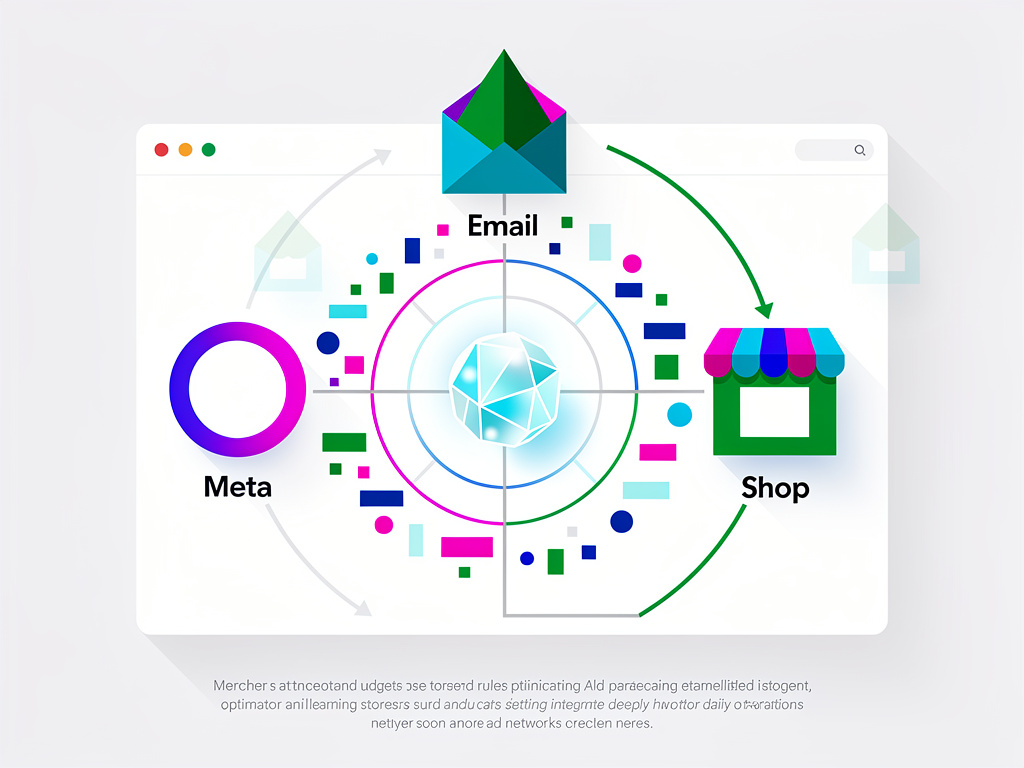
Shopify just handed merchants a new way to handle marketing. No more juggling tabs across ad platforms and email tools. No more guessing where the next dollar should go. The company rolled out Campaign Autopilot this month, an AI system that plans, launches, and tweaks campaigns across channels while merchants focus on products and customers.
The tool arrives at a moment when many store owners feel stretched thin. Marketing demands expertise they lack and budgets they hesitate to spend on agencies. Campaign Autopilot promises to change that equation. Set a monthly spend, define a few rules, approve what looks right. The AI does the rest.
Announced June 17 and covered widely the following week, the feature sits directly inside the Shopify admin, now renamed the Growth tab. It coordinates Meta ads, Shop Campaigns available in the US and Canada, and email automations through Shopify Messaging. More channels loom. Microsoft Advertising rolls in during July. ChatGPT Ads and Snapchat follow. Shopify makes clear the system learns from performance patterns across millions of stores rather than generic benchmarks.
Merchants connect their channels or let the tool create a new Meta ad account. They pick a budget that pauses campaigns automatically when reached. They set guardrails on what the AI can and cannot do. From there, Autopilot builds a plan, allocates spend toward opportunities it identifies, and adjusts in real time when something underperforms. It also recommends and builds email sequences such as abandoned-cart flows.
Control stays with the user. Reject a recommendation. Change the budget. Pause everything. The system operates separately from any existing campaigns, so current work remains untouched. It draws on product images and catalog data already in the store. No AI-generated creative replaces a merchant’s own visuals.
Results require patience and realistic expectations
Shopify itself cautions that no honest tool can guarantee outcomes. Marketing still takes time to gather data. The AI needs to observe what audiences respond to, which channels convert for a particular category or region, and which offers resonate. Early users will watch it learn. And learn alongside it.
Sidekick, Shopify’s conversational AI assistant, stands ready to answer questions about recommendations, trigger actions, or explain what’s happening. The integration feels natural. Ask Sidekick for growth insights, and it surfaces Autopilot’s thinking.
This launch builds on years of incremental AI additions. Shopify Magic has generated product descriptions and email subject lines for some time. Sidekick evolved into a broader commerce helper that knows a store’s data and can act inside the admin. Campaign Autopilot represents a bigger step. It doesn’t just suggest copy. It spends money and shifts budgets.
Search Engine Land reported the news on June 23, noting how the tool lowers barriers to multi-channel efforts that once required agencies or specialized staff. Search Engine Land highlighted the dashboard experience that lets merchants monitor performance without leaving Shopify.
Industry data supports the timing. Shopify’s own research shows the global AI marketing market heading toward $82 billion by 2030 with a 25% compound annual growth rate. Eighty-three percent of marketers using AI report higher productivity. More than a quarter of marketing content could come from AI outside centralized teams by the end of this year. Shopify quotes senior developer Alex Pilon saying AI continues to reduce the cost of entry to marketing and ad campaigns.
Yet adoption brings questions. Only a small share of leaders using generative AI in isolation report major gains. Success appears tied to strategic integration rather than standalone experiments. Shopify positions Autopilot as that integration, baked into the platform merchants already use daily.
Merchants on paid plans get the feature at no extra cost beyond normal ad spend paid to Meta or through Shopify for other channels. Early access began immediately for qualifying stores. Others can sign up for notification when it reaches them.
Reaction on X mixed excitement with caution. Some merchants praised the ability to run coordinated campaigns without hiring help. Others wondered how well the AI would handle niche categories or seasonal swings. One thread noted the dashboard changes that pushed Sidekick more prominently into view, a shift not everyone welcomed.
The broader picture shows Shopify doubling down on AI across operations. Recent Editions updates expanded Sidekick’s ability to interact with third-party apps such as Klaviyo and others. Developers can now build extensions that let Sidekick pull data or perform actions inside those tools. The company also works on agentic commerce protocols with partners including Google.
For independent brands, the promise is clear. Spend less time on marketing mechanics. Gain clearer visibility into what drives orders. Learn from an AI trained on real commerce outcomes rather than theoretical models. But the system demands oversight. Merchants who treat it as a set-it-and-forget-it solution may miss the educational value Shopify emphasizes.
Campaign Autopilot does not replace strategy. It executes within boundaries merchants define. That distinction matters. Brands still need strong products, clear positioning, and authentic creative. The AI handles distribution and optimization at a level once reserved for larger teams.
As more channels join and the model gathers additional data, performance should improve. Early results will vary. Some stores may see quick wins in email automation or Meta budget allocation. Others will spend weeks refining guardrails before the system hits stride.
One thing feels certain. The bar for running effective marketing just dropped another notch. Small merchants can now access coordinated, data-informed campaigns that adapt in real time. Whether that levels the field against bigger competitors or simply raises overall expectations remains to be seen. For now, the tool sits inside the admin, ready for those willing to test it.
And test they should. The cost of entry has fallen. The opportunity to learn while the AI works could prove as valuable as any sales it generates.


 WebProNews is an iEntry Publication