
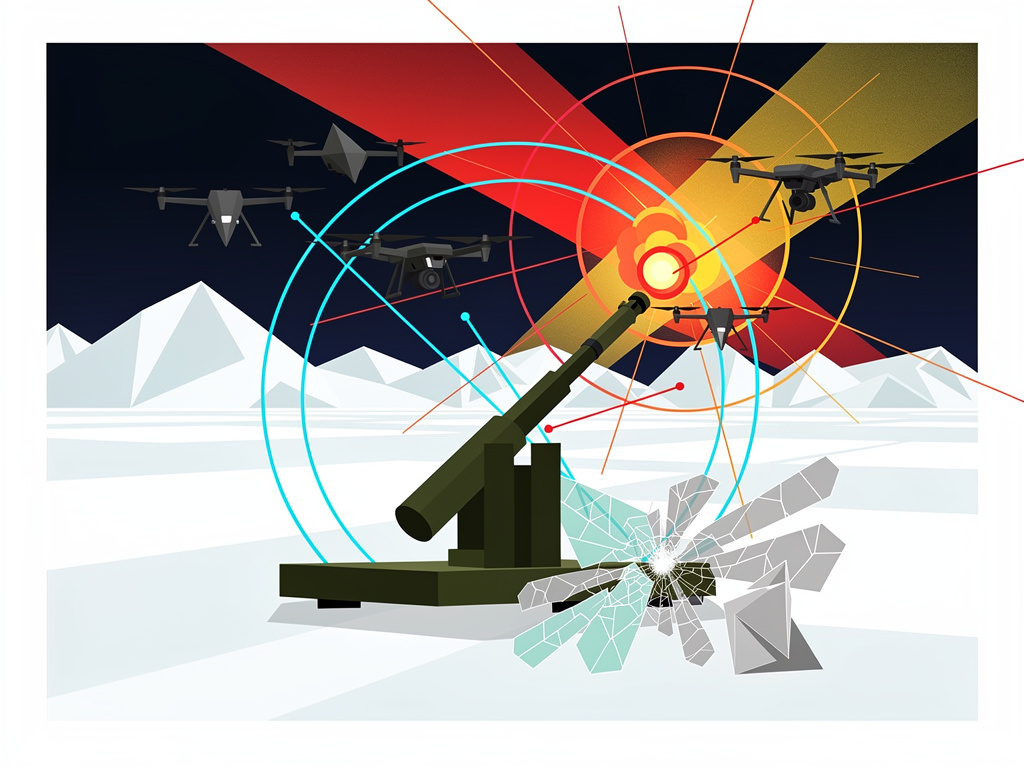
At a frozen firing range inside the Joint Pacific Multinational Readiness Center in Alaska, soldiers from the 2nd Battalion, 377th Parachute Field Artillery Regiment recently did something their unit has never done before. They launched drones. Not as a novelty. Not as a side experiment. As a core part of how they intend to fight.
The exercise, conducted during the Army’s Joint Pacific Multinational Readiness Center rotation known as JPMRC 25-02, marked a turning point for America’s only airborne Arctic artillery unit. For the first time, the battalion integrated first-person-view kamikaze drones and surveillance unmanned aerial systems directly into live-fire artillery operations in extreme cold weather, according to Business Insider. The implications stretch far beyond Alaska.
The 2-377th, nicknamed the “Spartan Steel,” is part of the 11th Airborne Division — the Army’s newest division, reactivated in 2022 specifically to address growing great-power competition in the Arctic. Based at Joint Base Elmendorf-Richardson, the unit operates M119A3 105mm howitzers, lightweight towed guns that can be dropped from aircraft and hauled across terrain where heavier systems simply can’t go. The guns are effective. But in a world where the battlefield is increasingly transparent — where cheap commercial drones can spot a firing position in minutes — artillery that can’t see for itself is artillery that dies.
That’s the problem the battalion set out to solve.
During the JPMRC rotation, soldiers employed small unmanned aircraft to locate enemy positions, adjust fire in real time, and conduct battle damage assessments after rounds hit. They also practiced using FPV drones as direct-strike weapons — the same type of improvised kamikaze systems that have become ubiquitous on the front lines in Ukraine. The training represented a deliberate effort to absorb the hard lessons of that war and apply them to Arctic operations, where communication infrastructure is sparse, GPS signals can be unreliable, and temperatures routinely plunge below minus 40 degrees.
“We looked at what’s happening in Ukraine and said, ‘We need to be able to do that, but in our environment,'” a battalion officer told Business Insider. The challenge is formidable. Batteries drain faster in extreme cold. Plastic components become brittle. Touchscreens freeze. Drone operators must work with thick gloves or risk frostbite in seconds. None of these are theoretical concerns — they’re operational realities that the unit confronted during the exercise.
And yet the soldiers made it work.
The integration of drones into artillery units isn’t happening in a vacuum. It reflects a broader push across the U.S. military to distribute drone capabilities down to the lowest tactical levels. The Army’s Rapid Capabilities and Critical Technologies Office has been accelerating procurement of small UAS platforms for infantry and fires units. The Marine Corps has moved aggressively in the same direction. But the 2-377th’s training stands out because it fuses two capabilities — indirect fire and unmanned systems — in one of the most unforgiving operating environments on earth.
The Arctic is not a theoretical battleground. Russia has spent the past decade militarizing its northern territories at a pace not seen since the Cold War. Moscow has reopened Soviet-era bases above the Arctic Circle, deployed advanced air defense systems to the region, and staged large-scale military exercises involving tens of thousands of troops. China, too, has declared itself a “near-Arctic state” and invested heavily in icebreakers and polar research infrastructure that carries obvious dual-use potential. The Northern Sea Route — increasingly navigable as ice retreats — represents a strategic corridor that both nations intend to control or contest.
The United States, by contrast, has been playing catch-up. The reactivation of the 11th Airborne Division was an acknowledgment that the Army had allowed its cold-weather warfare expertise to atrophy after decades of focus on desert and counterinsurgency operations in the Middle East. The division’s soldiers train year-round in conditions that would shut down most military operations: deep snow, whiteout blizzards, avalanche terrain, and darkness that lasts twenty hours a day in midwinter.
So when the 2-377th says it’s integrating drones, the statement carries weight that goes beyond technology adoption. It signals that the Army’s Arctic force is trying to leapfrog from a legacy formation into one capable of fighting a modern, sensor-saturated war in a place where most electronics struggle to function at all.
The lessons from Ukraine have been stark and unambiguous. Artillery remains the dominant killer on that battlefield — responsible for the majority of casualties on both sides. But the way artillery operates has changed fundamentally. Drone-corrected fire has compressed the sensor-to-shooter timeline from minutes to seconds. Units that can’t spot their own targets with organic drones are forced to rely on higher-echelon assets that may be unavailable, jammed, or destroyed. Units that can fly their own eyes over the battlefield survive longer and kill more effectively. Period.
The Ukrainian military’s use of cheap commercial quadcopters to direct howitzer fire has been extensively documented by outlets including Reuters and The New York Times. Russian forces have adopted the same tactics. The result is a battlefield where concealment is nearly impossible and the time between detection and destruction has collapsed. An artillery battery that fires and doesn’t displace within minutes risks annihilation from counter-battery fire guided by enemy drones overhead.
For the 2-377th, this means speed is everything. The M119 howitzer’s greatest asset — its light weight and air-transportability — becomes a liability if the crew can’t identify targets and move before the enemy responds. Organic drones change that calculus. A small quadcopter launched from the gun line can surveil a target area, confirm enemy positions, relay coordinates, and then loiter overhead to watch the rounds impact and adjust fire. All without waiting for a forward observer on foot to reach a vantage point that may not exist in flat Arctic tundra.
The FPV strike drones add another dimension entirely. These are not expensive precision munitions. They’re commercially derived platforms, often costing a few hundred dollars each, equipped with small explosive payloads and flown by operators wearing video goggles. In Ukraine, they’ve destroyed tanks, armored vehicles, bunkers, and supply trucks. They’ve also been used to attack personnel in trenches and fighting positions. For a light artillery unit operating in the Arctic, FPV drones offer a way to engage targets that don’t warrant a 105mm round — or targets that need to be hit immediately, before a fire mission can be processed through the traditional chain.
The training in Alaska wasn’t perfect. Soldiers encountered the expected cold-weather problems: shortened battery life, signal degradation, and the physical difficulty of operating small electronics in heavy Arctic gear. But the battalion treated these as engineering problems to be solved, not reasons to abandon the effort. Workarounds included keeping batteries warm inside clothing until the moment of launch, using modified antenna configurations to extend signal range in the flat terrain, and developing standard operating procedures that accounted for the reduced flight times cold weather imposes.
There’s a broader institutional significance here too. The Army has historically been slow to push new technology down to battalion level. Drones, electronic warfare systems, and advanced sensors have often been held at brigade or division level, parceled out to subordinate units as needed. The war in Ukraine has demonstrated that this model is too slow and too centralized for modern combat. When every squad and platoon on the opposing side has its own drone, holding your own drone assets at headquarters is a recipe for defeat.
The 11th Airborne Division appears to understand this. By training its artillery battalions to operate organic drone systems — owned, maintained, and employed by the artillerymen themselves — the division is pushing capability to the edge. This aligns with the Army’s broader doctrinal shift toward what it calls “distributed operations,” where smaller, more dispersed units operate semi-independently across wide areas, connected by digital networks rather than physical proximity to a command post.
In the Arctic, distributed operations aren’t just doctrine. They’re necessity. The distances are vast, the infrastructure minimal, and the ability to mass forces in any one location severely constrained by terrain and weather. A parachute artillery battery operating on a remote ridgeline in the Alaska Range or the Brooks Range may be dozens of miles from the nearest friendly unit. It needs to be able to find its own targets, protect itself from enemy drones, and communicate its situation without relying on systems that may not reach.
The drone threat cuts both ways, of course. If the 2-377th can fly drones over enemy positions, the enemy can fly drones over the gun line. Counter-UAS defense is now an existential requirement for any artillery unit, and the battalion trained on those measures as well during the JPMRC rotation. Electronic warfare systems capable of jamming drone control links, along with kinetic solutions for shooting down small UAS, are becoming as important to an artillery battery’s survival as camouflage and dispersion.
This is the new reality of fires in contested environments. Not just shooting accurately — though that still matters enormously — but seeing first, shooting fast, moving immediately, and defending against the same tools you’re using to attack. The 2-377th’s training in Alaska represents one unit’s effort to internalize all of these demands simultaneously, in conditions that amplify every difficulty.
Whether the Army can scale this approach across the force remains an open question. Procurement pipelines for small drones are still maturing. Training programs for drone operators at the battery and platoon level are being developed in real time. The doctrinal manuals haven’t fully caught up with what units in the field are already doing. But the direction is clear, and formations like the 2-377th are leading from the front — quite literally from the frozen edge of the continent.
The Arctic is warming, and the strategic competition there is heating up faster still. Russia’s Northern Fleet, based on the Kola Peninsula, represents one of Moscow’s most capable naval formations. Chinese research vessels increasingly operate in waters north of Alaska. The Bering Strait, just 55 miles wide at its narrowest point, separates the United States from Russia by a distance shorter than a morning commute in most American cities. If conflict ever comes to the High North, it will be fast, violent, and fought in conditions that break equipment and people alike.
The soldiers of the 2-377th Parachute Field Artillery are betting that when that day comes — if it comes — the unit that can see the battlefield through its own drones, strike with precision from its howitzers, and hunt individual targets with kamikaze UAS will be the unit that survives. Everything about their recent training in Alaska was designed to make that bet pay off.
Cold hands. Frozen screens. Rounds downrange. And overhead, the quiet buzz of small rotors cutting through Arctic air. That’s what modern artillery looks like now.


 WebProNews is an iEntry Publication