
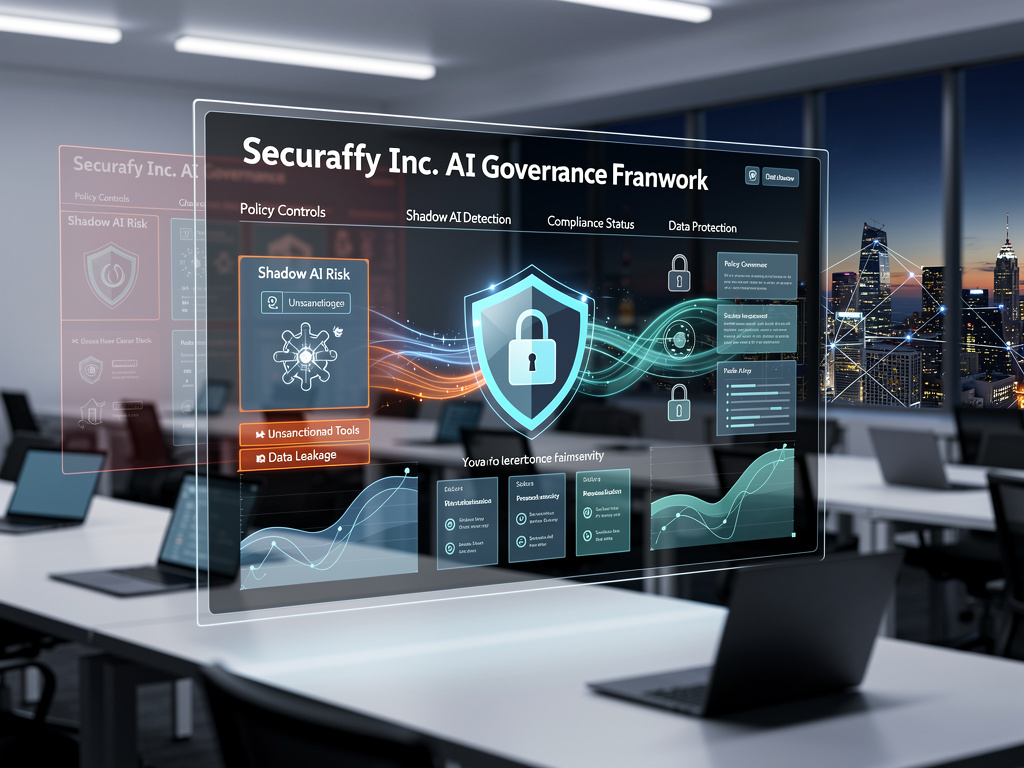
For years, the conversation around artificial intelligence governance has been dominated by Fortune 500 boardrooms, federal regulators, and Silicon Valley titans. But a quieter, more insidious problem has been metastasizing across the American economy: the millions of small and mid-sized businesses where employees are adopting AI tools with no oversight, no security protocols, and no strategic framework whatsoever.
Securafy Inc., a cybersecurity and IT management firm focused on the SMB market, is now attempting to fill that void. The company recently introduced what it describes as an end-to-end AI adoption framework designed specifically for small and mid-sized business leaders who are grappling with the rapid, often ungoverned proliferation of AI tools across their organizations. As reported by Yahoo Finance, the framework addresses growing concerns around what the industry has come to call “shadow AI” — the unsanctioned use of generative AI tools by employees operating outside the purview of IT departments and executive leadership.
The Shadow AI Problem Is Bigger Than Most Business Owners Realize
The term “shadow AI” may sound like a buzzword, but the underlying phenomenon is alarmingly concrete. Employees across industries are feeding proprietary data into ChatGPT, using AI-powered coding assistants without security review, and deploying automation tools that touch sensitive customer information — all without their employers’ knowledge or consent. For large enterprises with dedicated chief information security officers and robust compliance teams, these risks can be identified and mitigated. For a 50-person manufacturing firm in Ohio or a regional healthcare provider in Texas, the exposure is essentially unmanaged.
According to the Yahoo Finance report, Securafy’s framework is designed to give these smaller organizations a structured path to AI adoption that balances innovation with risk management. The company’s approach encompasses AI readiness assessments, policy development, employee training, and ongoing monitoring — a comprehensive suite of services that until now has largely been available only to organizations with enterprise-scale budgets.
Why SMBs Are Uniquely Vulnerable to Ungoverned AI Adoption
The vulnerability of small and mid-sized businesses to AI-related risks is a function of both resource constraints and organizational culture. Unlike their larger counterparts, SMBs typically lack dedicated cybersecurity staff, formal technology governance committees, or the budget to engage top-tier consulting firms for AI strategy work. Yet their employees have the same access to powerful generative AI tools as anyone working at JPMorgan Chase or Google.
This creates a dangerous asymmetry. The tools are enterprise-grade in their capabilities but are being deployed in environments with startup-grade — or worse, nonexistent — governance. Data leakage, intellectual property exposure, regulatory noncompliance, and reputational risk all escalate dramatically when AI tools are adopted in an ad hoc fashion. The problem is compounded by the fact that many SMB leaders are themselves uncertain about how AI should be integrated into their operations, leading to a vacuum of leadership that employees fill on their own terms.
Securafy’s Framework: A Closer Look at the Architecture
Securafy’s AI adoption framework, as detailed by Yahoo Finance, is built around several core pillars. The first is an AI readiness assessment that evaluates an organization’s current technology infrastructure, data handling practices, and workforce capabilities. This diagnostic phase is critical because it establishes a baseline understanding of where AI tools are already being used — often revealing shadow AI deployments that leadership was entirely unaware of.
The second pillar involves policy development. Securafy works with SMB leaders to create acceptable use policies for AI tools, data classification guidelines that determine what information can and cannot be processed by AI systems, and incident response protocols for AI-related security events. The third pillar is employee education — a component that the company emphasizes as perhaps the most important. Without workforce buy-in and understanding, even the most sophisticated governance framework will fail. The final pillar is ongoing monitoring and iteration, recognizing that AI technology and its associated risks are evolving at a pace that demands continuous vigilance rather than one-time compliance exercises.
The Regulatory Pressure Is Building — and SMBs Aren’t Ready
The timing of Securafy’s initiative is notable given the accelerating pace of AI regulation at both the state and federal levels. The European Union’s AI Act has already begun to reshape how companies operating in or selling to European markets must handle AI governance. In the United States, a patchwork of state-level regulations — from Colorado’s AI Act to proposed legislation in California, New York, and Illinois — is creating a compliance environment that grows more complex by the month.
For large enterprises, navigating this regulatory terrain is a matter of adding headcount to legal and compliance departments. For SMBs, it represents an existential challenge. A single data breach caused by an employee feeding customer records into an unsanctioned AI tool could trigger regulatory penalties, litigation, and reputational damage that a small business simply cannot absorb. Securafy’s bet is that proactive governance is far less expensive than reactive crisis management — and that SMB leaders are beginning to understand this calculus.
The Broader Industry Context: AI Governance as a Growth Market
Securafy is not operating in isolation. The AI governance space has emerged as one of the fastest-growing segments of the enterprise technology market, with firms ranging from established cybersecurity players to venture-backed startups competing for market share. Companies like OneTrust, Fairly AI, and Credo AI have all staked out positions in the governance and responsible AI space, though their primary focus has historically been on mid-market and enterprise clients.
What distinguishes Securafy’s approach is its explicit focus on the SMB segment — a market that represents the vast majority of American businesses by count but has been largely underserved by the AI governance industry. According to U.S. Small Business Administration data, small businesses account for 99.9% of all U.S. firms and employ nearly half of the private-sector workforce. The sheer scale of the SMB market means that ungoverned AI adoption at this level represents a systemic risk to the broader economy, not merely an isolated concern for individual business owners.
The Human Element: Why Training Matters More Than Technology
One of the more nuanced aspects of Securafy’s framework is its emphasis on the human dimension of AI governance. Technology controls — such as blocking access to certain AI tools or implementing data loss prevention systems — are necessary but insufficient. The reality is that determined employees will find workarounds, and overly restrictive policies risk driving AI use further underground rather than eliminating it.
Securafy’s approach instead prioritizes education and cultural change. By helping employees understand why certain AI practices are risky and equipping them with approved alternatives, the framework aims to transform the workforce from a source of AI risk into a line of defense. This philosophy aligns with broader trends in cybersecurity, where the industry has increasingly recognized that human behavior, not technological vulnerability, is the primary vector for most security incidents.
What Comes Next for AI Governance in the SMB Market
The introduction of Securafy’s framework raises important questions about the future of AI governance for smaller organizations. Will the market see a proliferation of similar offerings from competing firms? Will insurance companies begin requiring AI governance frameworks as a condition of cyber liability coverage? And will regulators eventually mandate AI governance standards for businesses below a certain size threshold?
All of these outcomes are plausible, and several are already beginning to materialize. Cyber insurance underwriters have increasingly been asking about AI usage in their risk assessments, and it is only a matter of time before formal governance frameworks become a prerequisite for coverage. For SMB leaders, the message is clear: the window for voluntary, proactive AI governance is narrowing. Companies that wait for regulation or a security incident to force their hand will find themselves playing catch-up in an environment that rewards preparation and penalizes complacency.
Securafy’s move to establish a standard for responsible AI adoption in the SMB market may prove to be an inflection point — not because one company’s framework will solve the problem single-handedly, but because it signals that the industry is finally taking seriously the needs of the businesses that form the backbone of the American economy. The question now is whether SMB leaders will seize the opportunity before the risks they’ve been ignoring seize them first.


 WebProNews is an iEntry Publication