
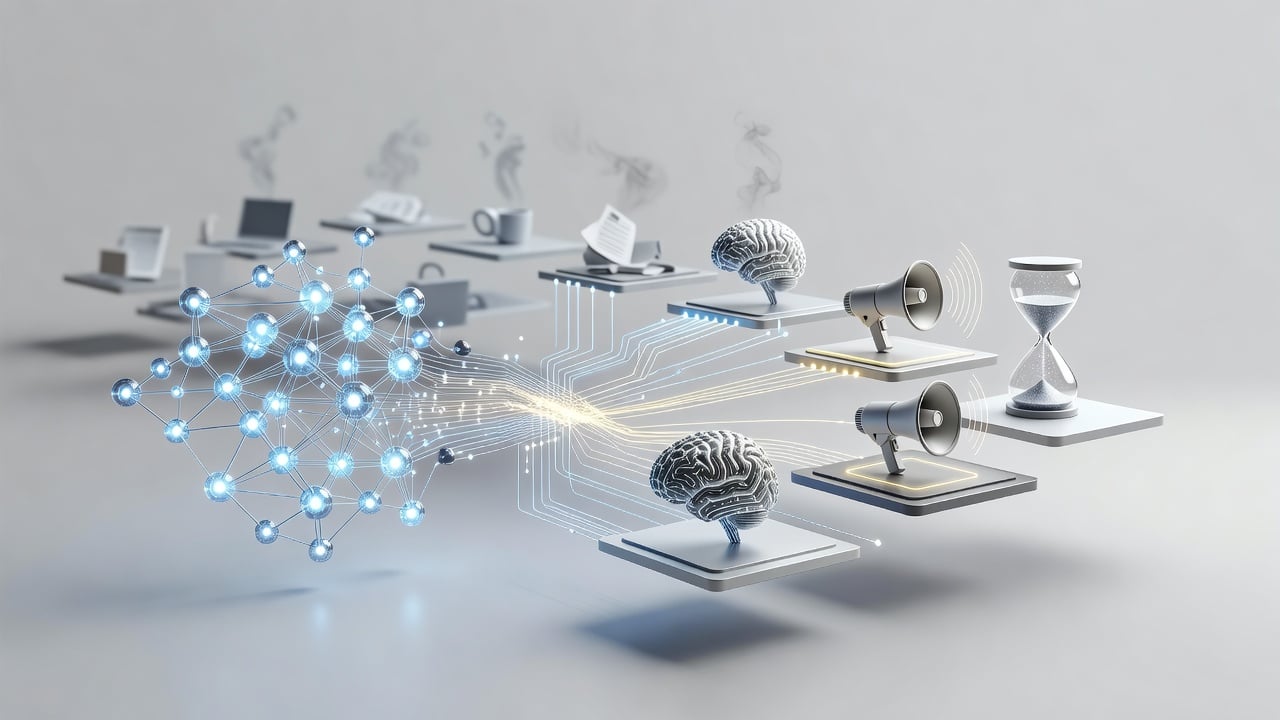
Workers check their phones dozens of times an hour. Notifications ping every couple of minutes. Deep thought? It lasts less than a minute before the next distraction hits. This isn’t just a personal failing. It’s a business problem costing billions.
From Factory Floors to Fractured Focus
Jayney Howson saw it firsthand at ServiceNow. As the company’s chief learning officer, she watched employees struggle to stay on task. Constant digital interruptions eroded their ability to concentrate. So ServiceNow built something different. They call them mind gyms. An AI-powered platform that treats mental focus like a muscle to be trained.
“When people moved from the fields and the mines and the factories onto a desk, we had an obesity epidemic and then gyms were created so that people could find time to go and build muscle,” Howson said. “The same thing is true now for the mind.” (Fortune)
The setup sounds simple at first. A “personal professor” – an AI guide – leads employees through brief cognitive drills. These exercises target focus, critical thinking and mental sharpness. One popular module puts sales staff in front of lifelike AI customers. The avatars hold realistic conversations. The system scores performers on eye contact, filler words and how concise they stay. Results have been striking. Some 75% of participants return to repeat the drill voluntarily.
But the real twist comes afterward. Workers then pair off with actual colleagues. They apply the practiced skills in live discussions. AI handles the repetitive practice. Humans handle the nuance. Howson insists this balance matters. Technology shouldn’t replace interaction. It should prepare people for it.
The numbers behind the problem paint a grim picture. Microsoft’s 2025 Work Trend Index, drawn from trillions of productivity signals, found employees face an interruption roughly every two minutes. That adds up to about 275 disruptions per day. (Speakwise)
Consequences follow. The average U.S. worker loses one hour and 18 minutes daily to distractions. Over a year that equals more than eight full workweeks. Distractions drain $468 billion annually in the United States alone. Managers lose around $37,000 each. Individual contributors lose about $21,000. And 80% of workers say they lack the time or energy to perform effectively. (Speakwise)
Other studies echo the alarm. Research from workplace analytics firm Insightful shows 79% of employees cannot focus for a full hour without distraction. Nearly 60% can’t manage even 30 minutes. Some 11% report getting pulled away every five minutes. (LinkedIn)
Gallup’s State of the Global Workplace 2026 report delivers an even broader blow. Just 20% of employees worldwide felt engaged in 2025. The resulting productivity gap? An estimated $10 trillion lost globally. (Gallup)
These figures arrive as lawsuits against major social media platforms intensify scrutiny on tech addiction. Cases targeting companies like Meta and Google have renewed debate over how platforms hook users. Employers now feel the downstream effects in meeting rooms and open offices alike. (Fortune)
ServiceNow’s experiment stands out because it flips the script. Instead of simply limiting screen time or preaching digital minimalism, the company deploys more technology. Targeted AI. Designed not to entertain but to rebuild capacity. The personal professor adapts exercises. It tracks progress. It offers feedback in real time.
Critics might scoff. More screens to fix screen addiction? Howson pushes back. “The narrative right now is all about what the human is doing wrong,” she said. “We’ve got to change the narrative to: are we creating the conditions for incredible human potential to be unlocked?” (Fortune)
Her point lands with growing force. Recent surveys from SHRM reveal 41% of workers already use AI on the job. Yet nearly half of those users describe some of their AI-assisted output as “AI slop” – low-quality material that requires heavy human cleanup. Entry-level staff feel particular pressure. Some 45% report expectations to adopt AI tools quickly. (SHRM)
McKinsey’s research from early 2025 adds context. Almost every company invests in AI. Few feel they have reached maturity. Only 1% of leaders describe their organizations as fully integrating the technology into workflows with clear business impact. Employees stand ready. Leadership lags. (McKinsey)
Other players explore adjacent ideas. Andrew Yang’s Noble Mobile pays users to reduce phone time, directly attacking the attention economy. Productivity tools like Clockwise, Reclaim AI and Motion use artificial intelligence to guard calendar blocks and minimize context switching. These solutions focus on prevention. ServiceNow’s mind gyms emphasize training. (TechCrunch)
So far the early data from ServiceNow looks promising. High repeat usage suggests employees find value. The blend of AI simulation and human follow-up avoids the trap of pure automation. Sales teams sharpen pitches without boring colleagues with endless rehearsals. Cognitive exercises build habits that might transfer to complex problem solving or strategic thinking.
Challenges remain. Will gains stick beyond the training sessions? Can AI truly replicate the unpredictable elements of human conversation? And what happens at companies without ServiceNow’s resources? Smaller firms may struggle to build similar systems.
Still. The approach signals a shift. Organizations increasingly view attention as a trainable skill rather than an inevitable casualty of modern work. They invest in tools that counter digital fragmentation with deliberate practice. They treat the mind like any other asset worth developing.
Phone checks won’t disappear tomorrow. Notifications will keep arriving. Yet companies like ServiceNow bet that targeted AI can help workers push back. Build resilience. Reclaim some measure of control. The mind gym may not solve everything. But it offers one concrete response to a problem that has grown too large to ignore.


 WebProNews is an iEntry Publication