
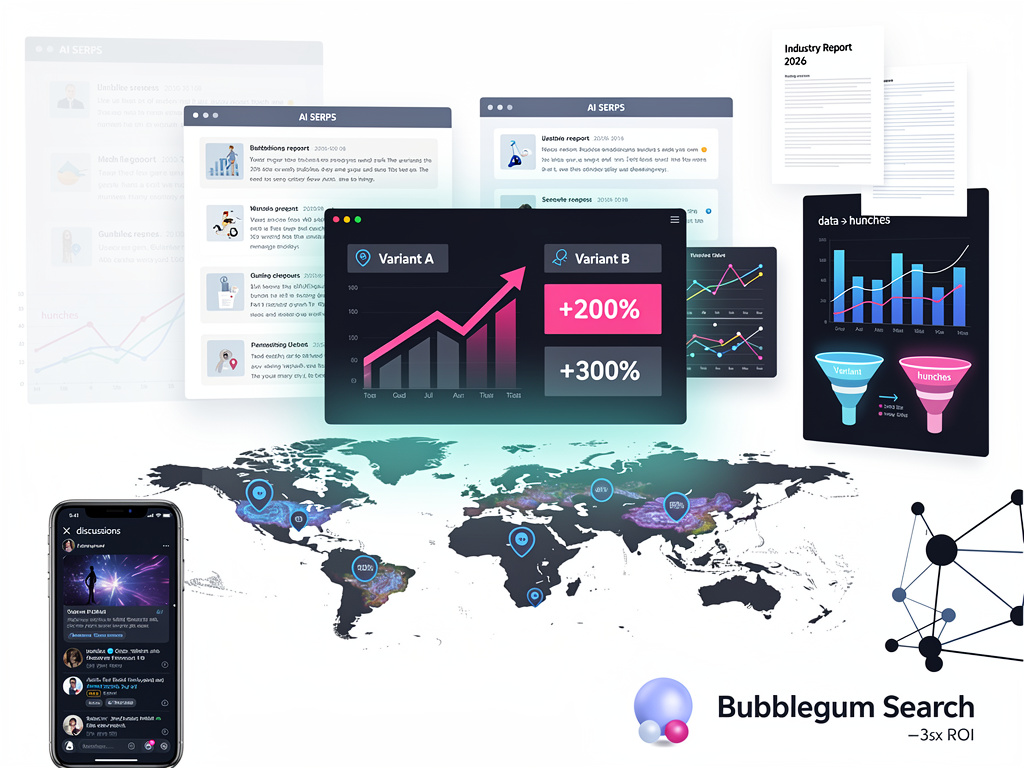
In the high-stakes arena of search engine optimization, where billions in revenue hinge on rankings, a stark divide separates elite performers from the pack. Top agencies now swear by rigorous testing protocols, ditching gut-driven hunches for data-backed experiments. As Google’s algorithms evolve with AI integration and zero-click features, firms clinging to outdated guesses face obsolescence. Recent industry discourse, amplified on X, underscores this shift: ‘Most SEO agencies don’t fail because they lack tools. They fail because they guess,’ posted Bubblegum Search on January 15, 2026.
The catalyst for this transformation traces to empirical revelations. A seminal study by Search Engine Journal revealed that 30-40% of common audit recommendations yield no impact, as shared in a 2018 X post by Cyrus SEO citing Will Critchlow. Fast-forward to 2026, and voices like Julian Goldie, CEO of Goldie Agency, warn in a DesignRush podcast that agencies ignoring AI SEO, generative engine optimization (GEO), and zero-click searches risk irrelevance amid Google’s updates.
Bubblegum Search, a Surrey-based firm, crystallized the debate in their January 2026 blog post, ‘Testing vs Guessing: How Good SEO Agencies Actually Work’ (Bubblegum Search). They argue that superior agencies deploy controlled experiments—measuring variables like click-through rates, dwell time, and conversion lifts—before scaling tactics across client sites.
Decoding the Guesswork Trap
Guessing permeates SEO when agencies apply blanket fixes: bulk schema markup, keyword stuffing, or generic backlink blasts without validation. AmpiFire highlighted this on X, noting ‘71% of SEOs never test whether their schema implementations actually do anything,’ in a January 12 post. Such practices stem from ‘SEO cargo culting,’ where tactics succeed once by chance and get replicated blindly, per Bubblegum Search’s analysis.
The perils compound in 2026’s volatile environment. WordStream’s nine SEO trends report from January 9 details surging AI-generated SERP results, Reddit spam proliferation, and GEO’s rise, demanding adaptive strategies. Agencies guessing amid these shifts report client churn rates exceeding 40%, according to internal benchmarks cited by Bubblegum Search.
Contrast this with testing regimes. Bubblegum outlines a four-step framework: hypothesize based on data, isolate variables in live tests, measure against control groups, and iterate only on proven winners. This mirrors CRO practices, where Faraz on X warned January 13 about redesigns tanking performance without phased rollouts.
Tools Powering Precision Experiments
Elite agencies arm themselves with suites like those ranked by Rankability on January 8, including Ahrefs for backlink audits, SEMrush for competitor SERP analysis, and custom A/B platforms adapted for page-level SEO tests. Lenny Rachitsky’s 2020 X thread, referencing Fan Favorite, emphasized SEO experiments’ uniqueness: testing at the page level, not user, with metrics like NDCG and MRR pre-deployment, as Archie Sengupta detailed on X in May 2025.
Bubblegum Search implements ‘SEO labs’—sandboxed environments simulating live SERPs. They cite a case where testing title tag variations boosted CTR by 22% for a B2B client, validated over 90 days. This data-first ethos aligns with Marketer Milk’s January 2 trends, where conference insights reveal testing as the differentiator post a decade of stagnant tactics.
Investment pays off. Agencies using statistical significance thresholds (p-value < 0.05) see 2-3x ROI on organic traffic, per Bubblegum’s client aggregates. Peter’s January 12 X post on AI synthetic focus groups for CRO, now adopted by Shopify, hints at SEO’s next frontier: pre-live simulations achieving 90% accuracy.
Case Studies Exposing the Divide
Bubblegum’s education sector client exemplifies success. Guessing-era tactics—vague content audits—yielded flat rankings. Post-testing: targeted GEO experiments for school admissions queries lifted impressions 150% and conversions 35%, as detailed in their blog. This outperforms industry averages, where Semrush’s 2026 U.S. agency list shows many still tout unverified case studies.
In e-commerce, Shopify specialists at Bubblegum tested schema against structured data alternatives. Results: a 17% revenue uptick from rich snippets, validated via multi-variant tests. Paolo Trivellato’s X post on LLM SEO agencies booking $500k pipelines by niching into SaaS underscores scalable testing’s revenue potential, from January 27, 2025.
Failures illuminate risks. An unnamed agency’s Reddit spam push, guessed from 2025 trends, triggered penalties, costing $200k in lost leads—Bubblegum’s cautionary tale. Nell VH’s X insight on January 11: ‘Most agencies react to SEO. Strong ones anticipate it’ via SERP pattern studies, positions testers as prophets.
Red Flags in Agency Pitches
Bubblegum’s prior guides, like ‘6 Red Flags When Choosing an SEO & Digital PR Agency’ (November 27, 2025), flag guessers: vague timelines, no test data, or ‘guaranteed rankings.’ Their ’11 Key Questions’ post (October 20, 2022) probes for experiment histories. In 2026, demand proof-of-concept pilots, as Silverback Strategies ranks firms on measurement teams and CRO integration.
Expert consensus builds. Brian Dean’s 2019 X survey via Rand Fish showed relevance, keywords, and links as top signals, but 2026 updates prioritize E-E-A-T and user signals testable only empirically. Mariano Diaz’s January 14 X on ad volume testing translates to SEO: ‘test the most angles, fastest’ for advantage.
Forward-looking agencies integrate AI for hypothesis generation, human oversight for execution. Reha Sonmez on X January 9 stresses real data over assumptions, building tools for industry-specific relevancy.
Building a Testing-First Culture
Transitioning demands cultural overhaul. Bubblegum advocates weekly experiment cadences, shared dashboards, and failure normalization—’every test teaches,’ they state. This yields compounding gains: one agency’s six-month testing sprint netted 40% YoY traffic growth.
As 2026 unfolds, with Frack Tech’s top U.S. firms emphasizing data-driven growth, the message is clear. Guessing fueled the 2010s boom; testing sustains the 2020s empire. Agencies adapting thrive; others fade into digital irrelevance.


 WebProNews is an iEntry Publication