
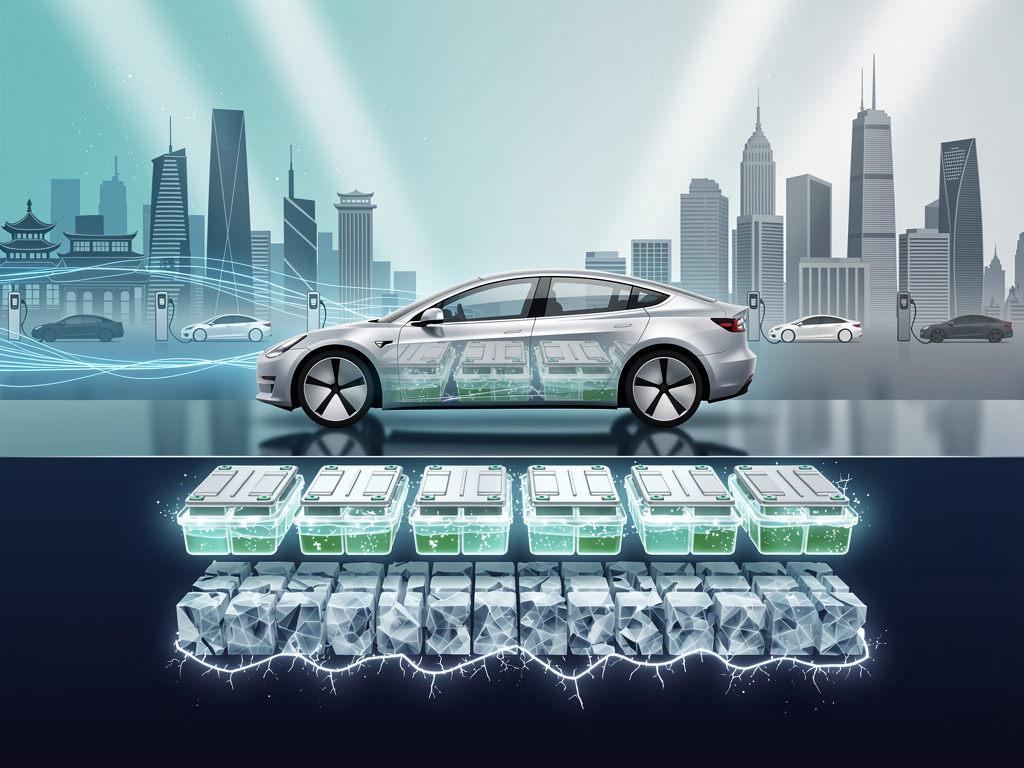
Promises of batteries that could double electric vehicle range and banish fire risks have circulated for years. Yet as 2026 unfolds, the vehicles hitting showrooms feature a compromise. Semi-solid designs, which blend solid particles with a dash of liquid electrolyte, deliver measurable gains today. True all-solid versions remain years from volume production.
That gap defines the current battery race. Chinese makers lead deployment. NIO sells cars with a 150-kilowatt-hour pack from partner WeLion that delivers roughly 577 miles of range on a single charge. The cells achieve 300 to 350 watt-hours per kilogram, a 20 to 30 percent improvement over conventional lithium-ion packs. Bonnen Batteries detailed the achievement in its January analysis of 2026 market shifts.
But these packs aren’t fully solid. They retain 5 to 15 percent liquid to ensure ion flow and ease manufacturing. The approach lets factories adapt existing lines rather than build from scratch. Safety improves anyway. Gotion Hi-Tech’s semi-solid G-Dome cell passed nail penetration tests that would ignite standard cells.
Europe gets its first taste this year. MG plans to launch the MG4 EV Urban equipped with a semi-solid-state battery it calls SolidCore. The 53.95-kilowatt-hour version promises around 420 kilometers of WLTP range. Charging from 30 to 80 percent takes 21 minutes on a capable fast charger. MG claims 30 to 50 percent better energy density, lifespan and safety compared with liquid-electrolyte cells. Acceleration, cold-weather performance and power delivery all rise by 15 to 20 percent. Forbes reported the specifications in March.
SVOLT intends to begin mass production of its own semi-solid cells in September. The company targets multiple vehicle models with a 100-kilowatt-hour variant among them. Honeycomb Energy declared 2026 the first year of solid-liquid hybrid batteries, with 100-kilowatt-hour packs reaching volume output by fall. These announcements reflect a pragmatic pivot. Full solid-state cells still struggle with interface resistance, dendrite formation and costly dry-room production.
David L. Wood III, founder of ChemPower Solutions, captured the tension in an April assessment. Manufacturing integration, not just new materials, will decide success. High compression requirements for solid-solid contact create voids that limit performance. Liquid electrolytes wet surfaces intimately. Solids do not. Battery Technology Online published his observations.
The Verge columnist Thomas Ricker put it bluntly last week. Solid-state batteries still aren’t ready, but gels are. Traditional lithium-ion cells triggered nearly 1.9 million power bank recalls in the United States in 2025 alone. E-bike fires prompted additional actions. Semi-solid gels resist thermal runaway far better. They last two to three times longer and perform in cold weather where liquid cells falter. Ride1Up’s Revv1 EVO e-bike, shipping in August with a 1,040-watt-hour semi-solid pack, withstands 1,200 cycles before dropping below 80 percent capacity. Giant and other makers follow with their own models. The Verge laid out the safety case.
Yet the industry hasn’t abandoned all-solid ambitions. Toyota aims for vehicles with 750-mile range by 2028. Samsung SDI targets mass production in 2027 after positive customer feedback on prototypes that reach 800 kilometers. CATL eyes small-series output by 2027 and has revealed details on sulfide-based cells with 20-amp-hour samples under validation. Greater Bay Technology, backed by GAC Group, claims it rolled out the world’s first mass-producible all-solid-state A-sample cells and wants production this year.
These targets draw skepticism. A July 2025 CarNewsChina article cited scientists who called volume output before the 2030s unrealistic. Honda operates a demonstration roll-to-roll line for all-solid cells, but scaling yields and costs remains difficult. Sulfide electrolytes conduct ions well but react with moisture to produce toxic gas. Oxide versions are stable yet brittle and demand high-temperature processing. Both formats resist easy cylindrical cell production.
Costs tell another story. Early all-solid packs run three to five times more expensive than current lithium-ion. Semi-solid versions add only a modest premium while delivering immediate benefits. That math explains why hybrids dominate near-term roadmaps. Stellantis and Mercedes test semi-solid cells from Factorial Energy. BMW evaluates all-solid prismatic cells from Solid Power. QuantumScape ships samples to automakers and licensed its process to Volkswagen’s PowerCo unit.
China formalizes the transition. A new solid-state battery standard takes effect in July. Regulators there enforce strict puncture and safety tests that favor gels over liquids. The country already controls much of the supply chain. Its manufacturers ship semi-solid packs in NIO, IM Motors, Dongfeng and MG vehicles. Svolt, Gotion and others expand production lines measured in gigawatt-hours.
Western observers watch closely. A February report from Engineer Live noted that while true solid-state cells stay rare, semi-solid systems already appear in production cars, particularly in China. Energy density targets climb steadily. Labs demonstrate cells above 500 watt-hours per kilogram, even 600 in select prototypes. Aviation and grid storage applications may adopt advanced versions sooner than passenger cars.
Still, physics imposes limits. Areal capacities in solid-state prototypes often fall short of the 4 milliamp-hours per square centimeter common in liquid cells. Low-temperature performance suffers without careful engineering. Cycle life varies widely. Some experimental cells manage only hundreds of cycles before degradation accelerates.
So the market splits. Consumers gain safer, longer-lasting batteries in the next one to two years. E-bikes, power banks, and entry-level EVs adopt semi-solid packs first. Premium models may follow with higher-density hybrids. All-solid cells, when they arrive at scale in the early 2030s, could enable lighter vehicles, faster charging and lithium-metal anodes free of graphite. But that future requires solving interface stability, compression needs and cost at volume.
Automakers hedge. They install semi-solid packs now while funding labs for the next leap. Suppliers race to lock in contracts. Investors pour money into both paths. The result feels incremental rather than sudden. No single breakthrough erases a decade of dashed timelines. Instead steady engineering gains accumulate.
Range anxiety eases a bit with 500-plus-mile packs. Fire risk drops. Cold-weather performance improves. These wins matter to drivers today. They also buy time for the harder problems. Pure solid-state batteries may one day deliver on every early promise. For now the gels bridge the distance. And that bridge looks increasingly sturdy.


 WebProNews is an iEntry Publication