
Four hardware builders stepped up last week in a downtown Seattle law firm conference room. They placed their creations on the table and walked attendees through the messy realities of turning ideas into working devices that must survive farms, orbit or the factory floor.
The evening, organized as part of Deep Tech Week, mixed show-and-tell with hard-earned lessons. No pitch decks. No slides filled with hockey-stick graphs. Just founders cradling prototypes and explaining what broke last month.
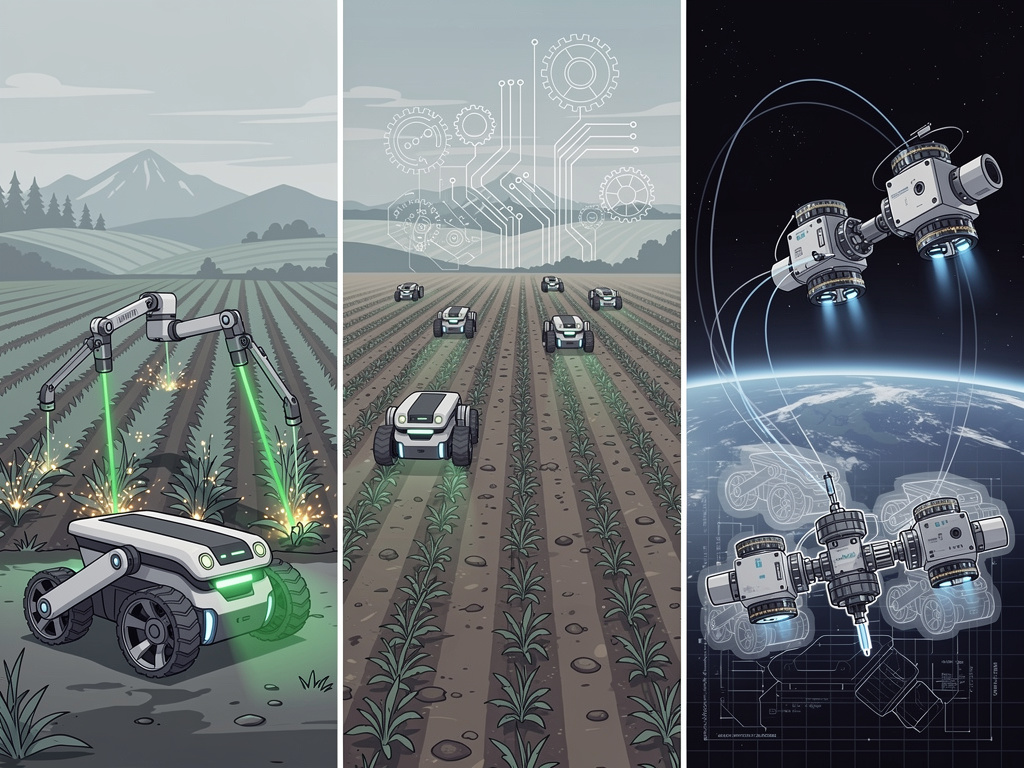
Paul Mikesell, founder and CEO of Carbon Robotics, kicked things off. He pointed to the LaserWeeder, a machine that rolls through vegetable fields and zaps weeds with pinpoint accuracy. “We had to get the cost down,” he said, according to GeekWire. The system uses AI vision to identify plants. Then it fires a laser. No chemicals. No hand-weeding crews.
Yet success demanded more than clever optics. Mikesell described years of field testing where dust, rain and uneven terrain wrecked early versions. Carbon Robotics has raised more than $85 million to date, per Crunchbase data referenced in multiple reports. Farmers care about one metric above all: does it save money compared with herbicides and labor? The answer increasingly appears yes. But only after the hardware proved tough enough for real dirt.
Next to the LaserWeeder sat a different kind of gadget. An engineering model of a spacecraft, too large to lift easily. Austin Link, co-founder of Starfish Space, used it to explain his company’s approach to orbital servicing. The Otter Pup spacecraft recently began an in-orbit satellite docking test, GeekWire reported on June 9, 2026.
Link spoke about the economics of space. Satellites die when they run out of fuel or suffer minor failures. Starfish aims to extend their lives by docking, refueling or repositioning them. The model on the table represented years of iteration on propulsion, guidance and capture mechanisms. “It’s all about making the business case close,” Link noted in the session. The hardware must work. The unit economics must work better.
His presentation carried extra weight given recent momentum in the sector. In September 2025, rival Rendezvous Robotics raised $3 million to develop self-assembling structures for orbit, SpaceNews reported. That startup, spun from MIT research, has already tested hardware on the International Space Station twice. The convergence feels unmistakable. Both companies chase the same vision: infrastructure that persists and grows in space instead of burning up on reentry.
Across the table, another founder displayed components from a system designed to operate without human presence. The details stayed technical. Yet the message came through clearly. Reliability in vacuum demands testing that ground-based engineers can barely simulate. Failures cost millions and years. These builders accept that calendar.
The fourth participant rounded out the group with technology aimed at precision tasks on Earth. Attendees saw small mechanisms and heard stories of integration challenges with existing industrial setups. Each speaker returned repeatedly to a common theme. Hardware iteration takes patience that software developers rarely face.
But something larger hung in the room. Investors have poured billions into robotics companies in recent years. Crunchbase recorded $6 billion in the first seven months of 2025 alone for the category, according to a TechCrunch analysis from September 2025. That pace continues. Figure AI drew headlines in 2025 with talks of a nearly $40 billion valuation despite limited revenue, as detailed in The Wall Street Journal.
Seattle’s gathering felt different from the spectacle at CES earlier this year. There, robots danced, played ping-pong and folded laundry with varying degrees of clumsiness. Coverage from The New York Times Wirecutter in January 2026 called 2026 “the year of the bad robot” at the show. Consumer-facing demos grabbed attention. The Seattle founders focused on unglamorous problems: weed control in lettuce fields, satellite life extension, autonomous labor in orbit.
Carbon Robotics stands out in that group. Its LaserWeeder already operates commercially. The company raised a Series C round in 2024 that brought total funding to $85 million, Crunchbase News noted. Mikesell didn’t sugarcoat the path. Early machines required constant tweaks. Computer vision had to distinguish crops from weeds under changing light conditions. The laser system needed enough power without damaging soil or nearby plants.
Those refinements took time. They also required close work with growers who tolerated trial runs on their land. The resulting data improved the AI. The business improved with it. Now the company sells a service that reduces herbicide use dramatically. For some crops, that shift matters as much for regulatory compliance as for cost.
Starfish Space takes a parallel bet on reuse. The Otter Pup isn’t a one-off experiment. The company plans repeated missions that capture value from satellites that would otherwise become debris. Austin Link’s oversized model illustrated the scale. Real flight hardware must survive launch loads, operate for years in radiation, and perform delicate maneuvers with centimeter precision.
The docking test underway as of June 2026 marks a critical milestone. Success could unlock contracts with satellite operators eager to protect billion-dollar constellations. Failure would send the team back to the drawing board. No one in the room pretended otherwise.
Recent activity elsewhere reinforces the pattern. Icarus Robotics raised $6.1 million in seed funding in late 2025 to develop robotic workers for commercial space stations, Payload Space reported. Its founders, fresh from Entrepreneurs First and with backgrounds at JPL and Formula 1, target routine tasks that consume astronaut time today. The goal: free humans for higher-value work while cutting operational costs.
These ventures share more than ambition. They face the same constraint. Physical systems resist rapid scaling. Simulation helps. But nothing replaces hours under actual conditions. Dust on a farm. Thermal extremes in orbit. Vibration during launch. Each environment reveals weaknesses that lab work misses.
That reality explains why veteran engineers fill these companies. Mikesell built database systems before turning to agriculture robotics. Link and his Starfish co-founders drew from aerospace programs that emphasized testing to destruction. Their patience shows in the hardware they brought to the Seattle event.
Attendees left with more than photos of gadgets. They heard founders admit mistakes. They saw prototypes that looked rough in places. One speaker joked that his device had duct tape hidden under a panel. The line drew laughs. It also rang true.
Funding flows toward these teams precisely because the problems resist easy solutions. AI advances help interpret sensor data. Yet actuators, power systems and materials still obey physics. Progress comes incrementally. A better laser diode here. Improved docking algorithms there. Each small win compounds.
The evening underscored Seattle’s role in this shift. The city hosts Boeing’s legacy, Amazon’s innovation muscle, and a growing cluster of space and robotics firms. Events like this one connect them. They let founders trade war stories away from the hype cycles that dominate larger conferences.
Carbon Robotics continues expanding its weeder deployments. Starfish pushes its Otter Pup through the current test campaign. Others in the room advance their own quiet breakthroughs. None claim victory yet. They simply keep shipping hardware that must work the first time customers turn it on.
And in that stubborn insistence on real performance over flashy demos lies the clearest signal for the years ahead. The robots are coming. But only after their creators spend enough nights debugging them in the rain, in the vacuum, and under deadline pressure that no algorithm can predict.


 WebProNews is an iEntry Publication