
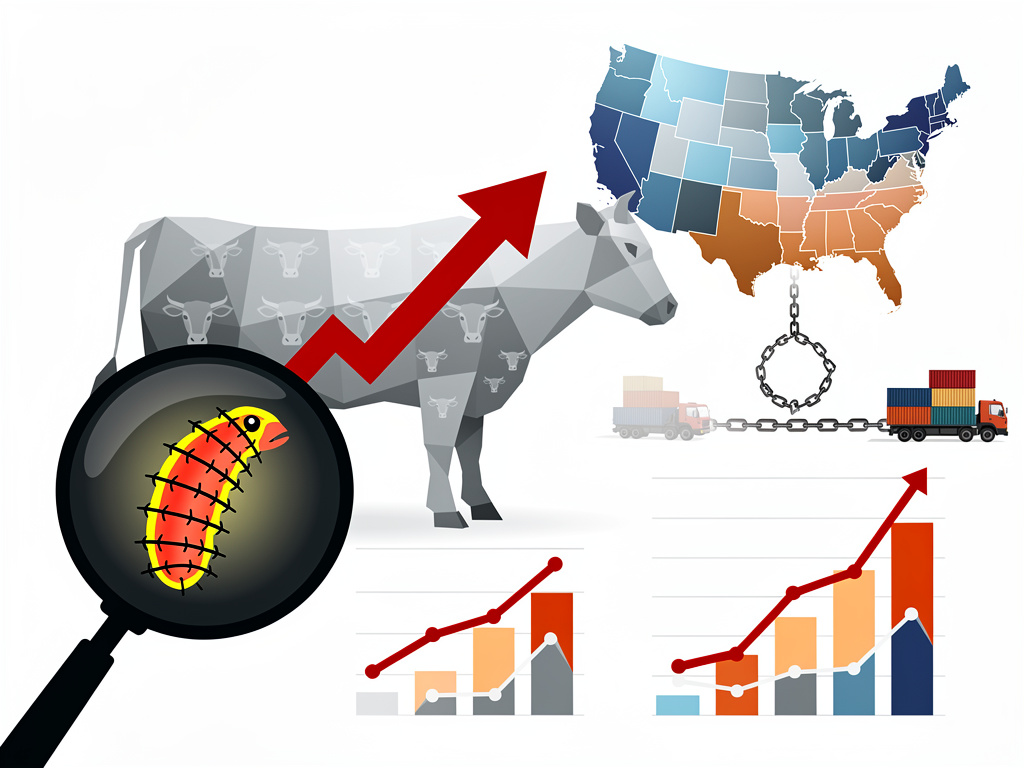
Ground beef costs 20% more than it did at the start of 2025. Steaks command even steeper premiums. Shoppers feel it at every checkout. Ranchers watch their margins tighten. And now a flesh-eating parasite has returned to U.S. soil after six decades of successful eradication.
The New World screwworm, a fly whose larvae burrow into open wounds of live animals, has infected cattle in south Texas and New Mexico. Cases remain limited. Yet the threat looms large. So does the smallest U.S. cattle herd in 75 years. Add in a looming July 1, 2026 deadline to review the United States-Mexico-Canada Agreement. The result? Persistent pressure on beef supplies and prices that shows no quick relief.
North American integration meets fresh shocks
Beef production across the U.S., Mexico and Canada operates as one interconnected system. Cattle cross borders multiple times from birth to slaughter. Feeder calves move north from Mexico. Fed cattle flow south from Canada. Processed beef travels in both directions to meet local demand. This flow kept supplies stable and prices manageable for years.
That changed. Live cattle imports into the U.S. dropped more than 50% in 2025. Mexican feeder cattle imports fell over 80% in early 2026. The screwworm outbreak in Mexico triggered the collapse. Canada responded by banning livestock from affected Texas and New Mexico regions. Fortune reported these exact trade disruptions and price surges on June 21, 2026.
Meanwhile drought has culled herds for years. The national cattle inventory sits at levels last recorded in the 1950s. Rebuilding takes time. Cows must be kept for breeding instead of slaughter. That delay stretches supply shortages into 2027 and beyond. Beef production will rise slowly at best, according to USDA projections cited in recent analysis.
Prices reflect the strain. The average cost of ground beef hit records in May 2026, up 13% from a year earlier per Bureau of Labor Statistics data. Some reports place it near $7 per pound. Steaks average closer to $13. These figures come from CNBC’s June 10 coverage of the screwworm’s potential to re-inflate record beef prices and Farm Progress reporting from the same week.
But. The trade dimension adds another layer. President Donald Trump has warned he may not renew USMCA. The agreement, which replaced NAFTA in 2020, faces its mandatory six-year review by July 1. A sunset clause means it could expire in 2036 without extension. Beef remained exempt from Trump’s 2025 tariffs on trading partners. That exemption could vanish if talks collapse.
Mexico ranked as the third-largest buyer of U.S. beef in 2025, purchasing over $1.3 billion. Canada followed at $874 million. Together they supplied more than $5 billion in beef and cattle to the U.S. market. Disruption here would ripple fast. Nontariff barriers, stricter inspections and new paperwork could slow movements that already cross borders several times during an animal’s life.
Ranchers understand the stakes. One told economists Andrew Muhammad and Charles Martinez, authors of the Fortune piece republished from The Conversation, “We can’t lose demand for our products. Look what happened with soybeans last year when China quit buying.” The quote appears directly in the June 21 Fortune article.
Trump appointed a screwworm czar in early June as cases mounted. Agriculture Secretary Brooke Rollins has coordinated with Mexico and deployed sterile fly releases, a technique that helped eradicate the pest from the U.S. in the 1960s. Yet past outbreaks inflicted heavy damage. A 1935 event killed an estimated 180,000 cattle. A 1970s flare-up in Texas cost millions.
Recent coverage highlights the tension. Politico noted on June 7 how the parasite threatens Trump’s goals of lowering beef prices ahead of midterms. USDA estimates suggest a widespread Texas outbreak could generate $1.8 billion in losses and $732 million annually in ongoing costs. Those figures come from historical impact studies referenced across multiple outlets.
Some experts push back on immediate consumer panic. Derrell Peel, an Oklahoma State University economist, told the Reporter-News that with only a handful of cases confirmed, the broader market impact stays minimal. “This thing is not going to affect cattle prices, and it’s not going to affect beef production, because not that many animals are involved,” he said. The story ran four days before the Fortune analysis.
Still, the combination of factors creates a perfect storm. Herd liquidation peaked in 2022 after years of drought. Rebuilding requires favorable conditions that have not materialized. Screwworm containment efforts now compete with trade negotiations. And consumers already facing high grocery bills see little relief in sight.
Mexico has adapted by processing more cattle domestically rather than exporting feeders. Mexican beef exports to the U.S. rose sharply in early 2026. That shift, detailed in Reuters’ June 6 dispatch, has padded Mexican profits but left Texas feedlots scrambling for animals. One 70-year-old operation faces survival questions.
USDA confirmed the first U.S. case on June 3 in Zavala County, Texas. Additional detections followed in nearby La Salle County. A goat and a dog also tested positive. Officials stress the parasite poses low risk to humans and no threat to meat already processed. The larvae die when animals are cooked or properly handled.
Yet vigilance remains high. Sterile insect technique programs, once scaled back, now receive renewed attention. Cross-border coordination with Mexico continues despite trade friction. Canada’s import ban adds complexity for exporters.
Farm groups, long supportive of Trump, lobby hard to preserve USMCA provisions. They argue reversion to basic WTO rules would invite retaliatory tariffs and regulatory hurdles. Small delays in cattle movement compound quickly when animals change hands several times before reaching packing plants.
The economic signals point in one direction. Beef prices stay elevated. Herd recovery stretches years into the future. Trade uncertainty adds friction just as supply chains need stability. Summer grilling season arrives with fewer affordable options on the menu.
Ranchers brace for tighter margins. Processors hunt for alternative supplies. Consumers weigh whether to switch to chicken or simply eat less beef. The screwworm, drought and policy questions have merged into one stubborn reality. Cheap beef has become a memory. And the forces keeping it expensive show every sign of persisting.


 WebProNews is an iEntry Publication