
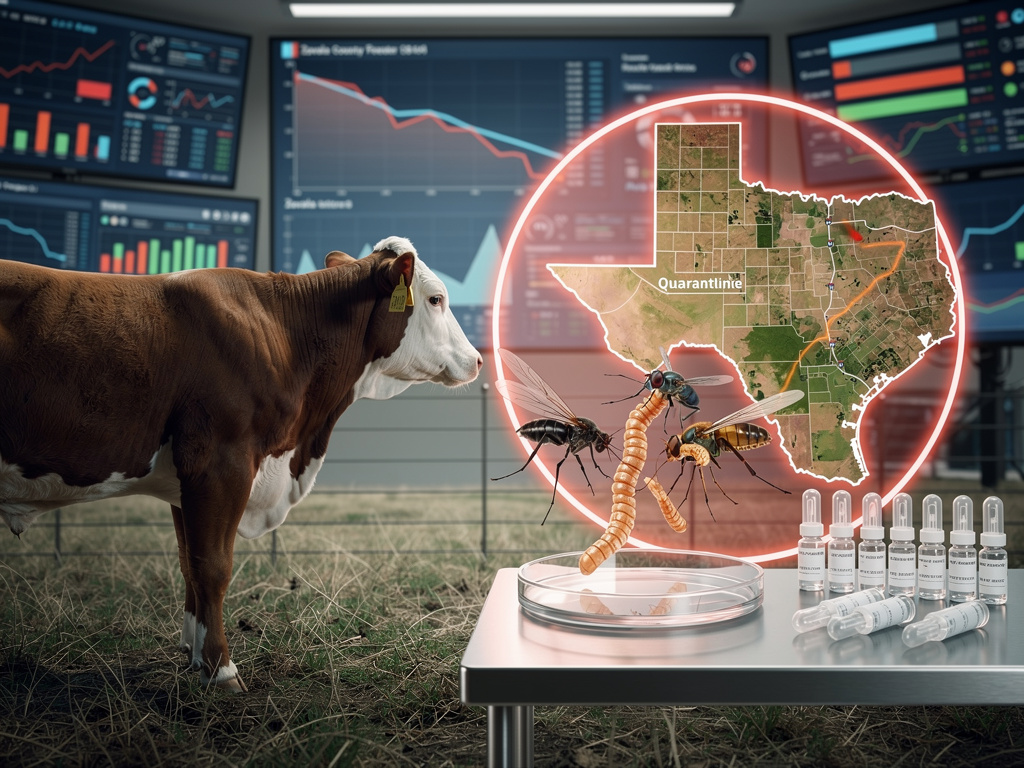
A single three-week-old calf in Zavala County, Texas. Larvae in its umbilical area. That discovery, confirmed on June 3, 2026, by the U.S. Department of Agriculture’s Animal and Plant Health Inspection Service, marks the first time the New World screwworm has been found in the state since 1966. The flesh-eating parasite had stayed south of the border for decades. No longer.
Officials moved fast. A 20-kilometer infested zone now surrounds the detection site. Quarantines restrict movement of all warm-blooded animals. Inspections and permits from the Texas Animal Health Commission are mandatory for anything leaving the area. And sterile flies? They’re being dropped in greater numbers. Ground release chambers supplement the four million sterile insects already dispersed weekly by air. The goal is simple. Mate with wild females. End the bloodline.
“All models showed New World Screwworm entering the country in 2025; however, thanks to the hard work across the entire Trump administration and our industry, state, and local partners, we were able to buy time for this moment,” said Dudley Hoskins, Under Secretary for Marketing and Regulatory Programs, in the USDA announcement. “Protecting our livestock industry is a national security issue of the utmost importance, and USDA is wasting no time in taking action.”
Yet the breach has rattled markets anyway. Feeder cattle futures on the Chicago Mercantile Exchange extended losses, closing 1.7 percent lower. August contracts fell to 342.625 cents per pound. Live cattle dropped 1.8 cents to 237.85 cents per pound. Shares of major meatpackers Tyson Foods and JBS slipped too. Traders voiced worry that even a contained incident could dent beef demand and shrink an already tight U.S. cattle herd, according to a Reuters report.
The parasite itself tells a brutal story. Female screwworm flies lay eggs in open wounds or mucous membranes. Larvae hatch and burrow into living flesh. They feed aggressively. Untreated infestations kill livestock, pets, wildlife, and occasionally humans. Unlike ordinary flies, these do not target dead tissue. They create fresh damage as they eat. One calf recovered after treatment. But scale the problem across ranches and the costs mount quickly.
Texas officials had warned for months. Cases in Mexico pushed northward. By early 2026, detections reached Tamaulipas, just miles from the border. The USDA halted cattle imports from Mexico in 2025. It expanded sterile fly releases into southern Texas. Eight thousand traps went up along the frontier. More than 58,000 fly samples and 19,000 wild animals were tested. Preparations bought time. They did not prevent the crossing.
Brooke Rollins, the agriculture secretary, struck a measured tone. The infested calf sat about 50 miles from the Mexico border in La Pryor. No additional detections have surfaced. “There is no reason to believe this incursion will result in establishment of the pest in our country,” she said, as reported by the Fortune article drawing on Associated Press coverage. The U.S. food supply remains safe. Screwworms do not infest meat.
But Texas State Veterinarian Bud Dinges delivered a direct plea to producers. “Please help us prevent any further movement of this pest by staying put.” The Texas Animal Health Commission designated the zone as Infested Zone 01, covering parts of Zavala and Uvalde counties. Warm-blooded animals, pets included, face strict controls. Ranchers must check livestock for draining wounds, discomfort, or visible maggots around body openings. Report suspicions immediately.
The response follows a detailed playbook. An incident command team unites federal and state personnel. Surveillance ramps up for both flies and wildlife. Targeted outreach reaches local producers. The National Veterinary Stockpile supplies treatments and equipment. Trade negotiators work to regionalize any restrictions, limiting them to the affected geography and sparing broader economic pain.
History offers both caution and confidence. The U.S. eradicated the screwworm in the 1960s and 1970s through the sterile insect technique. Factories once produced millions of irradiated males. Those facilities closed after success. Panama maintained the only major operation for years. Now production accelerates again. A fruit-fly plant in southern Mexico converts to screwworm output at a cost of $21 million. A new dispersal center operates in Texas. Construction proceeds on a $750 million domestic factory.
Yet the pest’s advance through Central America and Mexico since 2023 has been relentless. More than 171,700 animal cases and over 2,000 human cases reported across the region as of early June 2026, per CDC updates. The fly does not travel far on its own, officials stress. Human movement, pets, and wildlife can carry it. So vigilance extends beyond ranches.
Texas Agriculture Commissioner Sid Miller has criticized the pace of some federal measures. “Instead of using every available tool, USDA moved too slowly and relied solely on a partial solution that takes years to fully implement,” he said. The sterile fly method works. It simply demands sustained, large-scale effort. Models predicted an earlier arrival. Coordinated action delayed it by months.
Potential losses loom large. Pre-eradication outbreaks cost tens of millions annually, an amount that would reach billions in current dollars. One analysis tied to Texas alone once projected $2.1 billion for cattle and $9 billion for wildlife-related industries if the pest reestablished. A broader outbreak could push national cattle numbers even lower. The herd already sits near historic lows.
And. The response continues. Increased trapping outside the dispersal area. Wildlife management protocols. Outreach to ensure producers treat wounds promptly and maintain biosecurity. No one expects mass infestation. But the detection proves the threat is real. Containment must hold.
Recent coverage reinforces the urgency. A CNN story detailed the National Veterinary Services Laboratories confirmation from a sample sent to Ames, Iowa. The Associated Press account highlighted the third U.S. appearance in decades after the 2016 Florida Keys deer outbreak. Markets reacted before full confirmation in some cases. The pattern is clear. One calf changes calculations across the industry.
Producers face practical steps. Inspect animals daily. Clean and treat every wound. Avoid moving cattle without permits. Report anything suspicious to state hotlines. Federal teams already operate in the zone. Additional sterile fly releases accelerate. Success depends on rapid eradication before females lay viable eggs across a wider area.
The screwworm does not respect borders or forecasts. It exploits any opening. This time officials caught it early. The calf lived. The zone holds for now. Yet the episode exposes vulnerabilities built up over decades of complacency after eradication. Rebuilding capacity takes money and time. The pest demands both immediately.
So the work intensifies. Traps multiply. Flies disperse. Tests multiply. Trade talks proceed. And ranchers watch their herds with fresh eyes. One detection does not spell disaster. It does demand precision. The sterile insect technique defeated the screwworm once. Applied aggressively now, it can do so again. The stakes, for livestock, markets, and rural economies, leave little room for error.


 WebProNews is an iEntry Publication