
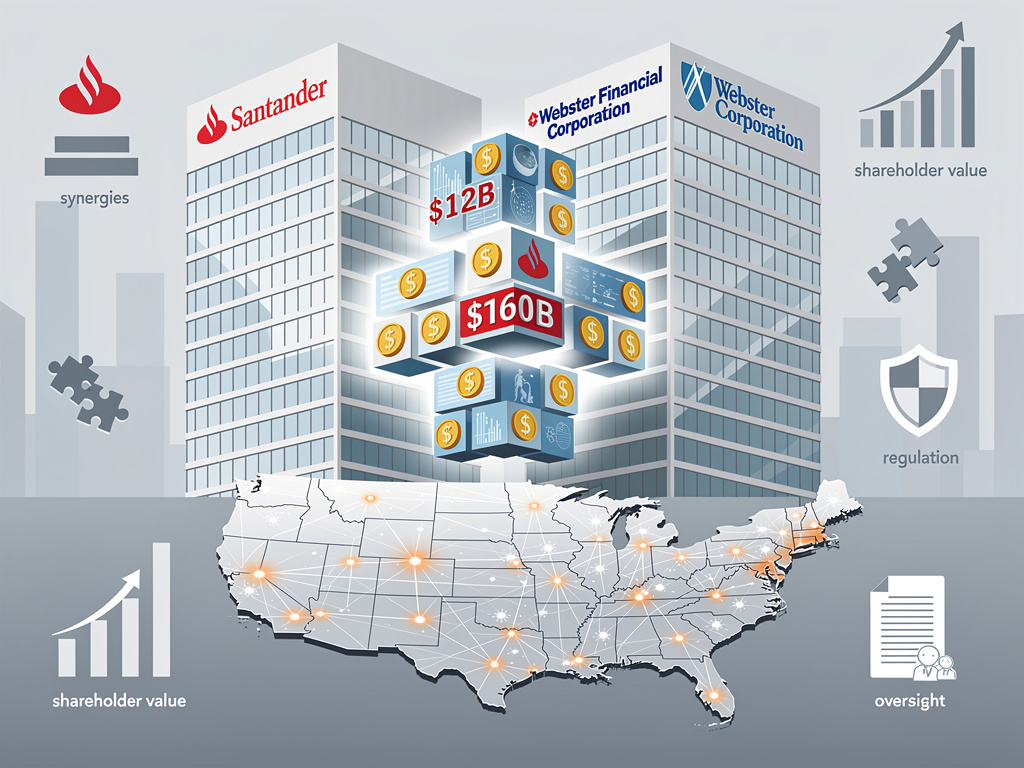
Santander Holdings USA has announced its intention to acquire Webster Financial Corporation in a transformative $12 billion transaction that promises to redraw competitive boundaries across the Northeast banking corridor. The all-stock deal, which values Webster at approximately $62.50 per share—representing a 24% premium over its closing price—signals a strategic pivot by the Spanish banking giant to consolidate its American footprint and challenge established regional players with enhanced scale and capabilities.
According to Banking Dive, the combined entity will command approximately $160 billion in assets, positioning it as a formidable competitor in markets stretching from New York to Massachusetts. This transaction represents one of the most significant bank mergers announced since regulatory scrutiny intensified following the regional banking turmoil of 2023, when institutions like Silicon Valley Bank and First Republic collapsed under the weight of deposit flight and interest rate pressures.
The strategic rationale extends beyond simple asset accumulation. Webster’s strong commercial banking franchise, particularly in middle-market lending and healthcare finance, complements Santander’s existing retail banking operations and auto lending prowess. The Stamford, Connecticut-based Webster brings deep relationships with businesses across Connecticut, New York, Rhode Island, and Massachusetts—markets where Santander has maintained a retail presence but lacked the commercial banking depth necessary to serve growing enterprises comprehensively.
Strategic Imperatives Driving Consolidation
The transaction emerges against a backdrop of persistent challenges facing mid-sized regional banks. Rising compliance costs, technology infrastructure demands, and competitive pressures from both larger national banks and nimble fintech challengers have compressed margins and forced strategic recalibrations. For Santander, which has operated its U.S. subsidiary with varying degrees of success since acquiring Sovereign Bank in 2009, the Webster acquisition represents an opportunity to achieve the critical mass necessary to compete effectively without the regulatory burden of crossing the $250 billion asset threshold that triggers enhanced Federal Reserve supervision.
Industry analysts note that the deal’s all-stock structure preserves capital flexibility while allowing Webster shareholders to participate in the upside of the combined entity. The transaction is expected to generate approximately $300 million in annual cost synergies within three years, primarily through branch consolidation, technology platform integration, and back-office efficiency improvements. However, these projections assume successful navigation of complex integration challenges that have derailed value creation in previous bank mergers.
The competitive implications ripple across multiple dimensions. In commercial banking, the merged institution will possess enhanced lending capacity to serve middle-market companies seeking credit facilities in the $10 million to $100 million range—a segment where relationships and local market knowledge create sustainable competitive advantages. Webster’s specialized expertise in equipment finance and asset-based lending adds capabilities that Santander has historically lacked in its U.S. operations, potentially opening new revenue streams and cross-selling opportunities.
Regulatory Scrutiny and Political Headwinds
The deal faces a regulatory approval process that has grown increasingly unpredictable under the Biden administration’s more skeptical approach to bank consolidation. Federal Reserve officials and the Office of the Comptroller of the Currency have signaled heightened scrutiny of transactions that reduce competition in local markets or raise systemic risk concerns. The Santander-Webster combination will undergo rigorous analysis of market concentration in specific geographies, particularly in Connecticut where both institutions maintain significant branch networks.
Community advocacy groups have already begun organizing opposition, citing concerns about potential branch closures in underserved neighborhoods and reduced access to banking services for low- and moderate-income communities. These stakeholders will participate in public comment periods and may request formal hearings to challenge the merger’s approval. Santander and Webster executives will need to demonstrate concrete commitments to Community Reinvestment Act compliance, affordable housing lending, and financial inclusion initiatives to satisfy regulatory requirements and mitigate political opposition.
The transaction structure includes provisions for Webster CEO John Ciulla to join the combined entity’s leadership team, signaling continuity for commercial banking clients and employees concerned about cultural integration. This leadership continuity may prove crucial in retaining key relationship managers whose departures could trigger client defections and undermine anticipated synergies. Previous bank mergers have demonstrated that talent retention in commercial banking often determines whether projected revenue synergies materialize or evaporate.
Technology Integration and Operational Complexity
Behind the strategic narrative lies formidable operational complexity. Santander and Webster operate on different core banking platforms, requiring extensive systems integration that typically consumes 18 to 24 months and billions of dollars in execution costs. The institutions must consolidate customer databases, reconcile product offerings, migrate accounts without service disruptions, and retrain thousands of employees on new systems and processes. Technology integration failures have plagued previous bank mergers, resulting in customer attrition, regulatory penalties, and destroyed shareholder value.
The combined entity will need to make critical decisions about which technology platforms to retain, which to sunset, and where to invest in new capabilities. Digital banking functionality has become table stakes for customer retention, particularly among younger demographics and small business clients who expect seamless mobile experiences and real-time account access. Santander’s parent company in Spain has invested heavily in digital transformation initiatives, potentially providing technological resources and expertise that could accelerate the U.S. subsidiary’s modernization efforts.
Cybersecurity considerations add another layer of complexity. Merging institutions create temporary vulnerabilities as systems interconnect and security protocols align. The combined entity will inherit two sets of legacy systems, each with distinct security architectures and potential vulnerabilities. Regulators will scrutinize cybersecurity preparedness as part of the approval process, requiring detailed integration plans and risk mitigation strategies.
Market Positioning and Competitive Response
The transaction positions Santander to compete more effectively against established Northeast regional banks including Citizens Financial Group, M&T Bank, and KeyCorp. These institutions have built dominant market positions through decades of relationship development and strategic acquisitions. The Santander-Webster combination creates a credible alternative for commercial clients seeking lending relationships with institutions possessing both scale and local market expertise.
Competitive responses from rival institutions may include accelerated digital banking investments, targeted hiring of commercial banking talent, and aggressive pricing on loan products to defend market share. The regional banking sector has witnessed multiple consolidation waves over the past two decades, with each major transaction triggering strategic reassessments by competitors. Some analysts speculate that the Santander-Webster deal could catalyze additional mergers as other mid-sized institutions seek scale advantages and efficiency improvements.
Private equity firms and specialty finance companies represent an additional competitive dimension. These non-bank lenders have captured significant market share in middle-market lending by offering faster decisions, more flexible terms, and specialized industry expertise. The combined Santander-Webster entity will need to demonstrate superior value propositions beyond traditional relationship banking to win business from increasingly sophisticated corporate borrowers who evaluate multiple financing alternatives.
Financial Performance and Shareholder Value Creation
The transaction’s success ultimately depends on financial performance metrics that satisfy shareholders on both sides. Webster investors receive equity in a larger, more diversified institution with enhanced earnings potential, while Santander’s parent company in Spain gains a stronger U.S. platform that could eventually justify increased capital allocation to American operations. The deal is expected to be accretive to earnings per share within the first full year following close, assuming successful execution of integration plans and realization of projected cost synergies.
Credit quality considerations loom large in valuation assessments. Both institutions entered the transaction with relatively strong loan portfolios and manageable non-performing asset levels. However, economic uncertainty, potential recession risks, and commercial real estate market pressures create downside scenarios that could impair asset quality and undermine financial projections. Stress testing the combined balance sheet under adverse economic conditions will form a critical component of regulatory review and investor due diligence.
The $300 million cost synergy target represents approximately 19% of Webster’s current expense base, suggesting aggressive branch consolidation and workforce reductions. These efficiency improvements must be balanced against revenue attrition risks if integration execution falters or key employees depart. Historical precedent suggests that bank mergers typically achieve 70-80% of projected cost synergies while realizing only 30-40% of anticipated revenue synergies, placing premium importance on expense reduction execution.
Long-Term Strategic Implications
Beyond immediate financial metrics, the transaction reflects broader strategic calculations about Santander’s long-term commitment to U.S. banking markets. The Spanish parent company has periodically evaluated its American operations, weighing continued investment against alternative capital deployment opportunities in faster-growing emerging markets or European expansion initiatives. The Webster acquisition signals renewed commitment to building a sustainable competitive position in the Northeast rather than pursuing exit strategies or gradual retrenchment.
The deal also represents a bet on the enduring relevance of relationship banking in an increasingly digital financial services environment. While fintech disruptors have captured payments, lending, and wealth management market share through technology-enabled experiences, commercial banking relationships remain deeply rooted in personal connections, industry expertise, and customized financial solutions. Santander and Webster executives are wagering that combining complementary capabilities will create a differentiated value proposition that withstands ongoing digital disruption.
As the transaction progresses through regulatory approval processes and eventual integration execution, the banking industry will watch closely for lessons about successful consolidation strategies in an era of heightened scrutiny and operational complexity. The Santander-Webster combination may prove either a template for value-creating regional bank mergers or a cautionary tale about integration challenges and regulatory obstacles. The ultimate verdict will emerge over the coming years as financial performance, customer retention, and competitive positioning become evident in quarterly earnings reports and market share data.


 WebProNews is an iEntry Publication