
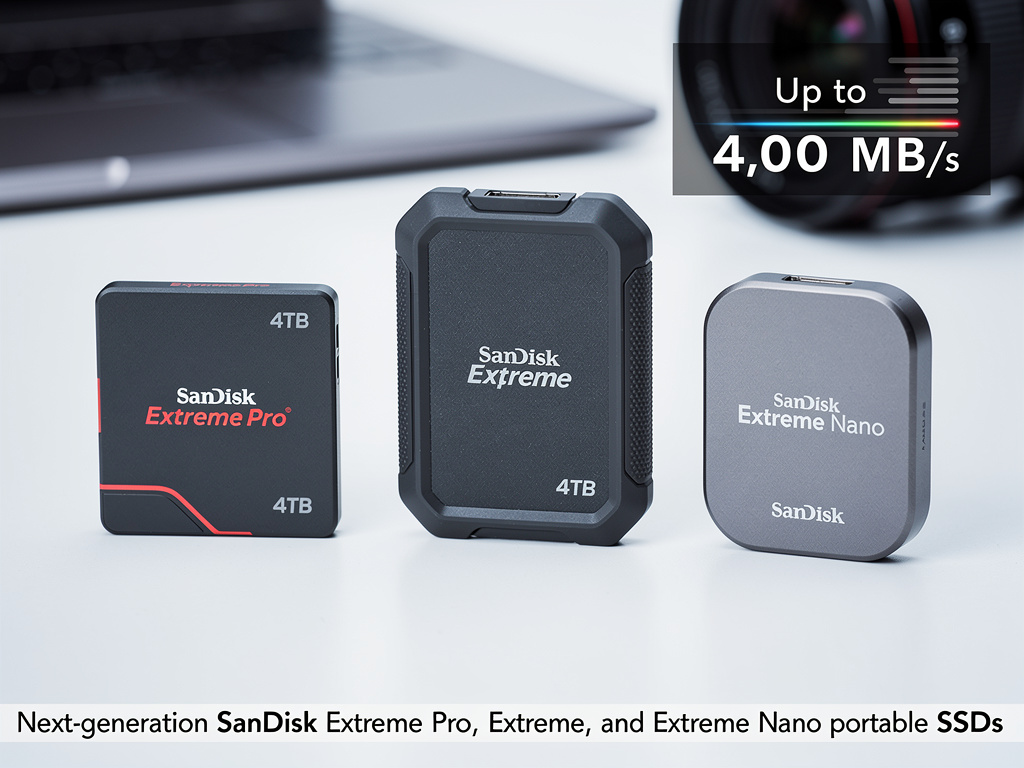
Western Digital’s SanDisk brand has unveiled its next generation of portable solid-state drives, rolling out refreshed versions of its popular Extreme and Extreme Pro lines alongside a new ultra-compact option designed to clip onto a keychain. The announcement, made during Computex 2025, signals the company’s aggressive push to maintain dominance in the portable storage market at a time when content creators are generating ever-larger files and remote workers demand faster, more reliable external storage.
The new lineup includes the SanDisk Extreme Pro Portable SSD, the SanDisk Extreme Portable SSD, and the diminutive SanDisk Extreme Nano Portable SSD. Each targets a slightly different user, but the overarching theme is clear: faster transfer speeds, higher capacities, and form factors that accommodate professionals who rarely work from a single desk. As reported by TechRadar, the new drives represent a significant step forward from their predecessors, with the flagship Extreme Pro now capable of sequential read speeds up to 4,000 MB/s and write speeds up to 3,800 MB/s.
The Extreme Pro: A Speed Machine Built for Heavy Workloads
The SanDisk Extreme Pro Portable SSD sits at the top of the new range and is clearly aimed at video editors, photographers, and other creative professionals who routinely move massive files between devices. With a USB 3.2 Gen 2×2 interface delivering those headline 4,000 MB/s read speeds, the drive represents a substantial improvement over the previous generation, which topped out at around 2,000 MB/s. The drive will be available in capacities of 1TB, 2TB, and 4TB, giving professionals enough room to store hours of high-resolution footage or tens of thousands of RAW image files.
Build quality has also received attention. The Extreme Pro carries an IP65 dust and water resistance rating, meaning it can withstand low-pressure water jets from any direction — a meaningful specification for photographers and videographers who frequently work outdoors. The drive also features a ruggedized silicone shell and is rated to survive drops of up to two meters, according to SanDisk’s specifications. A built-in carabiner loop allows users to attach the drive to a bag or belt loop, a small but practical design choice for professionals constantly on the move.
The Extreme Portable SSD: Balancing Performance and Value
One step down from the Pro model, the refreshed SanDisk Extreme Portable SSD offers sequential read speeds of up to 2,000 MB/s and write speeds of up to 1,800 MB/s. While those numbers fall short of the Pro’s throughput, they still represent a meaningful upgrade for users who need fast external storage but don’t require the absolute peak performance that high-end video workflows demand. The Extreme Portable SSD uses a USB 3.2 Gen 2 interface and will also be offered in 1TB, 2TB, and 4TB configurations.
The Extreme Portable SSD shares its sibling’s IP65 rating and two-meter drop resistance, ensuring that durability is not sacrificed for the lower price point. As TechRadar noted, this model may be the most compelling option for office workers and business travelers who need reliable, fast external storage without the premium associated with the Pro line. For those who spend their days shuttling between meetings, client sites, and home offices, the combination of speed, durability, and capacity makes it a strong contender against competing offerings from Samsung, Crucial, and others.
The Nano: Pocket-Sized Storage That Punches Above Its Weight
Perhaps the most intriguing addition to the lineup is the SanDisk Extreme Nano Portable SSD. As its name suggests, the Nano is built for maximum portability, with a form factor small enough to attach to a keychain. Despite its compact dimensions, the drive offers read speeds of up to 1,000 MB/s and write speeds of up to 900 MB/s via a USB 3.2 Gen 2 interface. It will be available in 500GB, 1TB, and 2TB capacities.
The Nano’s IP55 rating makes it slightly less resistant to dust and water than its larger siblings, but it still provides a level of environmental protection that traditional USB flash drives cannot match. The drive is clearly positioned as a replacement for the aging USB thumb drive — a product category that has seen little meaningful innovation in recent years. For professionals who need to carry important files at all times without the bulk of a larger portable SSD, the Nano fills a gap that few competitors have seriously addressed. The trade-off, of course, is speed: at 1,000 MB/s, the Nano is fast by flash drive standards but considerably slower than either the Extreme or Extreme Pro.
Why Speed Matters More Than Ever for Creative Professionals
The push toward faster portable storage is not happening in a vacuum. The rise of 8K video capture, increasingly large RAW photo files from high-megapixel cameras, and the growing use of portable drives as working storage — not just backup — have all increased the demand for external drives that can keep pace with internal NVMe SSDs. A videographer editing 8K ProRes footage directly from an external drive, for example, needs sustained read speeds that would have been unthinkable in the portable storage category just a few years ago.
SanDisk’s decision to push the Extreme Pro to 4,000 MB/s reads reflects this reality. The USB 3.2 Gen 2×2 interface, which doubles the bandwidth of the more common Gen 2 standard, is still not universally available on laptops and desktops, but its adoption is growing steadily. For users with compatible hardware, the Extreme Pro’s throughput approaches what many internal SATA SSDs can deliver, effectively blurring the line between internal and external storage performance. This is particularly relevant for MacBook Pro users and Windows laptop owners who increasingly rely on Thunderbolt and high-speed USB-C ports as their primary connectivity options.
Competitive Pressures and Market Positioning
SanDisk does not operate without competition. Samsung’s T9 Portable SSD, which launched in 2023, offers read speeds of up to 2,000 MB/s and has been well-received by both creative professionals and general consumers. Crucial’s X10 Pro, another strong competitor, delivers similar performance in a compact form factor. By pushing the Extreme Pro to 4,000 MB/s, SanDisk is attempting to establish clear daylight between its flagship and the competition, at least on the specification sheet.
The broader Western Digital strategy also comes into play here. The company has been working to rebuild consumer trust following well-publicized reliability issues with earlier SanDisk portable SSDs, which drew complaints from photographers and videographers who reported data loss and firmware problems. Western Digital addressed many of these concerns through firmware updates and revised hardware, but the reputational damage lingered. The new generation of drives, with their emphasis on both performance and durability, appears designed in part to turn the page on that chapter.
Pricing, Availability, and What Comes Next
SanDisk has not yet disclosed specific pricing for the new drives, though the company indicated they will be available in the coming months. Based on the pricing of current-generation models — the existing Extreme Pro Portable SSD typically retails between $100 and $350 depending on capacity — the new versions are likely to carry a modest premium at launch before settling into competitive price points as production scales up.
The timing of the announcement, coinciding with Computex 2025, is strategic. The annual technology trade show in Taipei draws attention from hardware reviewers, enterprise buyers, and technology enthusiasts worldwide, giving SanDisk maximum visibility for its new products. It also allows the company to position the drives alongside new laptop and desktop announcements from major PC manufacturers, many of which will feature the USB 3.2 Gen 2×2 ports needed to take full advantage of the Extreme Pro’s top speeds.
For creative professionals, the message from SanDisk is straightforward: portable storage no longer has to mean compromised performance. Whether the new drives deliver on that promise in real-world testing — particularly under sustained workloads where thermal throttling can become an issue — remains to be seen. But on paper, the specifications represent the most ambitious portable SSD lineup SanDisk has ever produced, and one that raises the bar for the entire category.


 WebProNews is an iEntry Publication