
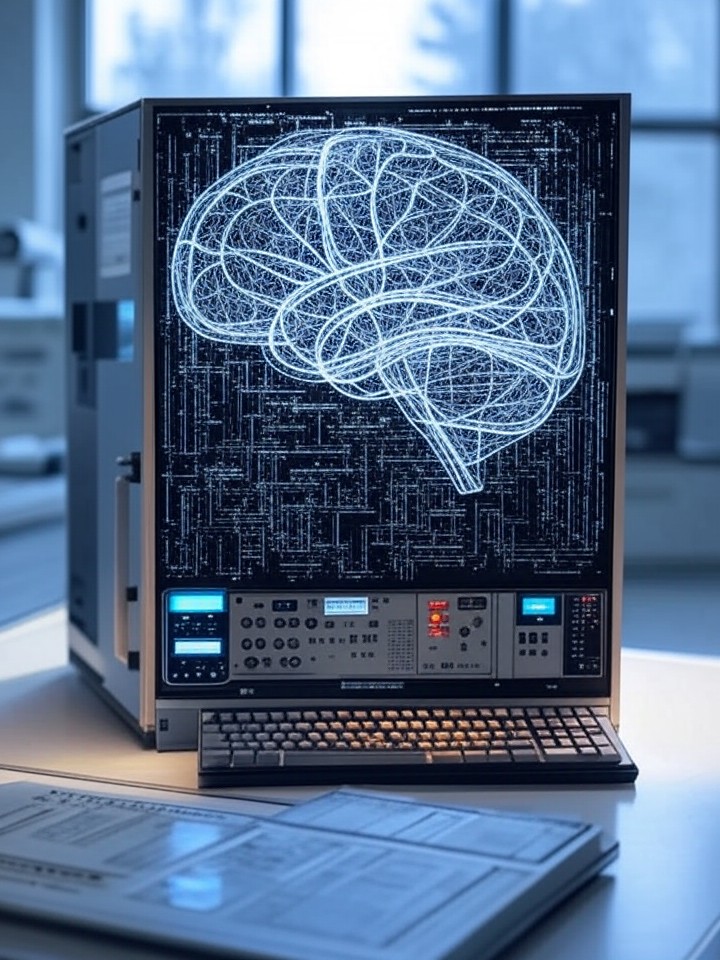
Brains in Circuits: The Astonishing Math Prowess of Neuromorphic Machines
In the ever-evolving realm of computational technology, a quiet revolution is underway, one that draws inspiration from the most sophisticated processor known to humanity: the human brain. Researchers at Sandia National Laboratories have unveiled findings that neuromorphic computers—systems designed to mimic neural structures—are not just efficient but remarkably proficient at tackling complex mathematical problems. This development, detailed in a recent study, suggests a paradigm shift in how we approach high-stakes computations in fields like climate modeling and materials science.
The core of this breakthrough lies in neuromorphic computing, which eschews traditional von Neumann architectures in favor of brain-like networks. These systems process information in a parallel, event-driven manner, much like synapses firing in the cortex. According to the research led by J. Darby Smith and his team, such setups excel at solving partial differential equations (PDEs), the mathematical workhorses behind simulations of fluid dynamics, heat transfer, and quantum mechanics. PDEs are notoriously demanding, often requiring supercomputers that guzzle energy and time.
What makes this discovery particularly intriguing is its unexpected nature. Neuromorphic hardware was initially pursued for tasks like pattern recognition and sensory processing, not rigorous numerical analysis. Yet, as reported in Phys.org, these brain-inspired circuits demonstrate a “shockingly good” aptitude for math, outperforming expectations in efficiency and accuracy for certain PDE classes.
Unveiling the Neural-Math Connection
The Sandia team’s work builds on a computational neuroscience model introduced over a decade ago. By adapting this model, researchers J. Bradley Aimone and William Severa, along with colleagues, uncovered a hidden link between neural dynamics and PDE solving. “We’ve shown the model has a natural but non-obvious link to PDEs,” explained lead researcher Brian Theilman in the study. This connection allows neuromorphic systems to handle equations that describe real-world phenomena with far less computational overhead.
Imagine simulating weather patterns or engineering new materials without the need for massive data centers. Traditional computers solve PDEs through iterative methods that approximate solutions step by step, but neuromorphic approaches leverage inherent parallelism to converge on answers more intuitively. This isn’t just theoretical; the team tested their algorithm on hardware prototypes, yielding results that rival conventional methods while consuming a fraction of the power.
The implications extend beyond efficiency. As Aimone noted, the brain performs exascale-level computations effortlessly in everyday tasks like catching a ball. “These are very sophisticated computations,” he said. By emulating such processes, neuromorphic computers could unlock new ways to model complex systems, potentially accelerating advancements in aerospace and renewable energy.
One key advantage is energy savings. Supercomputers like those at national labs devour electricity equivalent to small cities, but neuromorphic chips promise to slash that footprint. Drawing from posts on X (formerly Twitter), industry observers are buzzing about this potential, with users highlighting how such tech could democratize high-performance computing for smaller research outfits.
Further afield, this ties into broader trends in bio-inspired innovation. Publications like Sandia National Laboratories’ news release emphasize the bridge between neuroscience and mathematics, suggesting that understanding brain computation could inform treatments for disorders like Alzheimer’s. If brain diseases are “diseases of computation,” as Aimone posits, then neuromorphic models might simulate pathological states to test therapies.
Critics, however, caution that neuromorphic computing is still nascent. Hardware scalability remains a hurdle, with current prototypes limited in neuron count compared to the brain’s billions. Yet, optimism abounds, fueled by recent investments from tech giants exploring similar architectures for AI acceleration.
From Theory to Tangible Applications
Delving deeper, the Sandia algorithm retains “strong similarities to the structure and dynamics of cortical networks,” as described in the research. This fidelity to biology enables the system to process PDEs in a way that feels organic, almost instinctive. For instance, in modeling fluid flow, traditional methods discretize space into grids and iterate numerically, but neuromorphic circuits can evolve solutions dynamically, mirroring how neurons adapt to stimuli.
Testing revealed impressive performance metrics. In benchmarks against standard solvers, the neuromorphic approach not only matched accuracy but did so with reduced latency, crucial for real-time applications like autonomous vehicle navigation or financial modeling. As covered in Slashdot, commentators noted the surprise factor: these systems “weren’t expected to excel at solving rigorous mathematical problems like PDEs.”
Industry insiders are taking note. Posts on X from tech enthusiasts, including those referencing DeepMind’s AlphaGeometry work, underscore a growing synergy between AI and pure math. While AlphaGeometry tackled geometry proofs, neuromorphic tech targets differential equations, potentially complementing symbolic AI in hybrid systems.
Beyond math, this could reshape scientific discovery. Consider climate science, where PDEs model atmospheric interactions. Faster, greener computations might enable more granular forecasts, aiding policy decisions on global warming. Similarly, in pharmaceuticals, simulating molecular behaviors via PDEs could speed drug design.
Yet, challenges persist. Integrating neuromorphic hardware with existing infrastructure requires new programming paradigms, as traditional languages like Fortran aren’t suited for neural architectures. Researchers are developing specialized tools, but adoption will take time.
Moreover, ethical considerations loom. If these systems mimic brain functions closely, questions about consciousness or misuse in surveillance arise. While speculative, such debates are surfacing in online forums, reflecting broader societal concerns about bio-inspired tech.
Bridging Brains and Bytes
The Sandia findings also illuminate the brain’s computational secrets. “We don’t have a solid grasp on how the brain performs computations yet,” Aimone admitted. By reverse-engineering through neuromorphic models, scientists might decode neural efficiency, applying lessons to AI.
This interdisciplinary fusion is gaining traction. A recent article in EurekAlert! highlights how such research raises questions about intelligence itself. Is computation a universal language, translatable from wetware to hardware?
On X, posts from figures like Terence Tao and AI researchers discuss AI’s role in math, predicting co-authorship by 2026. Neuromorphic advances could accelerate this, enabling machines to assist in theorem proving or optimization problems.
Practically, companies like Intel and IBM are investing heavily. Intel’s Loihi chip, for example, embodies neuromorphic principles, and integrating PDE-solving capabilities could expand its market. Startups are emerging, too, focusing on niche applications like edge computing for IoT devices.
Energy efficiency is a standout benefit. Amid global pushes for sustainability, neuromorphic systems’ low power draw aligns with green tech goals. As one X post noted, a breakthrough AI device using graphene cuts computation by 100 times, hinting at material innovations complementing neuromorphic designs.
However, scaling to exascale remains elusive. Current neuromorphic supercomputers are prototypes, but projects like the European Human Brain Project aim for brain-scale simulations, potentially incorporating these math prowess findings.
Pushing Boundaries in Computation
Looking ahead, the fusion of neuromorphic computing with quantum-inspired methods, as explored in Nature Communications, could yield hybrid systems tackling even thornier problems. Graph computing, vital for social networks and logistics, might benefit from brain-like efficiency.
In education, this could transform how math is taught. Interactive neuromorphic simulations might let students visualize PDEs in action, fostering intuitive understanding over rote memorization.
Critically, accessibility is key. If neuromorphic tech lowers barriers to advanced computing, it could empower developing nations in research, narrowing global divides.
Yet, security concerns can’t be ignored. Brain-inspired systems might be vulnerable to novel attacks, mimicking neurological disruptions. Cybersecurity experts are already pondering defenses.
The economic ripple effects are profound. Industries reliant on simulations—automotive, aerospace, finance—stand to gain. Faster iterations could shave years off development cycles, boosting innovation.
As sentiment on X reflects, excitement is palpable. Posts laud the “shockingly good” performance, with some speculating on applications in nonlinear thermodynamic computing, per another Nature Communications piece.
The Horizon of Hybrid Intelligence
Ultimately, this research underscores a convergence: biology and technology blurring lines. By harnessing nature’s blueprints, we’re not just building better computers; we’re unraveling the essence of thought.
Collaborations are accelerating. Partnerships between labs like Sandia and universities could yield open-source neuromorphic frameworks, spurring widespread adoption.
In the corporate sphere, expect patent filings to surge. As detailed in Newswise, the algorithm’s ties to cortical dynamics open doors to bio-computing startups.
For insiders, the message is clear: invest in skills bridging neuroscience and engineering. The next wave of tech leaders will be those fluent in both.
While hurdles remain—from hardware maturation to ethical frameworks—the trajectory is upward. Neuromorphic computing isn’t just good at math; it’s redefining what’s possible.
Reflecting on posts from X, where users like Jim Fan predict AI’s mathematical co-authorship, it’s evident we’re on the cusp of a new era. Brains in circuits may soon solve problems we haven’t yet imagined, propelling humanity forward.


 WebProNews is an iEntry Publication