
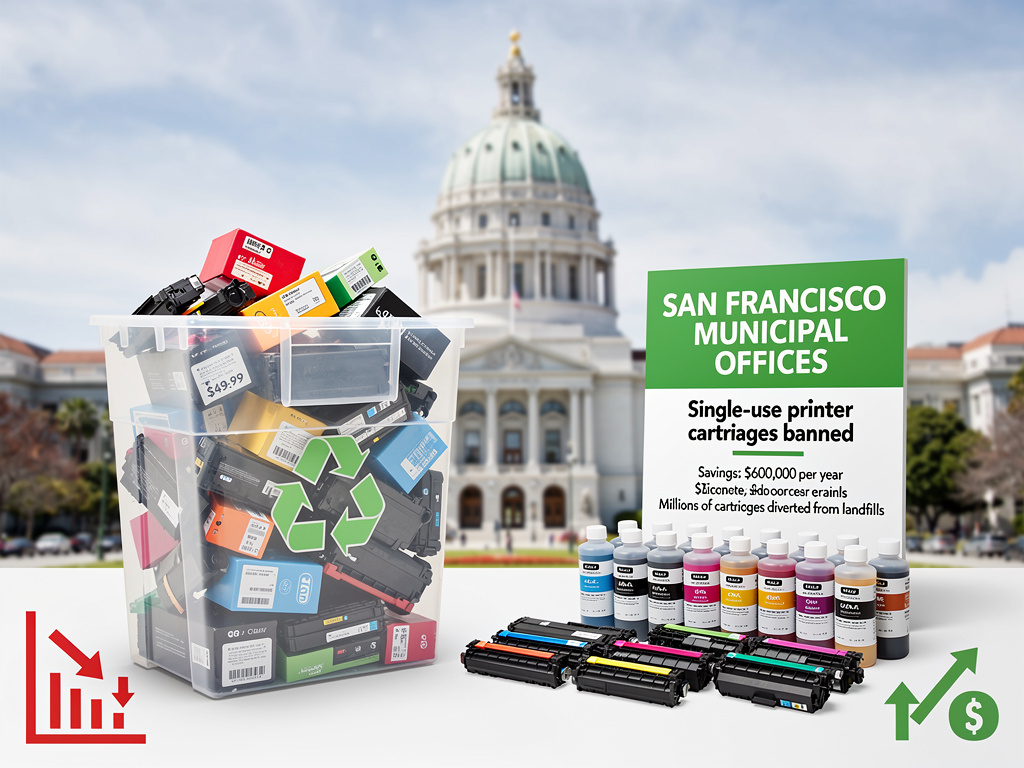
San Francisco has emerged as the first major American city to prohibit single-use printer cartridges in municipal operations, establishing a precedent that could reshape how corporations and government entities approach office supply procurement. The decision, announced in early 2024, represents a significant escalation in the city’s environmental initiatives and places pressure on printer manufacturers to accelerate their transition toward sustainable business models.
According to TechRadar, the ordinance mandates that all city departments must exclusively purchase refillable or remanufactured cartridges, effectively eliminating the procurement of original equipment manufacturer (OEM) cartridges designed for single use. The policy affects approximately 25,000 city employees across more than 50 departments, making San Francisco’s municipal government a testing ground for what could become a nationwide movement.
The environmental rationale behind the ban is substantial. Industry estimates suggest that approximately 375 million printer cartridges are discarded annually in the United States alone, with the vast majority ending up in landfills where they can take up to 1,000 years to decompose. Each cartridge contains a complex mixture of plastics, metals, and residual ink or toner that can leach harmful chemicals into soil and groundwater. The cumulative environmental impact has long concerned sustainability advocates, yet meaningful action at the municipal level has remained elusive until now.
The Economics of Cartridge Consumption
The financial implications of San Francisco’s decision extend far beyond environmental considerations. The global printer cartridge market, valued at approximately $20 billion annually, has operated on a business model that critics have long characterized as deliberately wasteful. Printer manufacturers have historically sold hardware at minimal profit margins or even losses, recouping their investment through the sale of proprietary cartridges that often cost consumers more per ounce than premium champagne.
This “razor and blade” business model has created a lucrative revenue stream for major manufacturers including HP, Canon, Epson, and Brother. However, it has also generated significant consumer frustration and spawned a thriving third-party cartridge industry. Remanufactured cartridges typically cost 30-50% less than OEM products while delivering comparable performance, according to industry analysts. San Francisco’s procurement department estimates the city could save between $400,000 and $600,000 annually by transitioning to refillable alternatives, demonstrating that environmental responsibility and fiscal prudence can align.
Industry Resistance and Technological Barriers
The printer manufacturing industry has not welcomed San Francisco’s initiative with open arms. Major manufacturers have invested billions in developing sophisticated authentication systems designed to prevent third-party cartridges from functioning in their devices. These digital rights management (DRM) technologies, which include microchips that communicate with printer firmware, ostensibly protect print quality and prevent counterfeiting. Critics argue these measures serve primarily to maintain monopolistic control over consumables markets.
HP, which commands approximately 40% of the global printer market, has faced particular scrutiny for its “dynamic security” features that automatically reject third-party cartridges through firmware updates. The company maintains that these measures protect customers from substandard products and potential security vulnerabilities. However, consumer advocacy groups have filed complaints with the Federal Trade Commission, alleging anticompetitive practices. San Francisco’s ban effectively circumvents these technological barriers by requiring the city to procure only printers compatible with refillable cartridges, potentially forcing manufacturers to reconsider their hardware strategies for government contracts.
The European Precedent
San Francisco’s action follows similar initiatives in Europe, where regulatory pressure on printer manufacturers has intensified significantly. The European Union’s Right to Repair directive, which took effect in stages beginning in 2021, includes provisions requiring manufacturers to design products that facilitate refilling and remanufacturing. Several European cities, including Amsterdam and Copenhagen, have implemented procurement policies favoring sustainable printing solutions, though none has enacted an outright ban on single-use cartridges as comprehensive as San Francisco’s measure.
The European approach has yielded measurable results. A 2023 study by the European Environmental Bureau found that cities with sustainable printing procurement policies reduced cartridge waste by an average of 68% while achieving cost savings of 35-42%. These findings have provided San Francisco policymakers with empirical evidence supporting their decision and offer a roadmap for other American cities considering similar measures.
The Remanufacturing Industry Responds
The ban has energized the cartridge remanufacturing sector, which has long operated in the shadow of major OEMs. Companies specializing in cartridge refilling and remanufacturing report surging interest from municipal governments and private sector organizations seeking to align their procurement practices with San Francisco’s example. The International Imaging Technology Council, a trade association representing remanufacturers, projects that the North American remanufactured cartridge market could grow by 25-30% annually if additional major cities adopt similar policies.
However, scaling up to meet potential demand presents challenges. Remanufacturing facilities require specialized equipment and trained technicians to disassemble, clean, refill, and test cartridges to ensure they meet quality standards. The industry currently operates with significant excess capacity, but a rapid surge in demand could strain supply chains and quality control processes. Several major remanufacturers have announced plans to expand their facilities in anticipation of growing market opportunities, with investments totaling more than $50 million announced in the first quarter of 2024 alone.
Corporate Sector Implications
While San Francisco’s ban applies only to municipal operations, its ripple effects are already visible in the private sector. Several major corporations with significant operations in San Francisco have announced reviews of their printing and office supply procurement policies. Technology companies, which maintain substantial presences in the city and often position themselves as environmental leaders, face particular pressure to align their practices with municipal standards.
Salesforce, headquartered in San Francisco, announced in March 2024 that it would transition to refillable cartridges across all its global offices by the end of the year, potentially eliminating more than 50,000 single-use cartridges annually from its waste stream. Other companies are watching closely to assess whether such transitions affect operational efficiency or print quality. Early indications suggest that modern remanufactured cartridges perform comparably to OEM products in most applications, though some specialized printing requirements may necessitate original cartridges.
The Legal and Regulatory Framework
San Francisco’s ban operates within a complex legal framework that balances municipal authority, environmental regulation, and intellectual property rights. The city’s legal team carefully structured the ordinance to withstand potential challenges from printer manufacturers, focusing on procurement decisions rather than attempting to regulate the products themselves. This approach mirrors strategies used successfully in other environmental initiatives, such as bans on single-use plastic bags and polystyrene food containers.
Nonetheless, legal experts anticipate potential litigation. Printer manufacturers could argue that the ban interferes with interstate commerce or violates intellectual property protections. However, government entities generally enjoy broad discretion in setting procurement standards, and courts have historically upheld environmental preferences in purchasing decisions provided they don’t explicitly discriminate against particular manufacturers or states. The outcome of any legal challenges could significantly influence whether other cities feel confident adopting similar measures.
Implementation Challenges and Timeline
San Francisco has structured its ban with a phased implementation timeline designed to minimize disruption to city operations. The policy took effect immediately for new printer purchases, requiring all acquisitions to specify compatibility with refillable cartridges. Existing printer inventory will be replaced on normal replacement cycles, with full compliance expected by 2027. This gradual approach allows departments to plan transitions and provides time for the remanufacturing industry to scale capacity.
The city’s Department of the Environment has established a technical assistance program to help departments navigate the transition. This includes maintaining a list of approved refillable cartridge suppliers, providing guidance on printer selection, and monitoring performance to identify and address any quality issues. Early reports from departments that have completed their transitions indicate minimal operational impact, with print quality and reliability meeting or exceeding expectations in most cases.
The Path Forward for Other Cities
Municipal governments across the United States are closely monitoring San Francisco’s experience, with several cities already exploring similar initiatives. Los Angeles, Seattle, and Portland have all initiated studies examining the feasibility of cartridge bans or restrictions. The success or failure of San Francisco’s implementation will likely determine whether this becomes a national movement or remains an isolated experiment in progressive environmental policy.
The broader implications extend beyond printer cartridges to fundamental questions about product design, planned obsolescence, and corporate responsibility for end-of-life waste. San Francisco’s ban represents a growing willingness among government entities to use procurement power as a tool for driving environmental change, even when doing so challenges established business models. Whether this approach proves effective and replicable could influence policy development across numerous product categories where single-use designs dominate despite available alternatives.
For printer manufacturers, the writing may be on the wall. Adapting to a future where refillable cartridges become standard rather than exceptional will require significant business model adjustments. Some companies are already developing new approaches, including subscription services that emphasize cartridge return and refilling. The transition may prove painful for companies heavily invested in single-use consumables, but those that adapt successfully could find opportunities in a market increasingly shaped by sustainability concerns and regulatory pressure. San Francisco’s ban may ultimately be remembered not as an isolated policy experiment, but as the catalyst that transformed an entire industry’s approach to a problem that has indeed, as critics note, gone unaddressed for far too long.


 WebProNews is an iEntry Publication