
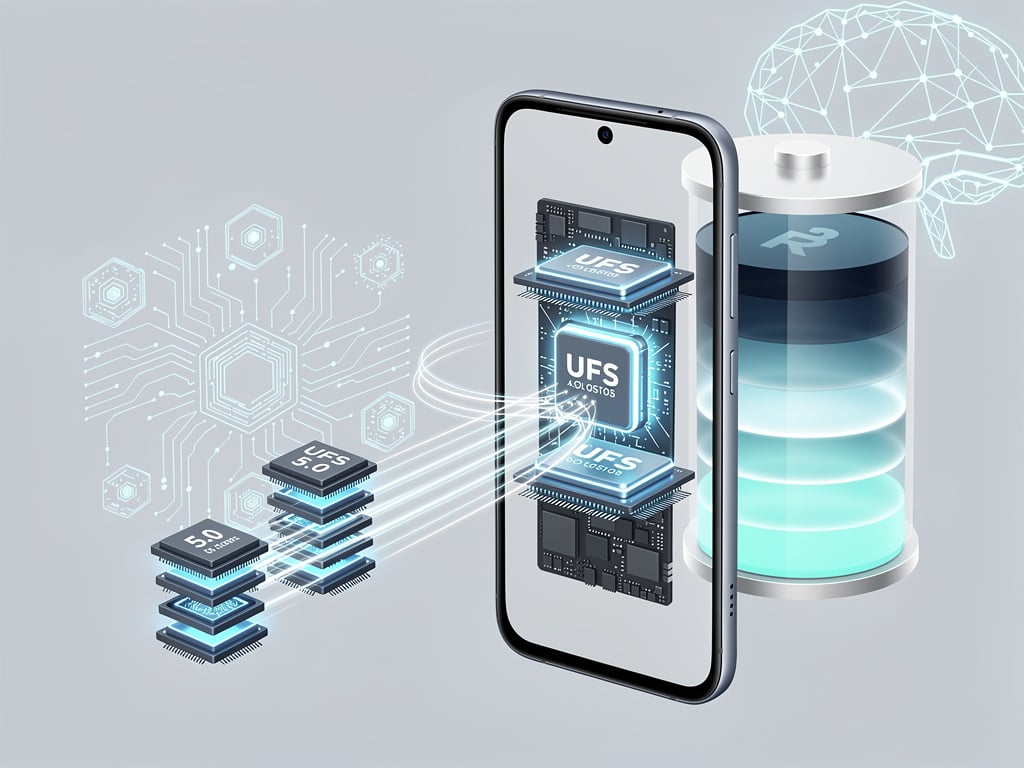
Samsung just unveiled its first UFS 5.0 storage solution. The move targets the growing demands of on-device AI. It delivers read speeds up to 10.08 GB/s. That’s more than double the previous UFS 4.1 standard. But the real story lies in efficiency gains that directly extend battery life.
The new memory cuts power consumption by over 40 percent. It monitors data movement in real time. When no transfer occurs, it powers down idle hardware. Processors finish intensive tasks quicker. They return to low-power states sooner. The result? Users gain meaningful extra hours on a single charge without sacrificing AI performance. Samsung’s UFS 5.0 also shrinks the storage die by 16.7 percent. That freed space lets engineers fit larger batteries or improved cameras inside the same chassis.
Mass production begins in the fourth quarter of 2026. Flagship smartphones and wearables should receive the technology by early 2027. The timing aligns with expectations for the Galaxy S27 series. Earlier Galaxy S26 models appear locked into existing storage. Yet the efficiency improvements signal a broader shift. Samsung no longer relies solely on bigger battery cells to win endurance contests.
MakeUseOf reported the details on June 23, 2026. The article highlights how UFS 5.0 removes data bottlenecks that previously slowed AI workloads. Near-instant responses become possible even offline. Privacy improves because sensitive processing stays on the device. And the power savings compound across the system.
But storage represents only one piece. Samsung SDI, the company’s battery division, outlined a wider strategy under the slogan “AI thinks, Battery enables.” The firm plans to display high-power, high-quality solutions tailored for the AI era at InterBattery 2026. These include advanced batteries for data-center UPS systems and all-solid-state designs aimed at physical AI such as humanoid robots. Mass production of those solid-state cells starts in the second half of 2027. While not yet destined for phones, the underlying chemistry improvements could trickle down.
PhoneArena examined Samsung’s solid-state roadmap in January 2026. The company first teased solid-state batteries for Galaxy phones back in 2017. Delays followed. Now the focus has shifted. Galaxy Watch models and the Galaxy Ring will likely debut the technology by the end of 2026. Energy density hovers around 200 Wh/kg in current prototypes. That trails some rivals but offers faster charging and stable output. Success in wearables could open the door for the Galaxy S27. A phone with days of battery life no longer sounds like marketing hype.
For the immediate future, Samsung sticks with proven 5,000 mAh cells in the Galaxy S26 Ultra. Forbes noted in February 2026 that this marks the seventh consecutive generation at that capacity. Competitors have adopted silicon-carbon anodes to reach 6,000 mAh or more in smaller bodies. Samsung counters with architectural gains instead. A new OLED panel draws less power. The 3nm Snapdragon 8 Elite chipset runs cooler and more efficiently. Charging hits 75 percent in under 30 minutes at 60 watts. These tweaks stretch the existing battery further.
Agentic AI features run quietly in the background. They handle tasks locally without constant cloud calls. The approach reduces energy spikes that drain older devices. Samsung’s Now Bar and Now Brief integrate these agents so users barely notice the computation. The phone simply lasts longer while feeling smarter.
Recent coverage reinforces the momentum. ZDNet published battery-optimization tips for Samsung phones on February 12, 2026. Dark mode, adaptive brightness and targeted app restrictions can add noticeable runtime. The advice complements Samsung’s hardware advances. Users who combine both see the biggest gains.
Yet challenges remain. Battery swelling still plagues some Galaxy models. Reports from SamMobile in 2025 discussed adoption of stainless-steel SUS CAN designs. The technology increases energy density, speeds charging and curbs expansion. If integrated into future flagships, it would address a longstanding complaint.
Solid-state batteries bring their own hurdles. Higher manufacturing costs and scaling issues have delayed adoption for years. Samsung SDI’s 2026 exhibition emphasizes safety and longevity. Fire-prevention software powered by AI monitors energy-storage systems. The same principles could eventually protect phone batteries.
Industry watchers expect the Galaxy S27 to blend UFS 5.0, refined power management and possibly early solid-state elements. The combination won’t just add minutes to screen time. It will enable richer AI experiences that previous hardware could not sustain. Local generative edits, real-time translation and proactive agents all consume cycles. Efficient memory and batteries make them practical for daily use.
Samsung isn’t chasing headline-grabbing capacity numbers alone. The company builds a balanced system where storage, display, chipset and battery work in concert. The strategy appears conservative next to Chinese rivals pushing 7,000 mAh packs. But reliability and software integration have defined Samsung’s flagship success for years. Early 2027 devices will test whether that formula still holds when AI demands surge.
And the signs look promising. Power efficiency gains from UFS 5.0 compound with display and processor improvements. Solid-state research progresses on a parallel track. The next Galaxy phones won’t simply last longer. They’ll handle more complex intelligence without forcing users to hunt for outlets by midday. That’s the quiet promise behind Samsung’s latest moves.


 WebProNews is an iEntry Publication