
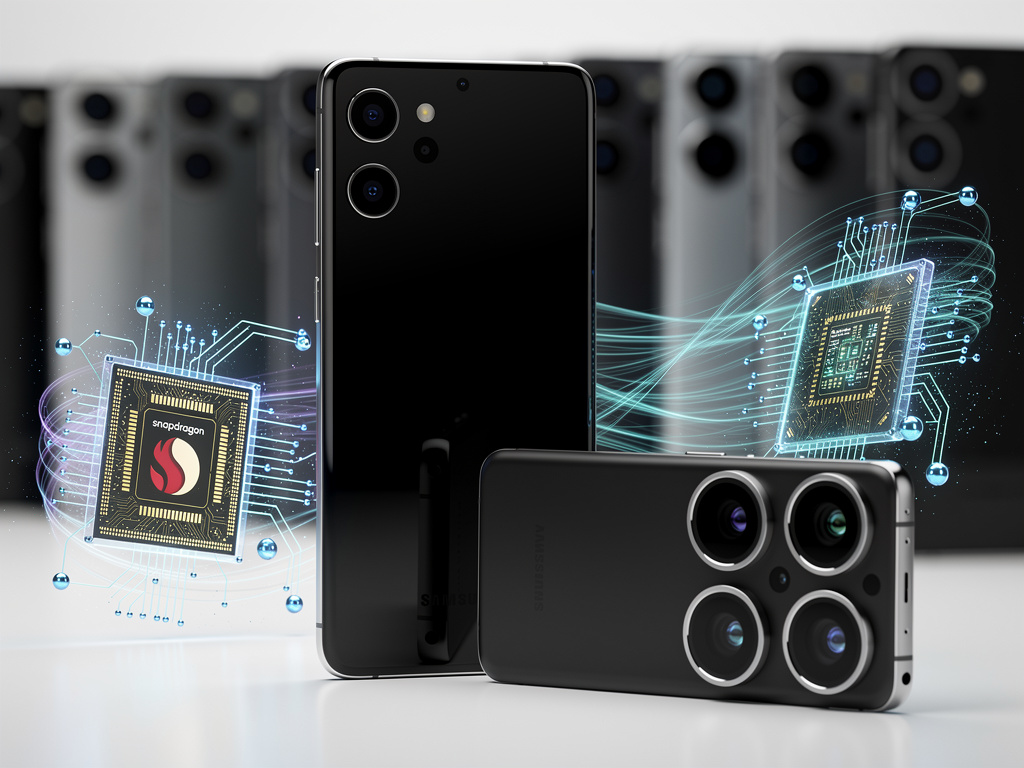
Samsung Electronics is preparing to unveil its Galaxy S26 Ultra flagship smartphone, and early indications suggest the device represents a calculated evolution rather than revolution in premium mobile technology. As the global smartphone market enters its maturity phase, with annual shipment growth stalling and consumer upgrade cycles extending beyond three years, Samsung’s approach with the S26 Ultra reflects broader industry dynamics where differentiation increasingly depends on subtle refinements rather than transformative breakthroughs.
According to detailed renders and specifications reported by Android Police, the Galaxy S26 Ultra maintains Samsung’s commitment to premium materials and cutting-edge specifications while introducing targeted improvements in camera technology, processing power, and display capabilities. The device is expected to feature Qualcomm’s Snapdragon 8 Elite processor in most markets, continuing Samsung’s strategic pivot away from its own Exynos chipsets for flagship devices in key regions—a decision that carries significant implications for the company’s semiconductor division and its competitive positioning against Apple’s vertically integrated approach.
The specifications reveal a device that prioritizes refinement over reinvention. The S26 Ultra is anticipated to sport a 6.9-inch Dynamic AMOLED display with a 120Hz adaptive refresh rate, marginally larger than its predecessor while maintaining the premium visual experience Samsung customers have come to expect. The camera system reportedly includes a 200-megapixel primary sensor, continuing Samsung’s megapixel arms race with Chinese competitors, alongside improved telephoto capabilities and enhanced computational photography features powered by on-device artificial intelligence processing.
The Chip Strategy Conundrum: Balancing Internal Development with Market Demands
Samsung’s decision to predominantly utilize Qualcomm’s Snapdragon processors in the S26 Ultra lineup underscores a strategic tension at the heart of the company’s business model. As both a smartphone manufacturer and one of the world’s largest semiconductor producers, Samsung faces the challenge of competing with its own foundry business while ensuring its mobile devices remain competitive against rivals who benefit from custom silicon strategies.
The Snapdragon 8 Elite, built on TSMC’s advanced 3-nanometer process technology, offers significant performance and efficiency improvements over previous generations. This choice reflects Samsung’s pragmatic acknowledgment that processor performance has become a critical differentiator in premium smartphones, particularly as artificial intelligence features become increasingly central to the user experience. However, it also represents a missed opportunity for Samsung’s semiconductor division, which has struggled to match TSMC’s manufacturing yields and power efficiency at cutting-edge process nodes.
Industry analysts note that Samsung’s foundry business has invested billions in catching up to TSMC’s technological lead, but continues to face challenges in attracting major customers for its most advanced nodes. The decision to use Qualcomm chips in flagship smartphones—devices that could serve as showcases for Samsung’s own semiconductor capabilities—highlights the extent of these challenges and the company’s unwillingness to compromise device competitiveness for the sake of promoting internal chip production.
Camera Innovation Meets Computational Photography Reality
The S26 Ultra’s camera specifications represent Samsung’s continued belief that hardware superiority in imaging sensors remains relevant even as computational photography increasingly determines final image quality. The 200-megapixel primary sensor, while impressive on paper, raises questions about practical benefits for most users, particularly given the storage and processing demands of such high-resolution captures.
More significant may be the improvements in the telephoto system, where Android Police reports enhanced optical zoom capabilities that could extend Samsung’s lead in long-range photography. The device is expected to maintain a periscope telephoto lens with improved light gathering capabilities, addressing one of the primary limitations of smartphone zoom photography. These hardware improvements will be complemented by AI-enhanced image processing that can reduce noise, improve detail retention, and optimize dynamic range in challenging lighting conditions.
The emphasis on AI-powered photography features reflects broader industry trends where the line between camera hardware and software continues to blur. Google’s Pixel devices have demonstrated that sophisticated computational photography can compensate for hardware limitations, while Apple’s iPhone lineup has shown that tight integration between custom silicon and imaging algorithms can produce exceptional results without resorting to extreme megapixel counts. Samsung’s approach with the S26 Ultra attempts to combine both strategies—offering superior hardware specifications while investing heavily in AI-powered image processing capabilities.
Display Technology: Incremental Gains in a Mature Category
The S26 Ultra’s display specifications highlight how certain smartphone technologies have reached a point of diminishing returns for most users. While the 6.9-inch Dynamic AMOLED screen with 120Hz refresh rate represents best-in-class technology, the improvements over previous generations are increasingly marginal. Peak brightness levels, color accuracy, and touch responsiveness have all reached levels that exceed most users’ perceptual capabilities, raising questions about where meaningful differentiation can occur in future generations.
Samsung’s display division has long been a competitive advantage for the company’s smartphones, with its AMOLED technology widely regarded as the industry’s best. The S26 Ultra is expected to feature improved power efficiency in the display subsystem, extending battery life without sacrificing visual quality—a practical improvement that may resonate more with users than incremental increases in resolution or brightness. The device will likely also include enhanced always-on display capabilities and improved outdoor visibility, addressing real-world usage scenarios rather than pursuing specification sheet superiority.
The maturation of display technology also reflects broader challenges facing the premium smartphone market. As core technologies like screens, processors, and cameras reach performance levels that satisfy the vast majority of users, manufacturers must find new dimensions of competition. This has led to increased focus on ecosystem integration, software experiences, and artificial intelligence capabilities—areas where differentiation is possible even when hardware specifications have plateaued.
Pricing Pressures and Market Positioning in a Saturated Segment
The Galaxy S26 Ultra will enter a premium smartphone market characterized by intense competition and increasingly price-conscious consumers. While Samsung has historically commanded premium pricing for its Ultra-branded devices, the company faces pressure from multiple directions: Apple’s iPhone continues to dominate the high end in key markets, Chinese manufacturers like Xiaomi and OPPO offer compelling flagship devices at lower price points, and consumers are extending their device upgrade cycles as year-over-year improvements become less dramatic.
Samsung’s pricing strategy for the S26 Ultra will need to balance several competing considerations. The device must be positioned as a premium offering that justifies its price through superior specifications and capabilities, yet it cannot be priced so high that it drives potential customers toward more affordable alternatives or encourages them to delay upgrades. The company’s typical approach has been to launch at premium pricing and then offer aggressive promotions and trade-in incentives, effectively creating a tiered pricing structure that captures both early adopters willing to pay full price and value-conscious buyers who wait for deals.
The broader market context adds complexity to Samsung’s positioning challenge. Global smartphone shipments have stagnated, with growth concentrated in emerging markets where premium devices represent a small fraction of sales. In mature markets like the United States and Western Europe, the installed base of smartphones is enormous, but replacement cycles have extended as devices have become more durable and capable. This dynamic favors manufacturers with strong ecosystem lock-in—primarily Apple—and puts pressure on Android manufacturers to offer compelling reasons for users to upgrade.
Artificial Intelligence: The New Battleground for Smartphone Differentiation
Perhaps the most significant aspect of the S26 Ultra’s positioning will be its artificial intelligence capabilities, an area where Samsung has invested heavily in recent generations. The device is expected to feature enhanced on-device AI processing for tasks ranging from photo enhancement to real-time translation, voice assistance, and predictive text input. These capabilities leverage both the processing power of the Snapdragon 8 Elite chip and Samsung’s own software optimizations to deliver experiences that were impossible in earlier smartphone generations.
The emphasis on AI reflects a broader industry recognition that artificial intelligence represents one of the few remaining areas where meaningful smartphone innovation can occur. As hardware specifications have matured, software-based experiences powered by machine learning have become increasingly important differentiators. Samsung’s Galaxy AI initiative, which spans multiple device categories, attempts to create a cohesive artificial intelligence experience that encourages users to remain within the Samsung ecosystem across smartphones, tablets, wearables, and home appliances.
However, Samsung faces significant challenges in the AI arena. Google’s integration of its Gemini AI models into Android and Pixel devices gives it a structural advantage in delivering cutting-edge AI experiences, while Apple’s control of both hardware and software allows it to optimize AI performance in ways that Android manufacturers using third-party chips cannot fully replicate. Samsung’s success with AI-powered features in the S26 Ultra will depend not just on the capabilities it delivers at launch, but on its ability to continuously improve these features through software updates—an area where the company has historically lagged behind its primary competitors.
Manufacturing and Supply Chain Considerations in a Turbulent Global Environment
The S26 Ultra’s development and production occur against a backdrop of ongoing global supply chain challenges and geopolitical tensions that affect the entire electronics industry. Samsung’s vertically integrated business model—spanning semiconductor manufacturing, display production, and device assembly—provides some insulation from supply chain disruptions, but the company still depends on external suppliers for critical components including the Qualcomm processor, camera sensors from Sony, and various specialized chips and components.
The decision to use Qualcomm’s Snapdragon 8 Elite processor, manufactured by TSMC in Taiwan, introduces geopolitical risk into Samsung’s flagship smartphone supply chain. Tensions between China and Taiwan, combined with ongoing U.S.-China technology competition, create uncertainty around the long-term availability and pricing of cutting-edge semiconductors. Samsung’s own foundry business, while currently behind TSMC in advanced process technology, represents a potential hedge against these risks—though one the company has chosen not to fully utilize in its most important smartphone products.
Manufacturing location decisions also carry strategic implications. Samsung has diversified its smartphone production across multiple countries including South Korea, Vietnam, and India, reducing dependence on any single manufacturing base and providing flexibility to navigate tariffs, trade restrictions, and regional market requirements. This geographic diversification has become increasingly important as governments worldwide implement policies designed to encourage domestic manufacturing and reduce dependence on concentrated supply chains.
The Evolution of Premium Smartphone Design Philosophy
The S26 Ultra’s design, as revealed in early renders, represents Samsung’s mature understanding of premium smartphone aesthetics. The device maintains the company’s signature design language with refined materials, precise manufacturing tolerances, and attention to detail that signals premium positioning. However, the design also reflects constraints imposed by physics and ergonomics—larger batteries require larger devices, advanced camera systems necessitate prominent camera bumps, and heat dissipation needs influence material choices and internal layouts.
Samsung’s design philosophy for the Ultra series has evolved toward maximalism—offering the largest screens, most capable cameras, and highest specifications possible within the constraints of smartphone form factors. This approach contrasts with Apple’s more restrained design language and creates clear differentiation within Samsung’s own product lineup, where the standard S26 and S26 Plus models will offer more compact alternatives. The Ultra designation has become synonymous with “everything but the kitchen sink” specifications, appealing to users who prioritize capability over portability or one-handed usability.
The challenge for Samsung’s design team lies in making incremental refinements feel meaningful to consumers who have seen similar designs for multiple generations. The smartphone industry has largely converged on a design paradigm—large touchscreens with minimal bezels, camera arrays on the rear, and glass or metal construction—that leaves limited room for dramatic visual differentiation. Samsung’s solution has been to focus on details: the precise curve of screen edges, the arrangement and finish of camera lenses, the feel of button actuation, and the quality of haptic feedback. These subtle refinements may not photograph well for marketing materials, but they contribute to the premium experience that justifies flagship pricing.
As Samsung prepares to launch the Galaxy S26 Ultra, the device represents both the company’s continued commitment to premium smartphone excellence and the challenges facing the entire industry. In a mature market where technological improvements have become incremental and consumer upgrade cycles have extended, success depends less on revolutionary features and more on executing across dozens of small details, maintaining ecosystem stickiness, and delivering reliable experiences that justify premium pricing. The S26 Ultra’s reception will provide important signals about consumer appetite for high-end smartphones and the effectiveness of Samsung’s strategy in an increasingly competitive and saturated market.


 WebProNews is an iEntry Publication