
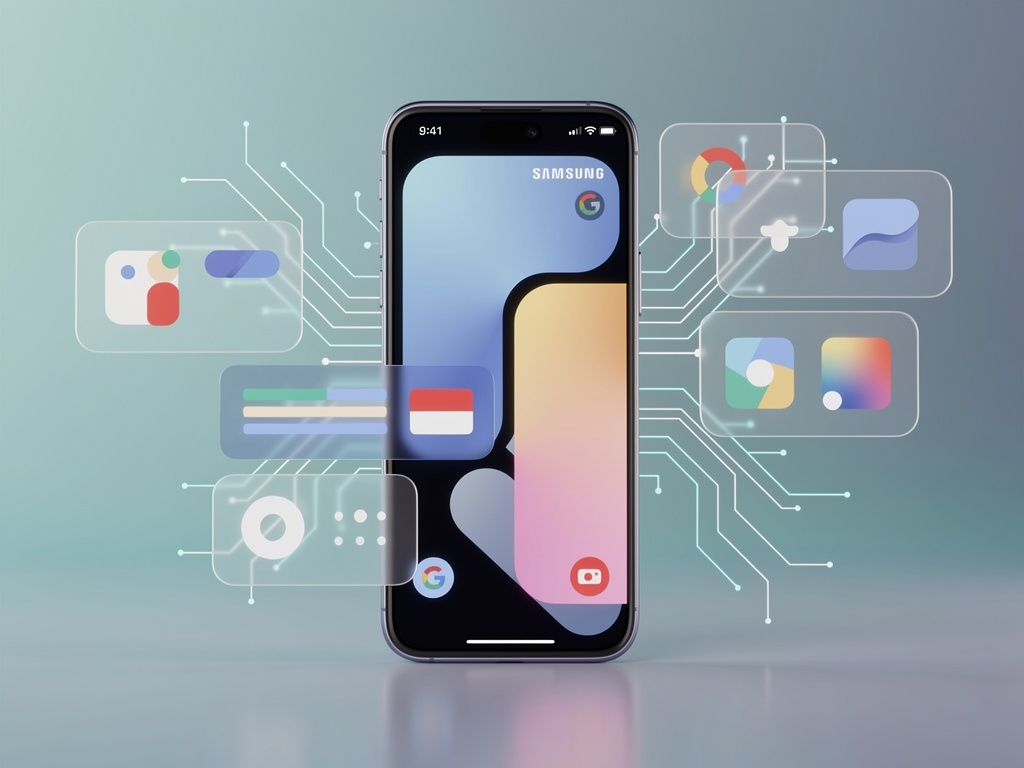
Samsung Electronics is preparing the most significant visual redesign of its Android software in years, and the first leaked screenshots suggest the South Korean giant is willing to sacrifice some of its design identity in exchange for something cleaner, more unified, and unmistakably Google-inspired.
Early images of One UI 9, Samsung’s next major software layer built atop Android 16, surfaced this week through leaked firmware builds, giving industry watchers a preview of what’s coming to hundreds of millions of Galaxy devices later this year. The redesign touches nearly every surface of the interface — from the notification shade and settings menus to the Quick Settings panel and system icons. It’s not a subtle refresh. It’s a ground-up rethinking of how Samsung’s software should look and feel.
Android Police published a detailed breakdown of the leaked UI elements, noting that the new design borrows heavily from Google’s Material You design language. The Quick Settings panel, for instance, now features pill-shaped toggles arranged in a grid pattern that closely mirrors the layout found in stock Android on Pixel devices. The notification shade appears cleaner, with more whitespace and rounded card-style containers for individual alerts. Even the settings menu has been restructured with simplified iconography and a flatter visual hierarchy.
This matters more than aesthetics.
For over a decade, Samsung has maintained one of the most distinctive Android skins in the industry. What was once called TouchWiz, then Samsung Experience, and finally One UI has always been immediately recognizable — sometimes for its feature density, sometimes for its visual heaviness. Samsung’s software historically prioritized packing in every conceivable option, which attracted power users but often left casual owners overwhelmed. One UI, introduced in 2019, began the process of simplification by pushing interactive elements toward the bottom of the screen for easier one-handed use. One UI 9 appears to accelerate that trajectory dramatically.
The leaked screenshots show a system that looks, at first glance, like it could be running on a Pixel. That’s not accidental. Samsung and Google have been deepening their partnership for several years, from co-developing the Wear OS platform for Galaxy Watch devices to integrating Google’s Gemini AI assistant more prominently into Samsung hardware. A visual convergence in software design was perhaps inevitable.
But the shift carries real risk. Samsung’s differentiation in the Android market has always rested partly on software. If One UI 9 looks too much like stock Android, what’s the argument for choosing a Galaxy S26 over a Pixel 10 — besides hardware specs and price? Samsung appears to be betting that the answer lies not in visual uniqueness but in the underlying feature set and AI capabilities it layers on top of the cleaner foundation.
According to Android Police, the leaked build also reveals changes to Samsung’s iconography. System icons appear thinner and more geometric, moving away from the slightly bolder, more playful style that has characterized recent One UI versions. The overall color palette leans more heavily on dynamic theming drawn from wallpaper colors — a hallmark of Material You that Samsung previously adopted only partially.
The timing aligns with Samsung’s broader strategic pivot. The company has increasingly positioned itself as an AI-first hardware maker, with Galaxy AI features becoming a centerpiece of its marketing since the Galaxy S24 launch in early 2024. A cleaner, less cluttered interface would give those AI features more room to breathe — and more visual prominence when they appear on screen.
There’s also a competitive dimension. Chinese manufacturers like Xiaomi, Oppo, and OnePlus have been steadily refining their own Android overlays, with recent versions of MIUI (now HyperOS), ColorOS, and OxygenOS all trending toward minimalism and Material You compliance. Samsung can’t afford to look dated by comparison, especially in European and Asian markets where these competitors are gaining ground.
One detail from the leak that caught the attention of developers and enthusiasts: the notification shade now appears to separate Quick Settings from notifications more distinctly, requiring a second swipe to access the full Quick Settings grid. This mirrors the two-swipe paradigm that Google introduced with Android 12 and has maintained since. Samsung had previously resisted this approach, allowing users to see both notifications and a row of Quick Settings toggles simultaneously. If the change sticks in the final release, it will mark a meaningful departure from Samsung’s long-standing usability philosophy.
Not everyone will welcome that.
Samsung’s forums and online communities have historically been vocal about UI changes, and the company has occasionally walked back design decisions in response to user feedback. The move toward a more Pixel-like interface will likely spark debate among the Galaxy faithful who’ve grown accustomed to Samsung’s particular way of organizing information. Power users, in particular, may feel that the simplification comes at the cost of efficiency — fewer visible toggles means more taps to reach frequently used settings.
Still, the broader industry trend is clear. Android fragmentation, once the platform’s defining weakness, has been steadily decreasing as Google exerts more design influence over its partners. The adoption of Material You as a near-universal design standard across major OEMs represents a significant consolidation of the Android visual identity. Samsung joining more fully is less a surprise than a confirmation of where things have been heading.
The leaked build is reportedly based on an early development version of Android 16, which Google is expected to finalize in the third quarter of 2025. Samsung typically launches its major One UI updates alongside new Galaxy S-series hardware in January, though a beta program for existing devices often begins several months earlier. If past patterns hold, Galaxy S25 and S24 owners could see a One UI 9 beta as early as October or November.
Samsung has not officially commented on the leaked images. The company rarely acknowledges pre-release software leaks, preferring to control the narrative through its own Unpacked events and developer conferences. But the images circulating online are consistent enough in their design language — and detailed enough in their scope — to suggest they represent a genuine direction rather than an early experiment that might be discarded.
And that direction is clear: less Samsung, more Google, with Samsung’s value-add shifting from visual differentiation to functional intelligence. Whether that trade-off pays off will depend on how compelling Galaxy AI and Samsung’s exclusive features become in the months ahead. The interface is just the canvas. What Samsung paints on it will determine whether One UI 9 is remembered as a smart evolution or an identity crisis.
For now, the leaked screenshots tell a story of a company willing to let go of old instincts. In an industry where brand identity in software has been a key differentiator, that’s a bold move. Bold — and potentially very smart.


 WebProNews is an iEntry Publication