
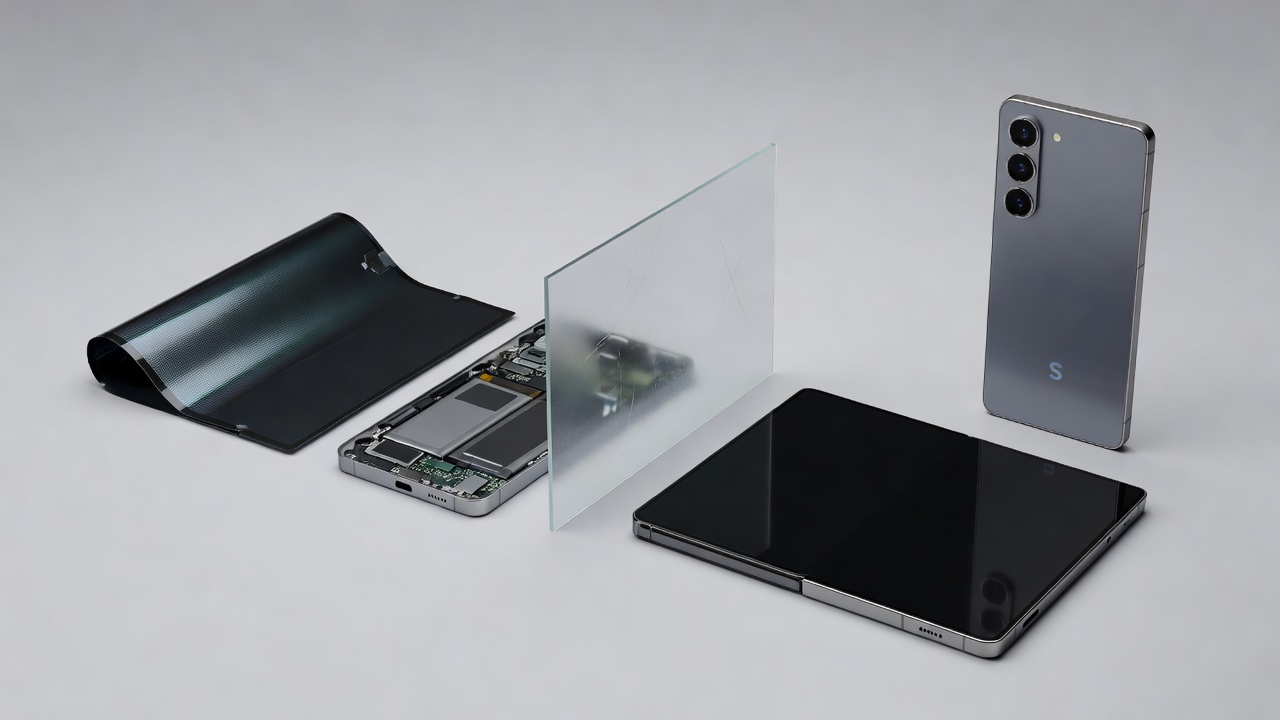
Samsung has spent years teasing flexible displays that do more than fold. Now fresh reporting points to a concrete plan. The company could ship its first commercial rollable smartphone in the first half of 2028. That device may arrive alongside the Galaxy S28 series. A source inside the company told South Korean outlet Money Today that internal development targets that window. Samsung Electronics is leading the charge with close coordination from its display division.
But don’t count on it hitting stores tomorrow. As of mid-2026 the idea still sits firmly in prototype territory. At MWC 2026 Samsung Display showed off a slidable phone concept that extended from 5.1 inches to 6.7 inches. The aspect ratio shifted dramatically from 16:9 to a tall 22:9. No hinge. No crease. Observers called it the Mobile Slidable. It carried a resolution of 1080 by 2640 pixels at 426 ppi when stretched. Yet the product team kept shipping tri-fold devices instead.
And the contrast matters. Samsung announced its Galaxy Z TriFold in December 2025. It reached buyers first in Korea then expanded to the U.S. The device opens to a 10-inch main screen and collapses to a 6.5-inch cover. CEO TM Roh described it as solving “one of the mobile industry’s longest-standing challenges” — the tradeoff between portability and screen size. That same pitch could have applied to a rollable. But the financials told a different story.
In its Q2 2025 earnings Samsung’s MX business laid out H2 priorities. Flagship phones. Foldables. The Galaxy S25 family. New form factors centered on XR and the TriFold. Rollables received no mention. The gap between what display engineers can demonstrate on a show floor and what the mobile division will actually sell remains wide. Gadget Hacks captured that tension in detail last month.
Earlier rumors painted a faster timeline. Reports once circulated about a 2025 or 2026 launch with a 12.4-inch screen when fully extended. Those figures dwarfed the Huawei Mate XT’s 10.2-inch unfolded display. Some leaks even attached the name Galaxy Z Roll and spoke of 200-megapixel cameras plus an 8000mAh battery. None of those plans materialized. The company appears to have recalibrated.
Recent coverage from today sharpens the picture. A report from Phandroid citing Money Today confirms the 2028 window and notes the device could carry a roughly 10-inch expandable display at 16:9 with around 440 pixels per inch. Stuff South Africa quoted a company source directly: “Internally, we are developing a rollable phone with a target launch date in the first half of 2028.” Threads and X posts this morning echoed the same Maeil Business Newspaper sourcing. The consensus has shifted from speculation to measured expectation.
Samsung Display holds the technical keys. It has shown rollable OLED concepts for years. The Rollable Flex prototype could stretch more than five times its original size. The Flex Hybrid mixed folding and sliding motions. These demos at CES and other events proved the panel technology works in a lab. Yet turning that into a pocketable product that survives daily abuse presents real obstacles. The display must endure thousands of roll and unroll cycles without degrading brightness, color accuracy or structural integrity. The mechanical system that drives the extension cannot fail after a few months of use.
Look at competitors for clues. LG once built a rollable prototype that increased viewable area by about 40 percent without adding foldable bulk. A teardown revealed two motors, geared rails, spring-loaded arms and a moving tray. The motors proved loud enough that engineers masked them with a chime. The entire assembly looked expensive to build and risky to certify for mass production. LG eventually exited the smartphone business. Samsung has avoided that fate by perfecting its foldable hinges first. Those hinges now feel mature. User behavior around them is understood. Repair networks exist.
Patents tell part of the story too. Samsung has filed multiple designs over the years for phones that expand via rolling mechanisms. Some unroll upward from a thick bottom bezel in a flip-style motion. Others extend from both ends. A 2022 concept called Flex Slidable did exactly that. None have reached consumers. The patents prove interest. They do not prove readiness. Android Headlines noted today that this time the project carries a stronger signal of commercial intent. The company has overcome some durability hurdles according to the latest details.
So why 2028? Several forces converge. Foldable sales continue to grow but face diminishing returns on the hinge-and-crease formula. A rollable offers a crease-free experience and variable screen sizes without the thickness penalty of multiple folds. It could function as a compact phone when retracted and a mini tablet when extended. That flexibility appeals to users tired of carrying separate devices. Yet the engineering bar sits higher. Yield rates on the complex mechanisms must improve. Supply chains for the motors and rails need scale. Pricing has to land in a range that justifies the premium without scaring away the mass market.
The internal split between Samsung Display and the MX division explains much of the delay. Display teams love to showcase wild prototypes. Product teams demand reliability, repairability and profit margins. The TriFold won that internal debate for the near term. It gives customers more screen real estate today. A rollable might deliver even more tomorrow. But only if the product division commits.
Market reaction on X this morning mixed excitement with skepticism. Some users posted concept renders showing clean 10-inch panels with under-display cameras. Others recalled past promises around foldables that slipped timelines. One post noted the potential to make secondary screens obsolete. Another wondered whether the device would feel too thick when rolled or too fragile when extended. Real answers won’t arrive for another 18 months at minimum.
Analysts see the 2028 target as realistic. It gives Samsung time to refine the panel, test mechanisms in the field and align component costs. It also lets the company watch how tri-fold adoption plays out. If that form factor succeeds the rollable could build on the same momentum. If adoption lags the company might accelerate the rollable to recapture attention.
Either way the direction looks set. Samsung refuses to cede the flexible-display future to Chinese rivals or to concepts that never ship. Its patents, its prototypes and now its internal roadmap all point toward a device that rolls rather than folds. The first half of 2028 could mark the moment that vision finally reaches buyers’ hands. Until then the prototypes will keep sliding across trade-show floors while the product teams focus on what they can sell today.
The gap between demonstration and delivery has defined Samsung’s flexible-phone efforts for half a decade. Closing it will test the company’s ability to turn laboratory marvels into everyday tools. Success could expand the entire premium smartphone category. Failure would hand the next chapter to someone else. For now the smart money watches 2028.


 WebProNews is an iEntry Publication