
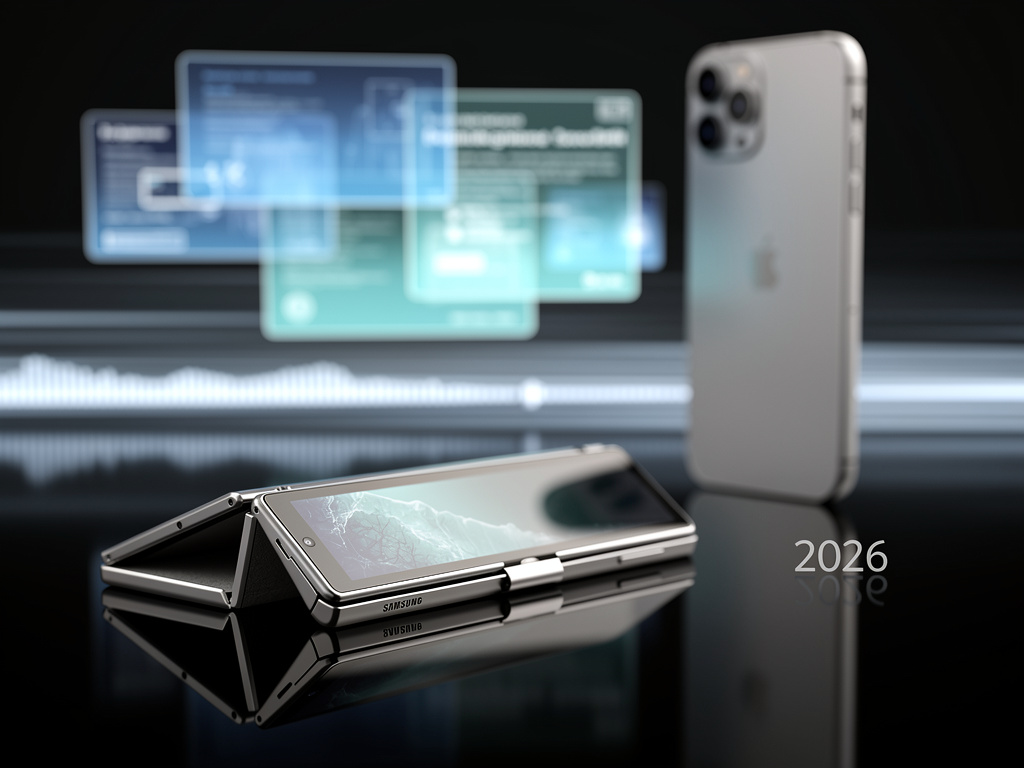
A leaked animation has given the clearest signal yet that Samsung’s next foldable flagship will abandon the narrow, passport-like proportions that have defined the Galaxy Z Fold line since its debut. The Galaxy Z Fold 8, expected to launch later this year, appears to feature a significantly wider cover screen — a change that would address the single most persistent complaint about Samsung’s book-style foldable phones.
The animation, first surfaced by Android Authority, was discovered inside a Samsung Members APK by tipster assemble_debug. It shows a device unfolding with exterior dimensions that look dramatically different from the current Galaxy Z Fold 7 and its predecessors. The cover display is wider. Noticeably so. And the inner folding screen, when opened, appears closer to a square aspect ratio rather than the elongated rectangle Samsung has shipped for years.
This isn’t the first rumor pointing in this direction. But it’s the most visually concrete evidence yet that Samsung is preparing a fundamental redesign rather than an incremental spec bump. The animation was embedded in official Samsung software, which gives it more weight than the typical render leak or supply-chain whisper.
For years, Samsung’s Z Fold series has occupied an awkward position. It was the most polished book-style foldable on the market, yet its cover screen was too narrow to use comfortably as a regular phone. Typing felt cramped. Apps looked squeezed. Users who spent $1,800 on a device still found themselves wishing for a wider front display when the phone was closed. Samsung tried to address this incrementally — the Fold 6 was slightly wider than the Fold 5, and the Fold 7 nudged things a bit further — but the fundamental constraint remained. The phone, when folded, felt like a tall, skinny slab that prioritized thinness over usability.
A wider Fold 8 would change that calculus entirely.
The timing matters. Samsung is no longer the only serious player in the foldable space, and its competitors have already moved toward wider cover screens. The OnePlus Open, which launched in late 2023, earned widespread praise for its front display proportions. Google’s Pixel Fold, despite mixed reviews on other fronts, also opted for a wider, more conventional cover screen ratio. Honor’s Magic V3 went even thinner while maintaining a usable front display. Chinese manufacturers like Huawei and Xiaomi have been shipping wider foldables for over a year. Samsung, the company that essentially created the modern foldable category, has been playing catch-up on this specific design choice.
And then there’s Apple.
Multiple reports from credible sources, including Bloomberg’s Mark Gurman, indicate that Apple is developing a foldable iPhone for launch as early as 2026. Apple’s entry into the foldable market would instantly reshape consumer expectations. If Samsung’s Z Fold 8 still carried the same narrow proportions when Apple showed up with something wider and more polished, the optics would be brutal. Samsung appears to understand this. The wider Fold 8 looks like a preemptive move — getting the design right before Cupertino arrives with its own take on the form factor.
The leaked animation suggests other changes too. The crease — that visible line running down the center of the inner display where the screen folds — appears less pronounced. Samsung has reduced crease visibility with each generation, but it remains noticeable, especially under certain lighting conditions. If the Fold 8 can make the crease nearly invisible, it removes another friction point that has kept mainstream buyers skeptical of foldables.
There’s also the question of thickness. A wider cover screen means the device will be wider when folded, which could make it feel bulkier in the pocket. Samsung’s engineering challenge is to go wider without going thicker. Recent reports from SamMobile noted that Samsung has been aggressively pursuing thinner designs across its foldable lineup, and the Fold 8 is expected to continue that trend. The company’s use of new hinge mechanisms and thinner battery cells could help offset the width increase.
Durability is another factor. Samsung has steadily improved the resilience of its foldable screens, moving from plastic-feeling displays to ultra-thin glass composites. The Fold 7 introduced improvements to its hinge dust resistance and screen hardness. But a wider screen means more surface area under stress every time the device opens and closes. Samsung will need to demonstrate that the wider format doesn’t compromise longevity — a concern that still lingers for consumers considering their first foldable purchase.
Pricing will be critical. Samsung’s foldables have always been expensive, and the Fold series has consistently launched at or above $1,800. A major redesign could push that number higher. But Samsung is also facing pressure from Chinese competitors selling capable foldables at significantly lower price points. The OnePlus Open launched at $1,700. Honor’s Magic V3 undercut Samsung by several hundred dollars in markets where it was available. If Samsung prices the Fold 8 above $2,000 without delivering a proportional leap in value, it risks ceding market share to rivals who are closing the quality gap fast.
So what does a wider Fold 8 actually mean for daily use? Practically everything gets better. A wider cover screen means a more comfortable typing experience, better app compatibility without aggressive letterboxing, and a front display that functions as a proper smartphone rather than a compromise you tolerate until you unfold the device. The inner screen, closer to a square ratio, would improve split-screen multitasking — one of the core selling points of book-style foldables. Watching video on the inner display would also benefit, with less wasted space above and below the content.
Samsung’s software will need to keep pace. One UI, the company’s Android skin, has gotten progressively better at handling foldable-specific use cases — drag-and-drop between split windows, app continuity when transitioning from cover to inner screen, and taskbar functionality borrowed from desktop computing. But a new aspect ratio means recalibrating all of these features. Third-party app developers will also need to optimize for the new dimensions, though Android’s flexible layout system handles aspect ratio changes better than it did a few years ago.
The broader strategic picture is worth examining. Samsung’s mobile division has been under pressure. Its smartphone market share has faced erosion from Apple at the premium end and Chinese brands at the mid-range. Foldables were supposed to be Samsung’s differentiator — the category where it could command premium prices and maintain technological leadership. That advantage has eroded faster than expected. A redesigned Fold 8 with a wider screen, thinner profile, and reduced crease would be Samsung’s clearest statement in years that it intends to defend its position at the top of the foldable market.
The animation leak, while not an official announcement, carries the hallmarks of something real. Samsung Members APK files have been reliable sources of upcoming product details in the past. Tipsters who mine these files have accurately predicted design changes for previous Galaxy devices. And the timing — months before Samsung’s expected summer Unpacked event — aligns with the typical leak cycle for major Galaxy launches.
Nothing is confirmed until Samsung puts it on stage. But the evidence is mounting that the Galaxy Z Fold 8 will represent the most significant design overhaul since the original Fold. For an industry that has been waiting for foldables to cross from niche curiosity to mainstream essential, a wider, thinner, more usable Fold 8 could be exactly the product that tips the balance. Or at the very least, it ensures Samsung won’t be caught flat-footed when Apple finally enters the ring.


 WebProNews is an iEntry Publication