
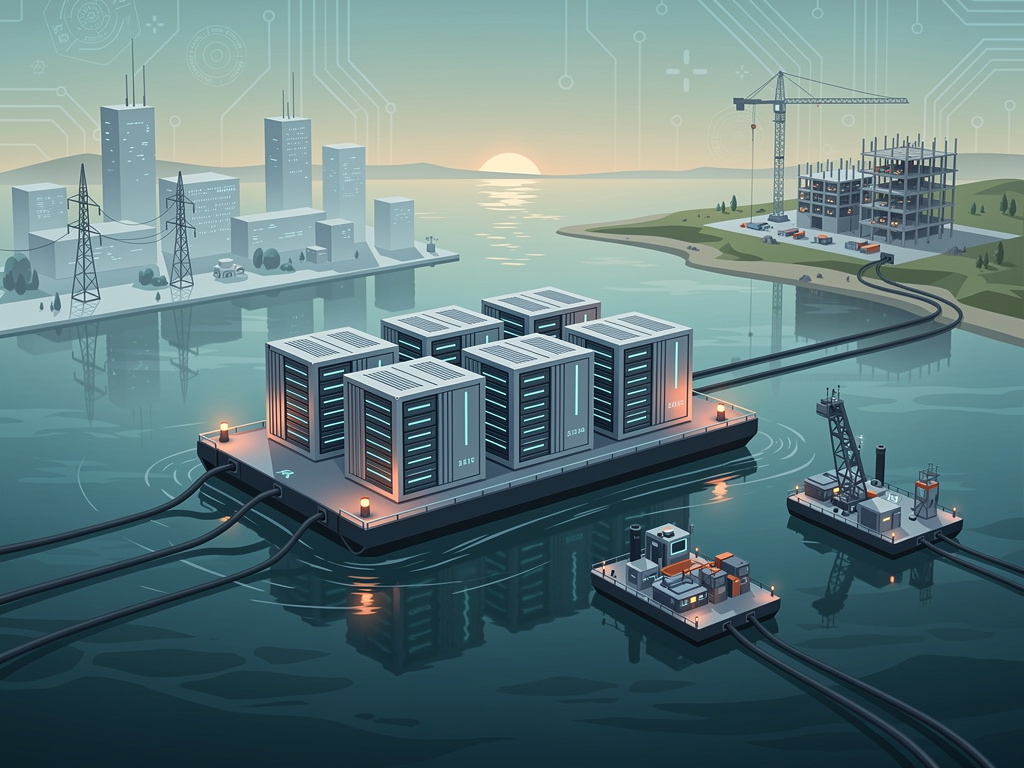
Samsung Heavy Industries recently put a scale model on display. The vessel represents more than a shipbuilder’s experiment. It signals a shift in how the biggest AI players hunt for power.
Parked offshore, these barges hook directly into coastal energy assets. They draw on existing thermal or nuclear plants that sit partly idle, bypassed by grid queues stretching five years or longer. The approach promises to flip development calendars. What once took years now targets quarters.
In October 2025, Samsung and OpenAI signed a letter of intent. The pact spans chips, data centers and maritime innovation. Samsung C&T and Samsung Heavy Industries took the lead on floating platforms. Their stated aims: tackle land shortages, slash cooling expenses, trim carbon output. Samsung’s official announcement framed the effort as support for OpenAI’s Stargate project and South Korea’s bid to rank among the top three AI nations.
Enter Mousterian Corp. The Dallas-based developer stayed quiet for a year before emerging in late April 2026. It paired with Samsung Heavy Industries to deliver institutional-grade floating data centers worldwide. Min Suh, Mousterian’s CEO, cut to the core. “Speed to power is the new moat.”
He elaborated in a LinkedIn post referenced across reports. “We’ve thoughtfully partnered with some of the leading global conglomerates, allowing us to deliver over 1,500MW of capacity over the next 3 years.” Suh’s team draws on executives who built the world’s first operational floating data center. They target underused baseload at water-cooled plants. “Most of the industry is racing to build new power,” Suh said. “We took a different angle. An enormous amount of baseload generation already exists—particularly at water-cooled thermal plants—that sits underutilized, curtailed, or stranded behind grid constraints. Activating what’s already there is faster, cleaner, and more capital-efficient than greenfield build.”
The model shown at industry events carries thousands of liquid-cooled servers. Each barge forms a self-contained data hall. Power flows straight from the adjacent plant. Cooling comes free from seawater. Fiber links reach shore. The setup bypasses traditional interconnection delays that hobble land projects across Texas, Virginia and beyond.
Samsung Heavy Industries secured concept design approval in April 2026 for a 50-megawatt version. Classification societies American Bureau of Shipping and Lloyd’s Register signed off. The approval marks a concrete step beyond concepts. Young-kyu Ahn, executive vice president and chief technology officer at Samsung Heavy Industries, described the opportunity. “Floating data centers represent a new business model that extends shipbuilding capabilities into the digital infrastructure sector. Combined with eco-friendly energy solutions, they will set new standards in the global data market and serve as a key driver of future growth.”
But scale remains the question. Mousterian and its partners talk 1.5 gigawatts within 36 months. That pace assumes smooth approvals, rapid fabrication, willing tenants and stable marine conditions. Skeptics point to the unknowns. Saltwater corrodes. Storms hit hard. Maintenance calls turn expensive when crews must boat out. Cybersecurity takes on new dimensions at sea. Emergency response slows. Fiber connections prove trickier than on dry land.
The TechRadar analysis captured the tension. It noted the design’s potential to compress timelines yet flagged “unproven timelines across shipbuilding, permitting, and tenant onboarding.” Analysts view the effort as a niche addition rather than a full answer to AI’s hunger. True measure, they say, lies in how many barges actually power up on schedule.
Context matters. AI training clusters now demand hundreds of megawatts apiece. Hyperscalers and startups alike scramble. Land-based builds face zoning fights, transmission bottlenecks and multi-year waits for new generation. Texas has drawn massive investment precisely because its grid sometimes moves faster. Even there, clusters risk tripping offline and stressing the system. A 2024 Virginia incident that shed 1.5 gigawatts offered warning. Floating options won’t replace every onshore campus. They could, however, unlock stranded power near coasts and rivers.
OpenAI’s role adds weight. The company eyes these platforms for future ChatGPT iterations and broader workloads. Samsung Electronics pledged memory chips to meet OpenAI’s projected appetite: up to 900,000 DRAM wafers monthly. Samsung SDS will help design, operate and even resell OpenAI tools in Korea. The partnership threads through the entire stack. Chips. Power. Compute. Services.
And yet execution will test everyone involved. Shipyards must adapt production lines. Regulators must decide how to classify sea-based facilities. Utilities weigh the value of selling otherwise-curtailed output. Investors size up the storm risks against promised returns. Suh’s group insists its model de-risks delivery. It combines Samsung’s fabrication muscle, Mousterian’s site pipeline and relationships with power generators and infrastructure funds.
Recent coverage reinforces the momentum. Dallas Innovates detailed Mousterian’s stealth period and its bet on adjacent baseload. Maritime outlets reported the cooperation agreement and approvals. No major new projects broke ground in the past week, but the model display and regulatory nods keep attention high.
So the industry watches. Can barges deliver gigawatts at the speed AI demands? Or will marine realities stretch those 36-month promises? The answer sits offshore, tethered to existing plants, waiting for the first large-scale deployment to prove the concept or expose its limits. Power has become the decisive factor. These floating halls represent one creative bid to seize it first.


 WebProNews is an iEntry Publication