
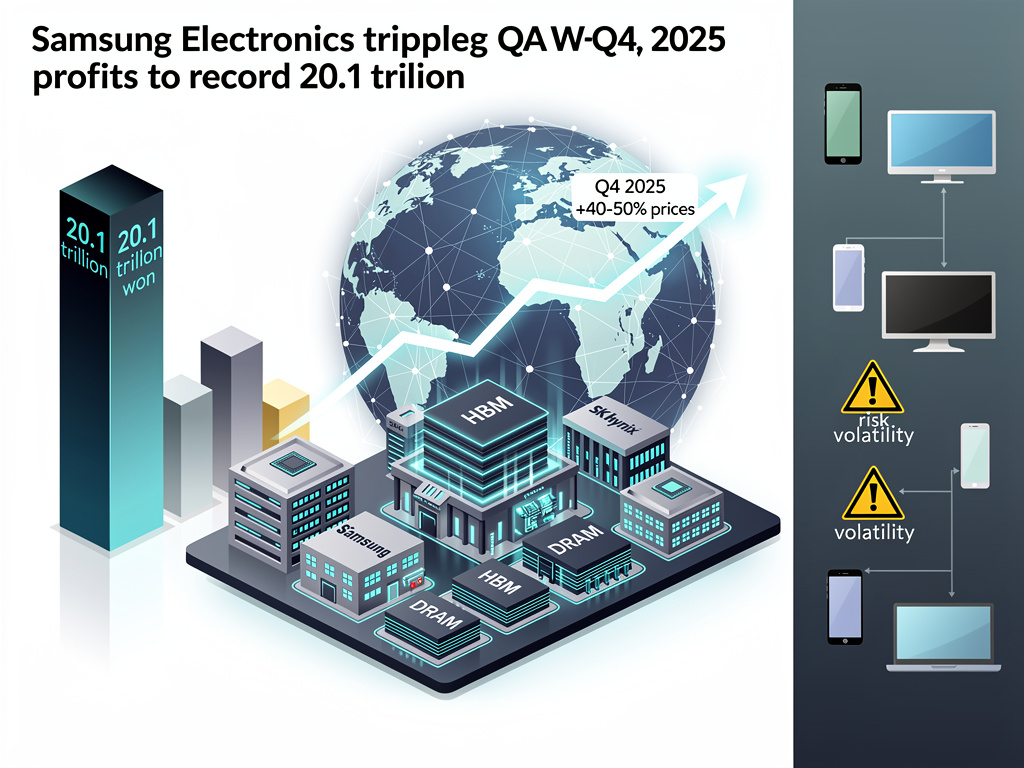
Samsung Electronics Co. unveiled staggering fourth-quarter results for 2025, with operating profit soaring more than threefold to a record 20.1 trillion Korean won ($14 billion), eclipsing analyst forecasts and the company’s own guidance. Revenue climbed 24% year-over-year to 93.8 trillion won ($65.58 billion), marking a fresh quarterly high. This windfall stems from explosive demand for high-bandwidth memory chips powering AI data centers, which has triggered widespread shortages and skyrocketed prices across memory types.
The semiconductor division, Samsung’s powerhouse, notched all-time highs in revenue and profit, propelled by a market-wide price surge, robust sales of high-value HBM products, and other premium offerings. Makers like Nvidia Corp. are vying for scant HBM supplies, with demand far exceeding availability. As producers such as Samsung reroute capacity to these high-margin AI essentials, supplies of standard DRAM and NAND for PCs and mobiles have tightened, boosting prices 40%-50% in the quarter, according to CNBC.
Record Breaker Shatters 2018 Peak
This performance vaults past Samsung’s prior benchmark of 17.6 trillion won from Q3 2018, during the last memory boom. Full-year 2025 operating profit hit 43.53 trillion won, up 33% from 2024, with sales rising 10.6% to 332.77 trillion won. Counterpoint Research dubbed the phase a ‘Hyper-Bull’ market, outstripping 2018 peaks, with supplier leverage at historic highs from AI and server hunger.
Samsung trails rival SK Hynix Inc. in HBM supremacy but dominates NAND and leverages conventional DRAM strength. SK Hynix, reporting record earnings earlier, saw FY2025 revenue of 97.1467 trillion won and Q4 operating profit of 19.1696 trillion won, fueled by HBM leadership. Samsung’s HBM shipments are poised to triple in 2026 as HBM4 ramps up, per analysts cited in Yahoo Finance.
HBM Frenzy Squeezes Broader Supplies
AI hyperscalers like Meta Platforms Inc. and Amazon.com Inc. are snapping up DRAM at premiums, as noted by CLSA’s Sanjeev Rana: “Hyperscalers and cloud providers are buying a lot of DRAM and they are willing to pay a price premium.” DDR5 contract prices leaped 313% year-over-year, per TrendForce data referenced in Reuters. Spot prices for mainstream DRAM surged 18-23% in Q4 alone.
Makers are diverting factories from consumer chips to AI-grade HBM, exacerbating shortages. Micron Technology Inc. CEO Sanjay Mehrotra warned markets will stay tight beyond 2026, meeting only half to two-thirds of key customer needs. Samsung plans aggressive HBM4 expansion for Nvidia’s Rubin platform, with CEO Jun Young-hyun noting customer praise: “Samsung is back.”
Rivals Ride the Wave, Foundry Edges Up
SK Hynix’s blockbuster results underscore the sector surge, with 58% operating margins and 2026 demand forecasts of +20% for DRAM and +18% for NAND, as shared by Counterpoint Research VP Neil Shah on X. Samsung’s non-memory units, including foundry and system LSI, narrowed losses to about 800 billion won in Q4 from mid-2 trillion won earlier in 2025, aided by a weaker won.
The mobile division held profitability at 2-3 trillion won despite rising component costs pinching margins. Display profits grew on Apple Inc.’s iPhone 17 sales. Samsung eyes Qualcomm for 2nm chip contracts and Intel for 8nm foundry work, per KED Global.
2026 Horizons: Capacity Race Accelerates
Memory prices could rise another 40-50% in Q1 2026, then 20% in Q2, with DDR5 RDIMMs potentially doubling by year-end. Samsung warns shortages will hike prices industry-wide, impacting its own gadgets. HBM orders secure visibility into 2026, with capex rising for U.S. expansion and MLCC/FC-BGA amid AI server demand, as Citi noted for Samsung Electro-Mechanics.
Analysts like DB Securities’ Seo Seung-yeon flag risks: soaring prices may curb PC/smartphone demand, while AI data centers lean on debt. Yet, AI server shipments could grow 80% in 2026, per reports, sustaining tightness. Samsung’s scale positions it to capture gains as factories, power grids, and packaging like TSMC’s CoWoS hit full utilization.
Investor Calculus in Volatile Boom
Shares jumped 125% in 2025, the best in 26 years, but dipped post-earnings on profit-taking. Valuation concerns linger amid potential demand slowdowns, as BNK’s Lee Min-hee cautioned on PC/smartphone pressures and AI financing risks. Still, with Nvidia’s Rubin on track and custom TPUs boosting HBM, Samsung’s dual exposure to conventional and advanced memory fortifies its stance in this protracted upcycle.


 WebProNews is an iEntry Publication