
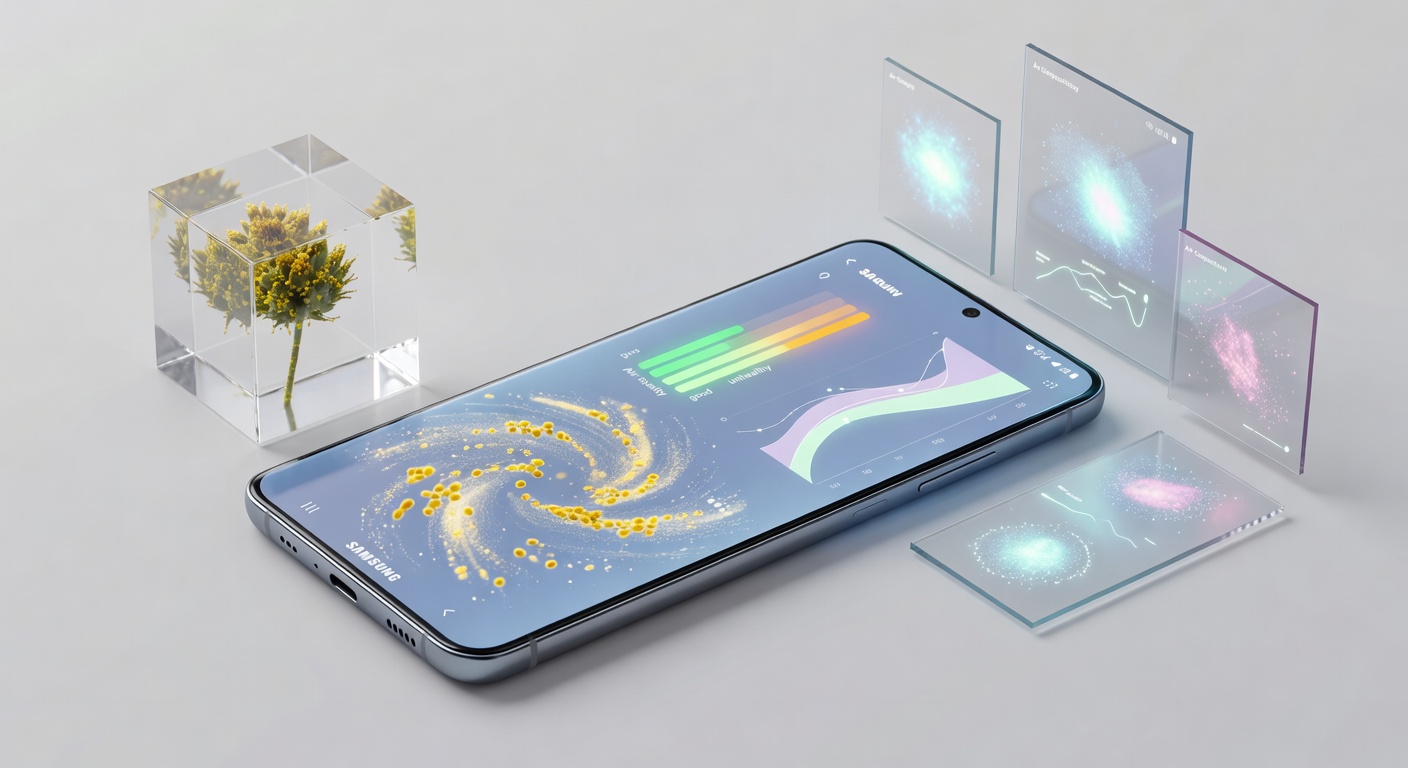
Somewhere between checking the five-day forecast and deciding whether to wear a jacket, Samsung decided your phone should also tell you exactly which pollen is ruining your morning. The company’s latest update to Samsung Weather — a stock app most users barely think about — now includes granular allergen data, air quality breakdowns, and health-oriented insights that transform a utilitarian tool into something approaching a personal environmental monitor.
It’s a small update. But it’s not a small signal.
As reported by Digital Trends, Samsung Weather now displays specific pollen types — tree, grass, and weed — alongside severity levels for each. The app also surfaces a UV index, air quality data including PM2.5 particulate readings, and an overall “allergy outlook” that synthesizes multiple environmental factors into a single digestible snapshot. Users running One UI 7 on Galaxy devices are seeing the changes roll out now, with the data sourced from The Weather Channel, Samsung’s longtime meteorological partner.
The feature isn’t buried in settings or hidden behind a toggle. It’s front and center in the app’s redesigned interface, presented with color-coded severity indicators that make the information scannable at a glance. Samsung clearly wants people to use this — not just notice it.
Why a Weather App Matters More Than You Think
Stock weather apps occupy a peculiar position in the smartphone hierarchy. They’re among the most frequently opened applications on any phone, yet they rarely command attention from reviewers or analysts. People open them reflexively, dozens of times per week, often without conscious thought. That frequency makes them extraordinarily valuable real estate for any phone manufacturer trying to deepen user engagement or demonstrate software differentiation.
Samsung’s move here mirrors a broader trend among device makers who are realizing that first-party app quality directly affects brand perception. Apple has been expanding its own Weather app since acquiring Dark Sky in 2020, adding features like severe weather notifications, next-hour precipitation charts, and air quality maps. Google’s Pixel Weather app, meanwhile, has earned a cult following for its clean design and AI-generated weather summaries — a feature Google highlighted during its Pixel 9 launch cycle.
Samsung is playing catch-up in some respects. But the allergen data is an area where it’s actually pushing ahead of both competitors in terms of specificity. Neither Apple Weather nor Google’s Pixel Weather currently breaks down pollen by type at this level of detail within the stock app experience. Third-party apps like Zyrtec’s AllergyCast and Pollen.com have offered this for years, but embedding it in the default weather tool eliminates friction entirely. No separate download. No extra account. Just open the app you were already going to open.
And that’s the point.
The strategic logic is straightforward: if Samsung can make its preinstalled apps genuinely useful — useful enough that users don’t immediately replace them with third-party alternatives — it strengthens the case for staying within the Samsung software environment. Every user who doesn’t download a competing weather app is one more user seeing Samsung’s interface, Samsung’s design language, Samsung’s advertising partnerships. The allergen feature isn’t charity. It’s retention.
The timing isn’t accidental either. Spring allergy season in the Northern Hemisphere is peaking right now, with the American Academy of Allergy, Asthma & Immunology reporting that pollen counts across much of the United States have been running above average this year due to warmer-than-usual temperatures through the winter months. Climate change continues to extend pollen seasons and increase pollen concentrations — a trend well-documented in research published by Nature Communications — making allergen tracking not a niche concern but an increasingly mainstream need.
The Bigger Picture: Health Data as a Differentiator
Samsung’s allergen play fits into a larger pattern of phone manufacturers embedding health-related data into everyday software touchpoints. Samsung Health already tracks steps, sleep, heart rate, blood oxygen, and body composition through Galaxy Watch integration. Adding environmental health data to the weather app extends that philosophy beyond wearables and into the phone itself.
This convergence matters. Roughly 60 million Americans suffer from allergic rhinitis, according to the Asthma and Allergy Foundation of America. Globally, the number exceeds 400 million. For these users, knowing that tree pollen is high today isn’t trivia — it determines whether they take medication before leaving the house, whether they run outdoors or hit the gym, whether they open windows or keep them sealed. Contextual health information delivered at the right moment, in the right app, has genuine utility.
Samsung seems to understand this. The company’s broader One UI 7 update, which began rolling out alongside the Galaxy S25 series earlier this year, has emphasized what Samsung calls “intelligent” features — AI-powered suggestions, contextual notifications, and proactive information delivery. The weather app update is consistent with that philosophy, even if it doesn’t involve any artificial intelligence per se. It’s about surfacing the right data at the right time without requiring the user to go looking for it.
There’s a competitive dimension too. As smartphone hardware increasingly commoditizes — cameras are universally excellent, processors universally fast, screens universally sharp — software and services become the primary battleground. Apple knows this. Google knows this. Samsung, which sells more phones globally than either of them, is investing accordingly.
Not every user will care about pollen breakdowns. Obviously. But the users who do care will care intensely, and they’ll remember which phone gave them that information without asking. That’s how brand loyalty compounds — not through one blockbuster feature, but through dozens of small, thoughtful touches that accumulate over time.
So yes, it’s just a weather app update. But it’s also a statement about where Samsung thinks the value in smartphones is shifting. Away from specs. Toward context. Toward relevance. Toward the kind of ambient intelligence that makes a device feel like it actually knows something about the person holding it.
What Comes Next
The logical extension of this approach is personalization. Right now, Samsung Weather shows the same allergen data to everyone in a given location. But combine that data with Samsung Health profiles — where a user could theoretically flag specific allergies — and the app could prioritize warnings for the specific pollens that affect that individual. A grass allergy sufferer doesn’t need to see tree pollen counts front and center. Someone with asthma might want PM2.5 alerts pushed more aggressively.
Samsung hasn’t announced anything like this. But the infrastructure is there. The Health app exists. The weather data pipeline exists. The AI processing capabilities on-device exist, particularly with Samsung’s growing investment in Galaxy AI. Connecting those dots would be a natural progression — and one that would be genuinely difficult for competitors to replicate without similarly integrated hardware-software stacks.
For now, though, the update is what it is: a well-timed, well-executed addition to a stock app that most Samsung users already open daily. It won’t make headlines the way a new foldable phone does. It won’t trend on social media. But it will quietly make life slightly better for millions of allergy sufferers who happen to own a Galaxy phone.
Sometimes that’s enough.


 WebProNews is an iEntry Publication