
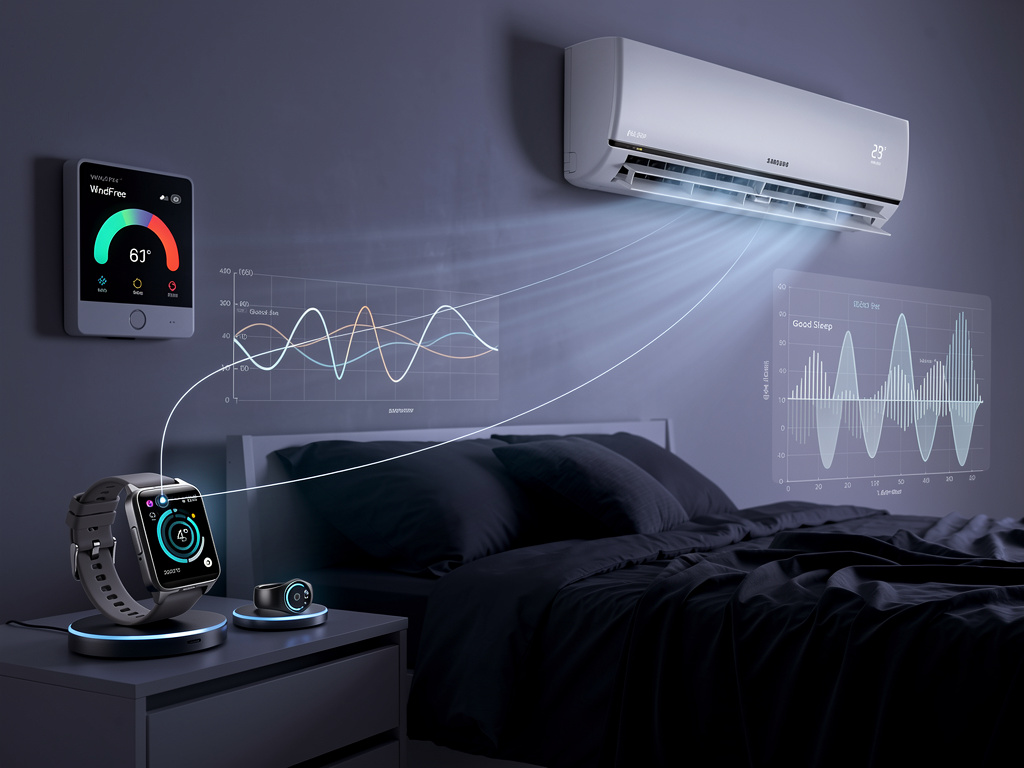
Samsung has taken another step connecting its wearable devices directly to home appliances. The company’s new WindFree Wearable Good Sleep mode links Galaxy Watches and Galaxy Rings to its 2026 Bespoke AI WindFree air conditioners. Once asleep, the wearable signals the AC. The unit switches to a specialized cooling profile. Temperature shifts gradually through the night. No manual tweaks required.
The feature builds on years of Samsung’s WindFree technology. Introduced in 2016, it disperses air through thousands of micro-holes. Draughts disappear. The result feels like still air yet keeps rooms cool. Now that foundation meets real-time biometric data from devices worn on the wrist or finger. Integration marks a practical expansion of Samsung’s connected health and home strategy.
Setup looks straightforward on paper. Owners install the SmartThings app on their Galaxy Watch or Ring. They connect the Bespoke AI WindFree unit to home Wi-Fi. Then they enable the sleep mode through the phone’s settings or the watch interface. Wear the device to bed. That’s it. When the wearable registers sleep onset, it triggers WindFree Cooling plus the Good Sleep adjustment. The AC modifies performance to match individual patterns. It does this multiple times during the night.
But. Real-world adoption hinges on owning several Samsung products. A compatible Galaxy Watch from Series 4 onward. Or the newer Galaxy Ring. The specific 2026 Bespoke AI WindFree model. A smartphone running One UI 4.0 or later. And the SmartThings ecosystem. TechRepublic noted this full buy-in requirement in its recent coverage. https://www.techrepublic.com/article/news-samsung-windfree-ac-wearable-good-sleep/. Early promotions sometimes bundle a Galaxy Fit3 to lower the barrier.
Samsung has not released clinical data showing measurable sleep gains from this AC linkage. Contrast that with its sleep apnea detection feature. The latter earned FDA authorization. It uses blood oxygen readings. A user study suggested lower risk estimates. The wearable-AC combination currently rests on promotional claims of deeper, more pleasant rest. Android Authority reported the announcement days ago, highlighting automatic adjustments without user input. https://www.androidauthority.com/samsung-galaxy-watch-ac-feature-3670717/.
SammyFans dug into the mechanics. The wearable detects the transition from awake to asleep. It sends a signal. The AC activates the special mode. Temperature drifts slowly rather than holding one fixed point. This approach aims to reduce awakenings caused by discomfort. Users avoid the classic problem of setting the thermostat too low at bedtime only to wake chilled hours later. Or too warm and restless. https://www.sammyfans.com/2026/05/25/samsung-unveils-windfree-wearable-good-sleep-mode-for-ai-ac/.
Energy savings form another part of the story. Samsung’s broader AI controls in the 2026 Bespoke line have shown efficiency gains in earlier tests. Up to 30 percent lower consumption compared with traditional units in some modes. The wearable-triggered feature should further limit unnecessary runtime. Yet exact figures for the Good Sleep profile remain unpublished.
Industry watchers see this as continuation of a larger trend. Consumer electronics firms now treat sleep as data. Heart rate variability. Movement. Skin temperature. Respiratory metrics. All feed algorithms. Samsung already surfaces sleep scores and coaching in its Health app. Linking those insights to the room’s climate control feels logical. The AC becomes an actuator for health recommendations.
Still, limitations exist. The system only works within Samsung’s closed garden. Owners of competing wearables or smart home platforms gain nothing. Privacy questions arise too. Sleep data travels from wrist to cloud to appliance. Samsung says the processing stays local where possible. Details stay sparse.
Competitors have chased personal cooling before. Sony’s Reon Pocket used thermoelectric effects in a neck device. Neck fans from various brands offer portable relief. Those solutions target the body directly. Samsung’s approach conditions the bedroom instead. Different philosophy. One follows the person. The other prepares the environment.
Analysts expect more such connections. Future updates could tie lighting, blinds, or even mattress firmness to the same sleep signals. The 2026 Bespoke AI WindFree already supports broader SmartThings routines. Turn off lights. Lower shades. Adjust the AC. All triggered by the moment the wearable senses sleep.
Early reaction on social platforms mixes curiosity with skepticism. Some users like the idea of never touching the thermostat again. Others question whether the temperature shifts will truly match complex sleep cycles. Human bodies cool naturally in the first half of the night. Core temperature bottoms out before dawn. An intelligent system should mirror that rhythm. Samsung claims its pattern-based adjustments do exactly that.
Availability will roll out with the new AC models later this year. Pricing remains undisclosed. Bundles with Galaxy wearables could sweeten the deal for existing Samsung customers. For everyone else, the feature adds one more reason to consolidate devices under a single brand.
The move underscores how ordinary appliances are gaining intelligence. An air conditioner no longer just cools on schedule. It listens to your body. Responds in the background. Delivers comfort without thought. That quiet operation may prove its strongest selling point. Not flashy hardware. But the absence of friction between intention and outcome.
Whether this particular integration lifts overall sleep quality for large numbers of users will take time to measure. Samsung has the sensors. The connectivity. The appliances. Now comes the test of turning data into better nights. The hardware is here. Results will decide if the promise holds.


 WebProNews is an iEntry Publication