
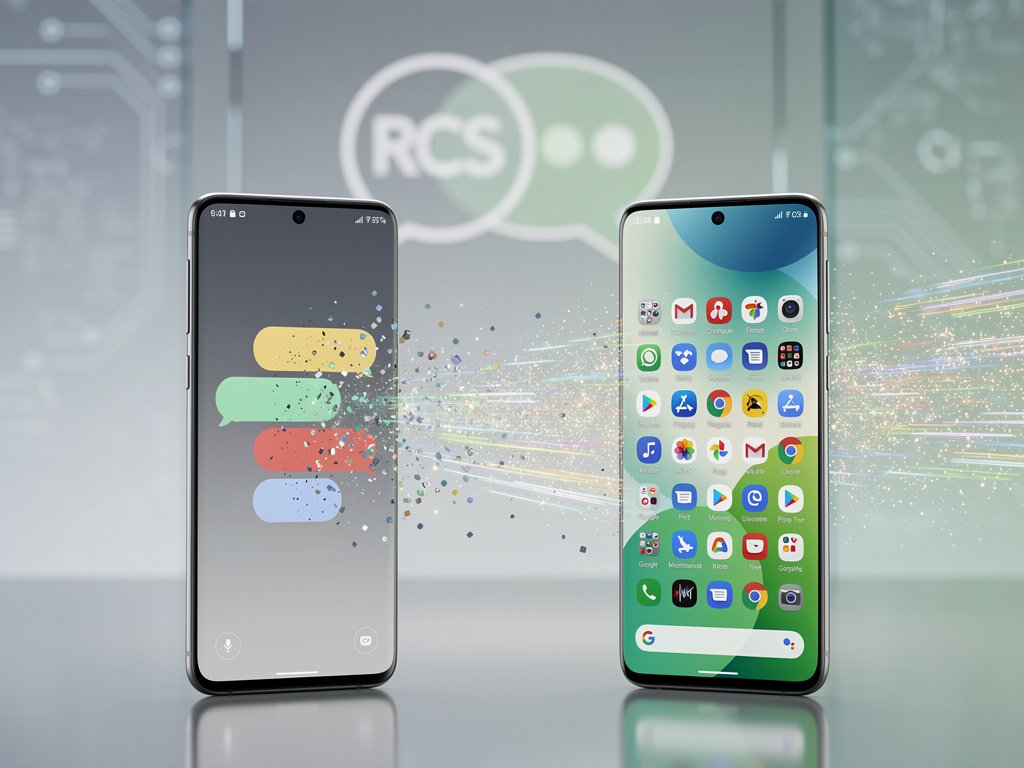
Samsung is finally pulling the plug on Samsung Messages, the default texting application that shipped on its Galaxy devices for over a decade. The move, confirmed through an update to the app itself, marks the end of a long and often awkward coexistence between Samsung’s homegrown messaging client and Google Messages, which has steadily become the de facto standard on Android phones worldwide.
The writing was on the wall. For years, Samsung had been nudging users toward Google Messages, first making it the default on select devices, then expanding that policy across its entire lineup. Now, as Android Authority reported, Samsung Messages is displaying an “end of service” notice to users who still have it installed, directing them to transition to Google Messages for their SMS and RCS needs.
No more dual messaging apps cluttering the app drawer. No more confusion about which client handles what. It’s over.
The Slow Death of a Default
Samsung Messages wasn’t a bad app. It handled SMS and MMS reliably for years, and Samsung even added RCS (Rich Communication Services) support to it—the modern messaging protocol that enables read receipts, typing indicators, high-resolution media sharing, and end-to-end encryption, features long associated with Apple’s iMessage. But Samsung’s implementation of RCS ran through its own servers and infrastructure, separate from Google’s Jibe platform, which created fragmentation in an already fragmented messaging environment on Android.
Google has spent the better part of five years campaigning aggressively to make RCS the universal standard on Android, publicly pressuring Apple to adopt it (Apple finally added basic RCS support in iOS 18) and signing up carriers and manufacturers worldwide. Samsung was the biggest holdout among Android OEMs—not in opposing RCS itself, but in insisting on running its own version of it rather than defaulting to Google’s infrastructure.
That changed in stages. In 2022, Samsung began shipping Google Messages as the default on new Galaxy devices in key markets. By 2023, the transition had gone global. Samsung Messages remained installed as a secondary option, but it was clear which direction things were heading. The app received fewer updates. Its feature set stagnated.
And now the formal shutdown.
According to the end-of-service notice spotted in the app, Samsung is telling users their messages and data can be migrated to Google Messages. The company hasn’t announced a hard cutoff date publicly, but the in-app messaging makes clear that active development and support are finished. Users who ignore the notice will eventually find themselves on an unsupported, non-functional app.
This isn’t unprecedented. Samsung has a history of maintaining its own versions of core Android apps—browser, email, calendar, keyboard—sometimes in direct competition with Google’s equivalents. Some of these, like Samsung Internet Browser, have carved out genuine niches with features Google Chrome doesn’t offer. Samsung Messages never achieved that kind of differentiation. It was, for most users, simply the app that was already there when they turned on their phone.
What This Means for the Broader RCS Push
The consolidation around Google Messages matters far beyond Samsung’s app drawer. RCS adoption has been one of the most drawn-out infrastructure upgrades in mobile telecommunications, a protocol that was first specified by the GSMA in 2008 and took more than 15 years to achieve anything approaching mainstream deployment. Google’s decision to build RCS directly into its Messages app and offer it over the internet (rather than requiring carrier-side implementation) accelerated adoption dramatically, but fragmentation remained a problem as long as major manufacturers like Samsung ran parallel RCS stacks.
With Samsung Messages out of the picture, Google Messages becomes the single dominant RCS client on Android. That’s significant. Samsung sells more Android phones than any other manufacturer globally—roughly one in five smartphones sold worldwide carries the Galaxy brand, according to IDC’s quarterly tracker data. Every one of those devices now funnels messaging through Google’s platform, giving Google Messages a user base that rivals WhatsApp in sheer scale across certain markets.
For carriers, this simplification is welcome. Interoperability testing between Samsung’s RCS implementation and Google’s was a persistent headache, particularly in markets where carriers had their own RCS deployments running on different backends. One fewer variable in the equation means fewer support tickets, fewer edge cases, fewer broken message threads.
For Google, it’s a strategic win that extends well beyond messaging. Google Messages is a conduit for features Google wants to push—AI-powered suggestions, Gemini integration, business messaging via RCS Business Messaging (RBM), and tighter integration with other Google services. Every Samsung user who migrates is another user inside Google’s orbit for these adjacent products and revenue streams.
But there’s a tension here that industry observers have noted. Samsung’s willingness to cede this ground to Google reflects a broader pattern in which Android OEMs are gradually losing control of the software experience on their own devices. Google has tightened its grip on the Android platform through requirements in its Mobile Application Distribution Agreement (MADA), through the expansion of Google Play Services as a mandatory middleware layer, and through deals like the one that presumably underpins Google Messages’ default status on Galaxy phones.
Samsung still maintains its One UI skin, its own app store (Galaxy Store), and a handful of proprietary apps. But the list of areas where Samsung competes directly with Google’s own apps is shrinking. Bixby persists, though Google Assistant (and now Gemini) dominates actual usage. Samsung Health remains strong. Samsung Internet holds its ground. Beyond that, the trend line points toward convergence with Google’s app stack.
Some see this as pragmatic. Why spend engineering resources maintaining a messaging app when Google offers one that’s better integrated with the carrier infrastructure and has broader interoperability? Samsung can redirect those developers toward areas where it actually differentiates—cameras, displays, foldable hardware, health sensors, on-device AI.
Others see it as a slow erosion of what made Samsung’s Android experience distinct. A Galaxy phone in 2025 runs more Google software by default than at any point in the company’s history. That’s a far cry from the Tizen experiments and the aggressive software differentiation strategy Samsung pursued in the early 2010s.
The User Impact—and What Comes Next
For the average Samsung owner, this change will be barely noticeable. Most have already been using Google Messages for months or years, either because it was the default on their device or because they switched voluntarily. The small population still clinging to Samsung Messages—often longtime Galaxy users who never changed their defaults—will see the migration prompt and, in most cases, move over without incident.
There are edge cases. Some users relied on Samsung Messages for specific features, like its integration with Samsung’s scheduled messaging function or its particular notification handling within One UI. These users will need to adapt to Google Messages’ slightly different behavior. It’s not a dramatic shift, but it’s the kind of small friction that generates disproportionate frustration among power users.
The bigger question is what this signals about Samsung’s software ambitions going forward. The company has invested heavily in Galaxy AI, its umbrella brand for on-device and cloud-based artificial intelligence features. It’s partnered with Google on many of these (Gemini powers several Galaxy AI functions), but Samsung has also developed proprietary capabilities. The messaging app surrender suggests Samsung is picking its battles more carefully now—competing where it can win, conceding where it can’t.
That’s a mature strategy. It’s also one that makes Samsung incrementally more dependent on Google with each concession.
The RCS story itself continues to evolve. Apple’s adoption of RCS in iOS 18, while limited in scope (no end-to-end encryption for cross-platform messages, no full feature parity with iMessage), has nonetheless expanded the protocol’s reach to billions of additional devices. The GSMA is working on a universal profile update that would bring encryption to cross-platform RCS conversations, a development that could finally deliver on the long-promised vision of a modern, carrier-agnostic messaging standard that works across iPhone and Android alike.
Samsung Messages won’t be around to see it. And frankly, it doesn’t need to be. The app served its purpose during a transitional period when Android messaging was fragmented, carrier RCS rollouts were inconsistent, and no single client had established dominance. That era is over. Google Messages won. Samsung acknowledged reality. The rest is migration prompts and app uninstalls.
So pour one out for Samsung Messages. It was fine. It did its job. And in the end, that wasn’t enough to justify its existence.


 WebProNews is an iEntry Publication