
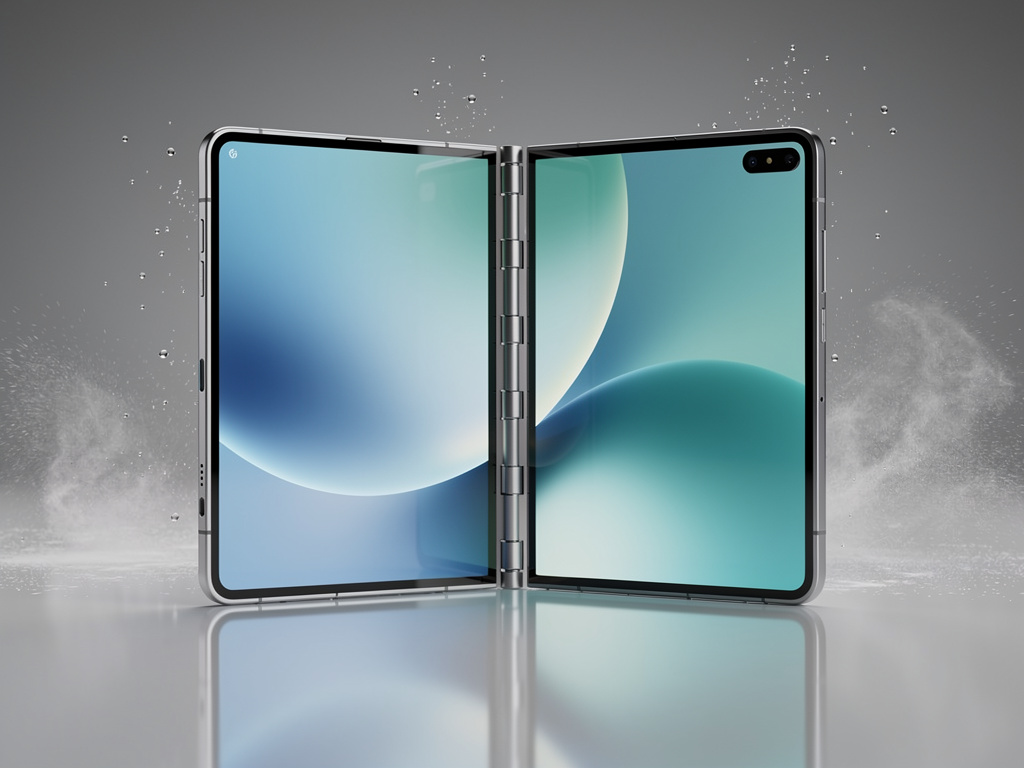
Unfolding Resilience: Samsung’s Galaxy Z TriFold Tests the Waters of Foldable Durability
In the ever-evolving realm of foldable smartphones, Samsung’s latest entry, the Galaxy Z TriFold, has sparked intense interest among tech enthusiasts and professionals alike. Announced just days ago, this ambitious device pushes the boundaries of mobile design with its triple-fold mechanism, offering users a expansive 10-inch inner display when fully opened. But beyond its innovative form factor, questions about its real-world toughness—particularly its ability to withstand water exposure—have dominated discussions. Drawing from recent reports, the TriFold isn’t marketed as fully submersible, but it carries an IP48 rating, which provides a level of protection against water jets and dust ingress. This rating, as detailed in a comprehensive breakdown by Android Central, means the phone can handle splashes and brief encounters with moisture, though it’s not designed for prolonged immersion like some traditional slab phones.
To understand the significance of this rating, it’s essential to unpack what IP48 entails. The “4” in IP48 refers to protection against water sprayed from any direction, equivalent to resistance against rain or accidental spills, while the “8” indicates solid defense against dust, ensuring that fine particles won’t easily compromise the internals. For a device with not one but two hinges, achieving this level of sealing is no small feat. Samsung has reportedly employed advanced gasket materials and reinforced seals around the folding mechanisms to prevent water from seeping into vulnerable areas. Industry insiders note that this represents a step forward from earlier foldables like the Galaxy Z Fold series, which started with lower IPX8 ratings focused solely on water without dust protection.
Comparisons to competitors highlight Samsung’s cautious yet progressive approach. Huawei’s Mate XT, another tri-fold contender, boasts an IPX8 rating but lacks official dust resistance, making it more vulnerable in sandy environments. Samsung’s choice of IP48 strikes a balance, prioritizing everyday usability over extreme scenarios. As one engineer familiar with foldable tech told me, the challenge lies in maintaining flexibility while ensuring rigidity against environmental threats— a delicate engineering dance that Samsung appears to have mastered in the TriFold.
Engineering Marvels Behind the Seal
Delving deeper into the TriFold’s construction, the device’s water resistance is intertwined with its overall build quality. At a mere 3.9mm thick when unfolded, the phone incorporates a titanium hinge and aluminum frame, materials chosen for their strength and lightness. According to leaks and official announcements shared on platforms like X (formerly Twitter), the TriFold features a 5600mAh silicon-carbon battery, which not only extends runtime but also allows for a slimmer profile that aids in better sealing. Posts from tech analysts on X emphasize how this battery tech reduces internal space constraints, enabling more robust waterproofing measures without adding bulk.
Samsung’s press release, as covered in Samsung Newsroom, describes the TriFold as unfolding twice to create an immersive workspace, but it subtly underscores durability features like enhanced hinge mechanisms that resist deformation under pressure. This is crucial for water resistance, as any gap in the folds could invite moisture. Testing protocols, inferred from industry standards, likely involved subjecting prototypes to simulated rain and dust storms, ensuring the device meets IP48 criteria without compromising its folding action.
Moreover, the TriFold’s displays— a 6.5-inch outer screen peaking at 2600 nits and the massive inner panel at 1600 nits— are coated with advanced oleophobic layers that repel water and fingerprints. This not only enhances usability in wet conditions but also contributes to the overall IP rating. Insiders speculate that Samsung collaborated with material scientists to integrate hydrophobic nanotechnology, a technique that’s becoming standard in high-end devices to bolster environmental resilience.
Market Implications and User Expectations
The introduction of the Galaxy Z TriFold comes at a pivotal moment for foldables, with sales projections indicating growing adoption among professionals who demand versatile tools. Priced starting around $2,000 in initial markets like South Korea, where it’s set to launch on December 12, the device targets power users seeking a phone-tablet hybrid. However, its water resistance has been a point of contention in online forums and X discussions, where users debate whether IP48 is sufficient for a premium gadget. Some argue it’s a pragmatic choice, given the mechanical complexities, while others pine for full IP68 like the Galaxy S series.
Recent news from The Verge highlights the TriFold’s U.S. availability slated for early 2026, giving Samsung time to refine features based on initial feedback. This delay could allow for potential upgrades, perhaps elevating the IP rating if consumer demand pushes for it. In conversations with supply chain experts, it’s clear that component costs for advanced sealing— such as specialized adhesives and membranes— add to the device’s premium pricing, but they also differentiate it in a crowded field.
On X, posts from influencers like Evan Blass have circulated specs confirming the 200MP main camera and Snapdragon 8 Elite processor, tying into how these elements interact with durability. For instance, the camera module’s placement requires precise sealing to prevent fogging in humid conditions, a common issue in less robust foldables. This integration shows Samsung’s holistic approach, where water resistance isn’t an afterthought but a core design pillar.
Performance in Harsh Environments
Beyond specs, real-world testing anecdotes shared on tech sites paint a promising picture. Early reviewers, as noted in GSMArena, have subjected the TriFold to light water exposure, reporting no issues with functionality post-splash. This aligns with the IP48 standard, which guarantees survival under 1 meter of water for limited times, though Samsung advises against intentional submersion. For industry professionals in fields like construction or outdoor media, this level of protection could make the TriFold a viable tool, provided users heed usage guidelines.
Comparatively, the evolution from Samsung’s earlier models is evident. The original Galaxy Fold lacked any official IP rating, making it a risky bet for clumsy users. By the Z Fold5, IPX8 became standard, and now with the TriFold’s IP48, dust resistance addresses a key gap. Analysts point out that this progression reflects broader industry trends toward making foldables as tough as their non-folding counterparts, driven by consumer feedback loops amplified on social media.
Furthermore, the TriFold’s software ecosystem enhances its durability narrative. Galaxy AI features, including on-device translation and summarization, are optimized for the large screen, but they also include predictive maintenance alerts for environmental risks. If sensors detect excessive moisture, the device could prompt users to dry it, a subtle but innovative safeguard.
Innovations Driving Future Foldables
Looking ahead, the TriFold’s waterproofing sets a benchmark that could influence upcoming devices. Reports from Mashable suggest Samsung is already exploring even thinner profiles with higher IP ratings, potentially using graphene-based seals for superior water repulsion. This aligns with patents filed by the company, hinting at self-healing materials that could automatically close micro-gaps exposed to water.
In terms of global rollout, X posts indicate strong interest in markets with variable climates, where dust and rain are daily realities. For instance, users in Southeast Asia have expressed enthusiasm for the IP48 rating, viewing it as tailored to tropical conditions. This regional appeal underscores Samsung’s strategy to customize durability features based on user data analytics.
Industry veterans argue that while the TriFold isn’t invincible against water, its rating represents a calculated risk-reward balance. By not over-engineering for extreme waterproofing, Samsung keeps costs down and focuses on the device’s core selling point: multifunctionality. Yet, as competition heats up with players like Google and OnePlus entering the foldable arena, expect pressure to elevate standards further.
Balancing Innovation with Practicality
The camera system’s resilience is another underappreciated aspect. With a 200MP primary sensor flanked by 12MP ultrawide and 10MP telephoto lenses, the TriFold promises stunning photography even in damp settings. Seals around the lenses prevent condensation, ensuring clear shots during light rain— a boon for content creators. References to Geekbench leaks in Bez Kabli show the Snapdragon 8 Elite delivering top-tier performance, which indirectly supports durability by enabling efficient heat management that reduces internal condensation risks.
User sentiment on X, aggregated from various tech accounts, leans positive, with many praising the TriFold’s slimness and resistance features as game-changers. However, some critiques focus on the absence of full dustproofing, suggesting room for improvement in future iterations.
Ultimately, the Galaxy Z TriFold embodies Samsung’s vision for foldables that blend cutting-edge design with practical endurance. Its IP48 rating, while not the highest, equips it well for most daily challenges, positioning it as a frontrunner in the push toward more resilient mobile tech. As the device hits shelves, ongoing user experiences will likely shape its legacy in this dynamic sector.


 WebProNews is an iEntry Publication